
In the Arizona Territory, a Teenager Races to Save His Mother from the Gallows After Their Butler Frames Her for Murder


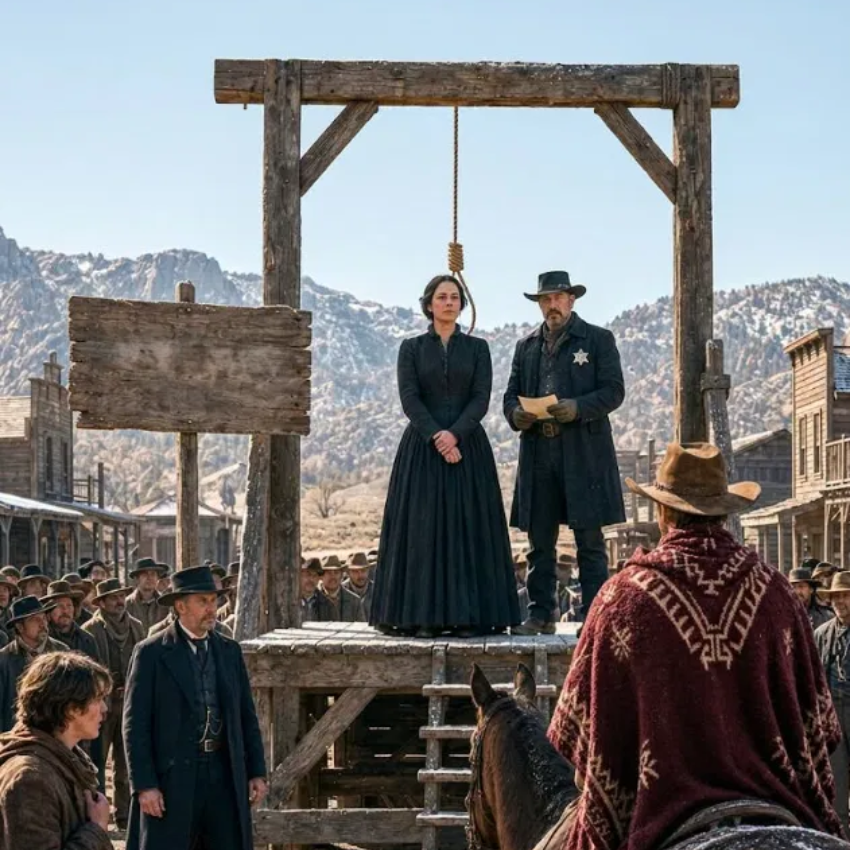


The warning shot had rattled me more deeply than I cared to admit. The close brush with real violence, the casual indifference of the men, confirmed the escalating danger we faced. I spent the rest of the night tossing and turning, the metallic tang of gunpowder still lingering in my memory. Silas, ever watchful, had stood guard by the window for most of the remaining hours of darkness.
The following morning, after Mrs. Gable’s quiet but firm insistence we depart, we moved our belongings to a small, isolated shack on the outskirts of town. It offered little comfort but provided a degree of privacy, a fragile shield against the constant scrutiny.
My mind kept returning to the forged will, a document designed not just to disinherit Eleanor but to utterly destroy her character. It was a sophisticated piece of deception, almost too perfect. It made me think of my father, a man of meticulous habits, a man who, despite his quiet nature, was fiercely protective of his land and his family.
I remembered his study, a sanctuary filled with books and maps. He often joked about “secrets in plain sight,” a habit he had learned from his own father, a man who believed in keeping important things close, but not always in obvious places. My father would mark certain books, small pencil ticks on the spine, for reasons I never understood.
A sudden, desperate thought sparked within me. What if my father had suspected something? What if he had left clues, not for a murderer, but for someone to find if something ever went wrong? It was a long shot, a desperate hope in a rapidly darkening situation.
I spoke to Silas about it, his face grimly contemplative. “Your father was a cautious man, Thomas,” he mused, cleaning his revolver again, the rhythmic clicks a counterpoint to my thoughts. “He didn’t trust easily, especially not after what happened to his brother’s ranch down south.”
He was referring to an old land dispute that had turned violent, wiping out a distant relative’s family fortune. My father had become even more wary of slick businessmen after that incident. It made sense that he would have a contingency, a backup plan for trouble.
“He used to put small marks on certain books, Uncle,” I explained, trying to recall the exact details. “Little pencil lines on the spine. He called them ‘breadcrumbs for future explorers.'”
Silas’s eyes, usually filled with a weary cynicism, narrowed slightly. “Breadcrumbs, huh? Could be worth a look. Might be something he wanted to hide, or keep safe.”
The idea gave me a flicker of purpose amidst the despair. I decided to revisit the Finch ranch, not in search of legal documents, but for those “breadcrumbs.” The ranch was likely still under the sheriff’s lock and key, but the chaos of the coming trial might offer a window.
Under the cover of dusk, we made our way back to the ranch. The house felt empty, hollowed out, no longer a home but a crime scene. A single deputy, a younger man I recognized as Deputy Collins, was posted near the front door. He looked bored, his attention drifting.
Silas, ever the strategist, created a diversion, feigning a loud argument with an imaginary prospector just out of the deputy’s sight. Collins, startled, hurried to investigate the disturbance. It was enough. I slipped through the back door, picking the simple lock with a practiced ease I’d learned watching my father.
The house was cold, dust motes dancing in the faint light filtering through the windows. Every object felt like a ghost. I made my way to my father’s study, the place where we had previously searched for evidence. This time, I wasn’t looking for obvious papers.
I scanned the rows of books on his shelves. My father had an extensive library, mostly histories, philosophy, and practical guides on ranching. My eyes darted across the spines, searching for those familiar pencil marks.
There. On the spine of a heavy, leather-bound history of the Civil War, a book my father rarely read but kept prominently displayed, were two faint, almost imperceptible pencil ticks. My heart gave a hopeful thump. It was the only one in the entire room.
My fingers trembled as I pulled the book from the shelf. It was heavier than it looked. I ran my hand over the spine, feeling for anything unusual. Nothing. I opened it, flipping through the yellowed pages. It seemed like an ordinary book.
Then, I remembered a story my father once told me about soldiers hiding messages in hollowed-out books. With growing excitement, I ran my fingers along the inside edge of the spine. There, a slight give. The spine wasn’t solid.
Using my thumbnail, I carefully pried open a small, almost invisible seam in the leather. A hollowed-out space, perfectly cut. Inside, nestled deep within, was a small, thin ledger, no bigger than my hand, bound in a dark, unassuming cover. It was a mundane object, easily overlooked, precisely the kind of thing my father would use.
I pulled it out, my breath catching in my throat. This was it. This was one of my father’s secrets. I flipped it open, my eyes straining in the dim light. The entries were handwritten, neat but cryptic. Dates and small sums of money, followed by initials or short, coded phrases.
“October 14th: $5, J.S. – Info. purchase.”
“November 2nd: $10, T.M. – Favors rendered.”
“December 18th: $15, G.H. – Supply Chain Intel.”
J.S.? T.M.? G.H.? The initials seemed meaningless at first, just a jumble of letters. But then, a chilling realization dawned on me. J.S. could be John Smith, the stable owner. T.M. could be Thomas Miller, the general store clerk. These were the very people who had refused us service, who had turned their backs on us.
The ledger was a chilling testament to Bracken’s long-standing manipulation, revealing a network of paid informants and accomplices right under our noses. He wasn’t just a recent opportunist; he had been sowing seeds of corruption for months, perhaps even years. This wasn’t a misunderstanding; it was a deliberate, calculated betrayal by men my father had known and trusted. The names of the townspeople, disguised in these cryptic notes, confirmed a deeper rot in the community than I had ever imagined.
My father must have suspected something, perhaps not outright murder, but certainly a scheme to undermine him, to gather information about his resistance to selling the ranch. He must have kept this ledger as insurance, as proof of Bracken’s deceit, a personal account of his subtle treachery.
I quickly tucked the ledger into my shirt, careful to re-hide the book and return it to its place on the shelf. As I slipped back out of the house, Silas was already waiting, his diversion having worked perfectly.
“Find anything?” he asked, his voice low, his eyes scanning the darkness.
I pulled out the ledger, handing it to him. “My father’s breadcrumbs,” I whispered, a mixture of triumph and horror in my voice. “Bracken’s bought and paid for half the town.”
Silas took the small book, his fingers tracing the cryptic entries. His face, illuminated by the faint moonlight, hardened with a grim understanding. The ledger laid bare the specific, mundane betrayals that underpinned Bracken’s larger scheme. It showed a deliberate, personal chipping away at my father’s community, building a web of deceit brick by brick.
He looked at me, a new resolve in his eyes. “This changes things, Thomas. This isn’t just about the will. This is about a snake that’s burrowed deep into the heart of this town. And your father knew it.”
The ledger wasn’t just evidence of Bracken’s manipulation; it was proof of a systematic dismantling of trust within our community. The specific names, however coded, represented specific betrayals by individuals my family had relied on. It was a far more insidious form of cruelty than I had imagined, a quiet corruption that poisoned relationships from the inside out. My father, in his quiet way, had collected the proof of his friends’ and neighbors’ small, petty treacheries, a testament to the pervasive reach of Bracken’s influence.
The realization settled deep in my bones, a cold weight. Bracken wasn’t just a murderer; he was a puppeteer, pulling strings in every corner of our lives, turning everyone we knew into potential informants. This ledger, hidden in plain sight, was my father’s last desperate warning, a legacy of betrayal.
More Stories













+ There are no comments
Add yours