
Her husband disinherited her entire medical legacy, then she found a secret journal entry warning her about her own sister.


I decided my next move needed to be subtle. I found my old hospital ID badge, still tucked into a forgotten purse, and drove to Boston Medical Center. Ostensibly, I was there to collect some of Elias’s personal items from his old lab. The truth was, Elias’s journal had contained several vague references to early, informal research logs kept in the lab, outside the official digital archives. I needed to see if he’d left anything there.
The lab itself was a familiar maze of gleaming chrome, buzzing machines, and the sterile scent of antiseptics, now eerily quiet without Elias’s focused presence. A lone lab technician, whom I didn’t recognize, greeted me with a polite, if distant, nod. I explained my mission and was directed to Elias’s former office within the lab, a small space with a single, dusty cabinet.
I began sorting through the cabinet, pulling out old lab coats, half-empty coffee mugs, and a stack of yellowed, bound printouts of early research data. Nothing immediately jumped out as a coded message. It felt like an ordinary task, almost mundane, until I heard voices from the adjacent main lab area. They were low, but distinct, filtering through the thin wall.
“I still can’t believe she got away with it,” a man’s voice muttered, thick with resentment.
My hand froze on a stack of petri dishes. I recognized the voice. Dr. Marcus Albright. He had been a fellow resident with Genevieve, years ago. Elias had occasionally mentioned him, usually with a shake of his head.
“Marcus, let it go,” a different, younger voice advised. “It was years ago. Her career took off. Yours… didn’t.”
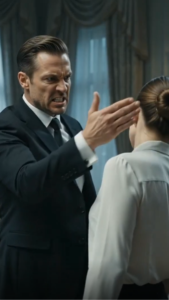
Albright scoffed. “Her career took off because she stood on my ruined one. She promised me the world, said we were partners in that clinical trial.” His voice grew louder, edged with a bitterness that cut through the sterile air. “The XyloCure trial. She knew the data was weak. She *made* it look strong. Patient outcomes, Clara. Patient *outcomes*.”
A cold dread spread through my chest. Patient data. Clinical trials. This was precisely the kind of manipulation Elias had documented in the journal entry about the metabolic marker patent, the kind of shortcut he’d always warned against. The echoes were deafening.
“She manipulated the patient data,” Albright continued, his voice cracking with emotion. “She changed the dosages in the reports. She fabricated side-effect profiles. It all looked perfect on paper. Then it failed catastrophically in later phases. Ruined me. Ruined XyloCure. She walked away, clean as a whistle, straight onto the Bellwether board. Said I was just ’emotional’ and ‘unprofessional’ for questioning her methods.”
The younger physician murmured something sympathetic, but Albright was too far gone in his rage. “Emotional? I saw patients suffer because of her shortcuts. I tried to blow the whistle, and she turned everyone against me. Said I was jealous. Said I was unstable. Sound familiar?”
It sounded *too* familiar. Genevieve’s current smear campaign against me, painting me as emotionally unstable and unfit to manage Elias’s legacy, was a direct replay of her past tactics. My heart pounded, a frantic rhythm against the quiet hum of the lab equipment. Elias’s warning about Genevieve wasn’t just abstract; it was a blueprint of her character.
I leaned against the cabinet, trying to steady myself. The XyloCure trial. Elias’s journal had mentioned a fleeting note about a “corrupted data set” from an early trial Genevieve was involved in, though he hadn’t named the product or even Genevieve explicitly. He’d simply coded it as “unethical accelerant,” a phrase that now resonated with sickening clarity. He’d documented her manipulative behavior, her willingness to sacrifice ethics for professional gain.
Albright’s voice continued, a lament. “I should have kept better records. Should have fought harder. But she had everyone convinced I was losing it. My professional reputation was shredded. I just… gave up.”
He paused, then sighed heavily. “Now she’s going after Elias’s legacy. His neuro-regenerative patent. Heard she’s pushing for fast-tracking, cutting corners, saying it’s what Elias would have wanted to ‘get it to market.’ That patent is a goldmine, though.”
My breath caught again. Fast-tracking. Cutting corners. These were precisely the ethical violations Elias had explicitly guarded against in his own research. Genevieve wasn’t just attempting to steal his legacy; she was attempting to *corrupt* it, to twist his life’s work into something dangerous and self-serving. Albright’s bitterness wasn’t just an old grudge; it was a chilling premonition of what Genevieve intended to do with Elias’s most precious research.
I needed to talk to Marcus Albright. His story, his experience, was the missing piece connecting Elias’s coded warnings about Genevieve’s past with her current, devastating actions. He was a broken man, hurt by her deceit, and perhaps, just perhaps, he was ready to finally break his silence. My grief for Elias transformed into a steely determination. I had to approach him carefully, strategically. He was an integral part of this puzzle, whether he knew it or not.
I quietly closed the cabinet door, the sound muffled by the lab’s ambient noise. My mind raced, piecing together fragments. Elias’s journal, Genevieve’s history, Albright’s raw testimony. It all pointed to a single, terrifying truth: Genevieve Caldwell was a predator, and Elias, with his incredible foresight, had laid a trap for her, a trap I was now assembling piece by piece. I had to find a way to make Albright trust me, to help me bring all of Genevieve’s betrayals to light. My path was clear.
More Stories
















+ There are no comments
Add yours