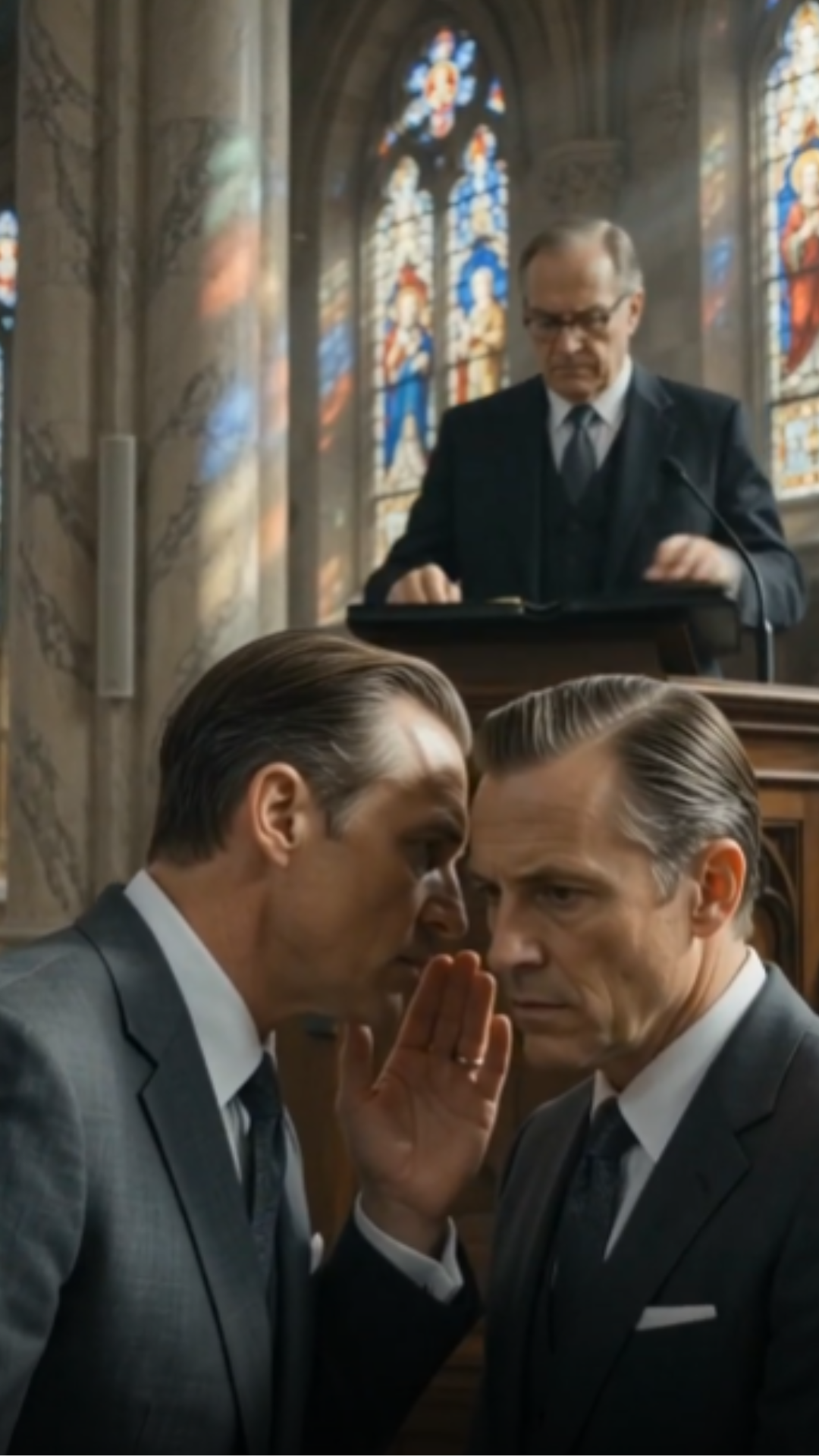
Silence in this hall costs more than the marble under our shoes, the estate attorney said, opening the black leather portfolio before sixty silent mourners.


Part 1
At my grandfather’s memorial in downtown Chicago, not a single senior partner stepped up to give the eulogy for the man who built Chen & Ross Architecture.
My co-director, Julian Ross, sat in the front row, whispering to board members that my grandfather died senile and left the firm $4.2 million in debt.
When I stepped up to the pulpit, the lawyer handed me a physical land transfer deed signed just 48 hours before my grandfather passed away.
I thought I was standing up to reclaim my grandfather’s sacred immigrant legacy from a greedy business partner.
I had no idea that breaking the silence would destroy every truth I ever believed about my family.
The air in the grand hall of the First Presbyterian Church of Chicago was thick with unspoken tension. Sixty pairs of eyes, mostly dressed in solemn black, stared forward, avoiding one another.
Sunlight, filtered through stained-glass windows, painted muted patterns across the cold marble floor. A faint smell of lilies and old hymn books hung in the air.
My grandfather, Master Jin-Woo Chen, had built this firm from nothing. He had designed some of the most iconic buildings in the city, bridging traditional Asian aesthetics with modern American ambition.
Yet, here we were.
Not one of his senior partners, the men who owed their careers to him, had stood to deliver a eulogy. They sat stiffly, gazes fixed on the ornate pulpit, mouths tight.
Julian Ross, my co-director and the other named partner, occupied the front row. His dark suit was impeccably tailored, his silver hair perfectly coiffed.
He leaned slightly towards David Kincaid, the Board Chairman, his voice a low, insidious murmur. I could just make out snippets.
“…died senile…”
“…$4.2 million in debt…”
The words were like tiny needles pricking the fabric of the solemn ceremony. Julian was painting a picture, even before the proceedings truly began.
A picture of Jin-Woo Chen as a liability, not a legend.
Arthur Pendelton, the estate attorney, a man whose expression rarely shifted from a practiced neutrality, strode towards the pulpit. He moved with the quiet confidence of someone accustomed to handling high stakes and raw emotions.
His black leather portfolio was clutched firmly in one hand. It looked heavy, filled with untold secrets.
He did not glance at anyone. His eyes scanned the room briefly, then settled on the polished wood of the pulpit itself.
“Ladies and gentlemen,” he began, his voice clear and resonant, cutting through the hushed murmurs. “We are here to honor the memory of Master Jin-Woo Chen.”
He paused, letting his words sink in, then reached into his portfolio.
He extracted a thick, cream-colored envelope, sealed with red wax. The silence in the room deepened, so profound it pressed against my ears.
A few mourners shifted in their pews. The rustle of their clothes was amplified in the stillness.
Mr. Pendelton slowly broke the seal, the crisp tearing sound echoing in the cavernous hall. He pulled out a single sheet of paper.
“It is my duty to inform all parties present,” he announced, his voice devoid of emotion, “that Master Jin-Woo Chen, forty-eight hours prior to his passing, executed a legally binding land transfer deed.”
My breath hitched. My heart began to pound a frantic rhythm against my ribs.
“This deed,” Mr. Pendelton continued, his gaze sweeping across the front rows, “transfers all rights and ownership of the Pilsen Cultural Center parcel to his senior business partner, Mr. Julian Ross.”
The world seemed to tilt. The ornate chandeliers, the stained-glass saints, the stoic attorney – all blurred into a kaleidoscope of impossible reality.
The Pilsen Cultural Center. My grandfather’s legacy. The project he had sworn to me, just weeks ago, would forever remain a community pillar.
I felt a magnetic pull towards the altar. My feet moved without conscious command, carrying me forward, past the rows of stunned faces. Each step echoed too loudly on the cold marble.
Julian Ross, still in the front row, finally looked up. His eyes, usually sharp and calculating, met mine with a flicker of something I couldn’t quite decipher.
He then subtly turned back to Chairman Kincaid. His voice, though still a whisper, carried like a serpent’s hiss in the sudden vacuum of sound.
“The old man was barely lucid,” he murmured, his gaze sweeping dismissively in my direction. “Racked up $4.2 million in debt.”
His words hung in the air, transforming the sacred space into a corporate battlefield. He was painting my grandfather as a senile, irresponsible shell of a man, and the board members around him nodded slowly, their expressions hardening.
I stood there, exposed, the lawyer’s words still ringing in my ears, Julian’s accusations forming a suffocating cloud around me.
Part 2
Before I could even speak, Julian Ross rose from the front row. He moved with a practiced grace, taking the microphone directly from Mr. Pendelton’s hand.
He adjusted the stand, a faint, almost imperceptible smile playing on his lips. The scent of lilies, once comforting, now felt cloying.
“It’s a tragedy,” Julian’s voice boomed, filling the hushed hall, “that Maya here chose to exploit her grandfather’s fragile state.”
My stomach clenched. I couldn’t breathe.
“Weeks ago,” he continued, his gaze sweeping across the stunned faces, “she pressured him to draft a fraudulent codicil, attempting to reverse his final, clear wishes.”
A ripple went through the pews. Heads swiveled, no longer avoiding eye contact but fixing it on me.
Board chairman David Kincaid, who had been nodding along with Julian moments before, now stared at me with open skepticism. His eyes narrowed, assessing.
Elena Vasquez, a junior architect I worked closely with, was two rows back. She quickly averted her gaze, pretending to study the program in her hands.
The silence returned, but it was a different kind now. It was a silence of judgment, heavy and cold. The solemn respect for my grandfather had evaporated, replaced by whispers of scandal.
Julian stepped down from the pulpit, not towards his seat, but directly towards me. He moved with purpose, his expensive leather shoes silent on the marble.
He stopped inches away, his towering presence casting a shadow over me. His face, publicly solemn, was now privately cold.
“You want to challenge this in Cook County court, Maya?” he murmured, his voice low, almost a hiss, meant only for my ears.
He leaned in, the faint scent of his cologne suddenly suffocating.
“Go ahead,” he whispered, a cruel twist to his lips. “But if you do, I will freeze every single one of your family’s remaining company dividends. What little liquidity you have left will be gone.”
More Stories



+ There are no comments
Add yours