
Harlem's Legacy: A Husband Finds His "Dead" Wife Breathing, Uncovers Family Betrayal


The next morning, the house was eerily quiet. Mama Ngozi had instructed me to stay in my room, citing the “sacred atmosphere” required for Amara’s recovery. I ate a sparse breakfast alone, my thoughts churning. The chance to search Amara’s room had to come soon.
I descended the stairs, feigning a look of renewed exhaustion, the kind that might come from a fitful night of worry. Mama Ngozi was in the living room, sitting on a low stool beside Amara’s makeshift cot, murmuring prayers under her breath. Jabari was nowhere in sight. This was my window.
I approached her cautiously, trying to appear deferential.
“Mama,” I said softly, not wanting to disturb her “vigil.”
She looked up, her eyes still holding that practiced concern.
“Elijah,” she whispered back. “How are you resting, my son?”
“Not well,” I admitted, my voice strained. “My mind keeps returning to Amara. To her condition.”
I paused, letting the words hang.
“I keep thinking about what you said, about her fragile state,” I continued. “Perhaps if I could look at her medical files, her prenatal charts… I could understand better what might have led to this collapse. It might help me support her recovery, in my own way.”
Mama Ngozi’s brow furrowed for a fraction of a second. The suggestion wasn’t entirely in line with her traditional narrative, but I had framed it as a son’s concern, a desire to “understand” and “support,” not to question.
“Western documents offer little insight into spiritual matters, Elijah,” she said, her tone gentle but firm. “But if it would ease your mind…”
She trailed off, clearly reluctant but seemingly unwilling to deny a son’s “grief-stricken” request outright.
“It would,” I assured her, meeting her gaze. “Her files are usually in her bedside table, are they not? I could just retrieve them quietly. Without disturbing her.”
She hesitated for another long moment, her eyes scanning my face, as if trying to discern my true intentions. I held my breath, forcing my expression to remain open, earnest.
Finally, she gave a slow, reluctant nod.
“Very well,” she conceded, her voice barely audible. “Be quick. Do not linger. Her spirit must remain undisturbed.”
A silent surge of triumph coursed through me. I kept my face neutral, offering a grateful nod.
“Thank you, Mama,” I said, and turned, making my way up the stairs.
Amara’s bedroom was at the end of the hall, a sanctuary that now felt violated. The curtains were drawn, casting the room in a dim, dusty light. Her scent, a mix of lavender and the shea butter she always used, still lingered faintly.
I moved quickly to her bedside table, a small antique piece she adored. I pulled open the top drawer. Inside, nestled beneath a small stack of books and a forgotten hair tie, was her pregnancy journal, its cover adorned with a delicate watercolor of a blossoming tree.
My fingers brushed against it. I picked it up, my heart aching as I saw her neat, looping handwriting on the first page. I set it aside gently, my focus now on what lay beneath it.
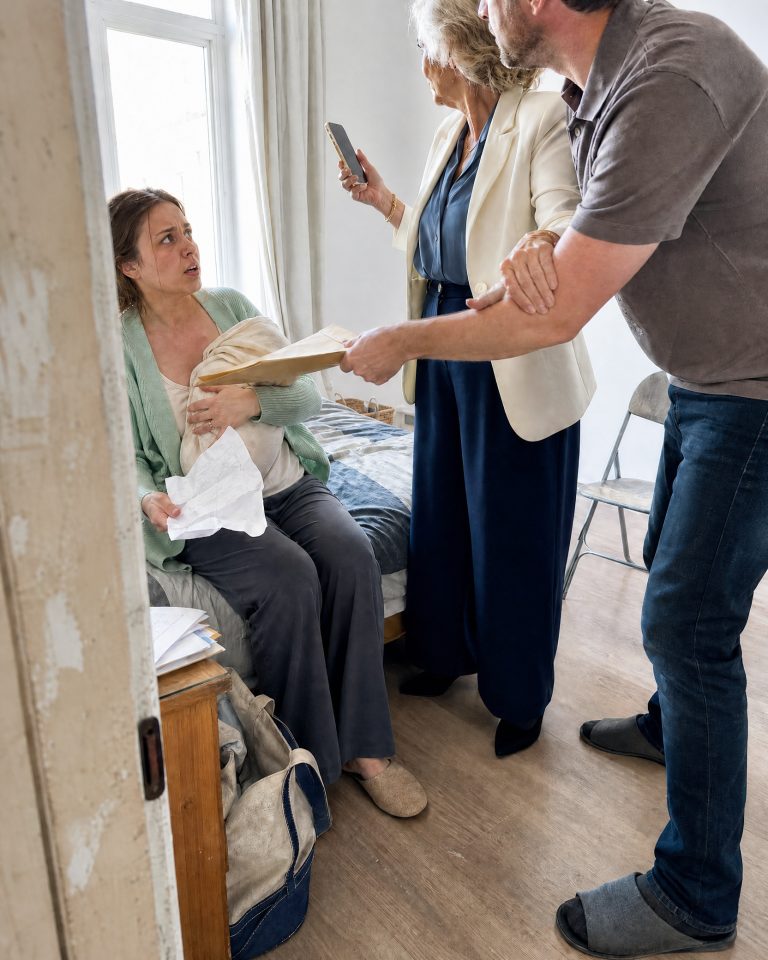
Beneath the journal, there were no medical charts, no prenatal records. Instead, I found a thick envelope, slightly yellowed, marked with the Adeyemi family crest. My breath hitched.
I pulled it out, my fingers trembling slightly. Inside were copies of the Adeyemi family legacy trust documents. And they were heavily annotated.
I fanned through them, my eyes scanning the pages. My name. Jabari’s name. Mama Ngozi’s signature, dated and notarized. My bankruptcy had been a public, humiliating affair, but I had thought my inheritance, established years ago by my father, was immutable.
I quickly found the relevant clauses. Recent amendments, dated just two weeks after my business collapsed abroad, were clearly marked. They systematically redirected a significant portion of *my* inheritance – the portion designated for my entrepreneurial ventures and Amara’s artistic foundation – directly to Jabari. My share was drastically reduced, essentially leaving me with a pittance, just enough to maintain face but not enough to wield any real power. Amara was effectively disinherited, her name removed from any beneficial clause.
My vision blurred with a mix of rage and disbelief. It wasn’t just about control; it was about outright theft. They weren’t merely trying to sideline me; they were stripping me bare, financially crippling me, ensuring that I would remain completely dependent on Mama Ngozi’s whims. This wasn’t a sudden crisis; it was a premeditated coup.
The dates were crucial. My bankruptcy, then the amendments, then Amara’s “collapse.” The timing wasn’t coincidental. It was a clear, cold-blooded plot. My return home, broken and vulnerable, had been their signal to execute the final stages of their scheme. Amara’s “death” had been the ultimate solution to ensure no challenge could be mounted from her side, no child born to complicate the new distribution of wealth.
I took out my phone, activated the camera, and meticulously photographed every page of the amended trust documents, focusing on the changes, the dates, the signatures. This was concrete. This was proof.
My hands clenched into fists, knuckles white. The “traditional ritual,” the “fragile state,” the “herbal remedy”—all of it was a grotesque charade. Amara’s prolonged “trance” was not for healing; it was to allow enough time for her “death” to be convincing, for the changes to the trust to be irreversible, for my last remaining claim to the family legacy to evaporate.
The depth of their malice was a physical blow. Mama Ngozi wasn’t just a controlling matriarch; she was a criminal, ruthless and calculating. And Jabari, my own brother, was her willing accomplice, eager to profit from his sibling’s ruin and his sister-in-law’s demise.
I carefully placed the documents back in the envelope, sliding it under the journal, trying to leave everything exactly as I had found it. I took a deep breath, forcing my heart rate to slow. I had to maintain the charade. If Mama Ngozi suspected I knew, if she realized I had found this, Amara’s life would be in even more immediate peril.
I made a show of finding “nothing” of use, closing the drawer with a gentle click. My hand lingered on the pregnancy journal. I opened it to a random page. Her entry dated a few weeks prior spoke of excitement, plans for the nursery, a craving for mangoes. It was a snapshot of a life they tried to extinguish.
I closed the journal, placing it back on the bedside table. I looked around the room, taking in the small details: her easel in the corner, a half-finished painting of a Harlem street scene, her favorite reading chair by the window. This was *her* space, filled with her dreams and her essence.
I walked to the window and pulled back a corner of the curtain. The familiar Harlem street below seemed distant, unreal. The world outside, oblivious to the quiet horror unfolding within these brownstone walls. I felt a profound sense of isolation. Who could I trust? Who could I turn to?
I needed allies, but first, I needed more information. The sedative. What exactly was it? Where did Mama Ngozi get it? She had mentioned Iya Modupe, a traditional healer, but that felt too convenient, too easily dismissed. Someone had supplied it, someone knew.
I gently closed Amara’s bedroom door, making sure it clicked softly into place. I walked back down the stairs, my face carefully composed into a mask of mild disappointment. Mama Ngozi looked up as I approached.
“Any luck, my son?” she asked, a hint of something in her voice I couldn’t quite place – perhaps a subtle curiosity, a test.
“No, Mama,” I replied, forcing a sigh. “Nothing useful. Just her journal, and some old papers. No medical charts.”
Her lips twitched, a tiny, almost imperceptible smile. Relief? Triumph? I couldn’t be sure, but it confirmed her deception. She knew the medical files wouldn’t be there, or she had removed them herself.
“Just as I suspected,” Mama Ngozi said, her voice laced with mock sympathy. “These things are beyond the realm of doctors, Elijah. This is spiritual.”
“I suppose you’re right,” I said, deferring to her wisdom, even as my mind churned with images of the trust documents, her signature bold and damning. “I just… worry for her.”
“We all do,” Mama Ngozi stated, turning back to Amara, her hand resting lightly on Amara’s brow. “But faith, my son, is our strongest medicine.”
I retreated, leaving her to her performance. The house, once a symbol of my family’s enduring strength, now felt like a prison. The weight of what I had discovered, the cold, hard proof of their betrayal, pressed down on me. Amara’s “trance” was a ticking clock. I had to expose them, and I had to do it quickly. The stakes were no longer just about inheritance; they were about life and death.
More Stories











+ There are no comments
Add yours