
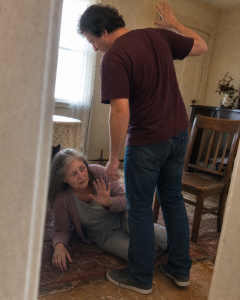
My prospective father-in-law shoved me full force onto the glass patio table when my fiancé refused to break our engagement for a high-society merger.


The crisp October air, usually invigorating, now felt like a slap. Beacon Hill, with its elegant brownstones and polished brass, was a world that had once welcomed me. Now, it felt like an impenetrable fortress.
My face, a roadmap of my recent trauma, was still healing, the fourteen stitches a stark line across my jaw. I called Mrs. Albright, a collector whose antique porcelain I’d restored flawlessly just last spring. Her assistant answered, cool and formal.
“Mrs. Albright sends her regrets, Ms. Linwood. She’s unavailable. And will not be taking on new restoration projects at this time.”
A dismissal. Not just for now, but “at this time.”
I tried another. Mr. Henderson, whose family portraits I had meticulously brought back to life. He was a long-time patron of the arts, usually effusive in his praise. His secretary informed me he was “indisposed indefinitely.”
The message was clear. Arthur Danforth hadn’t just attacked me physically; he was systematically erasing me from the social landscape of Boston.
I walked down Newbury Street, the fashionable boutiques a blur. I saw Mrs. Davies, a woman who had once praised my “exquisite touch” at a gallery opening. She was stepping out of a high-end dress shop, carrying a cream-colored bag.
Our eyes met. Her smile, which had been bright just a moment before, flickered and vanished. Her head tilted slightly, a subtle acknowledgement of my presence, and then she turned sharply into the crowd, pretending not to see me.
My mentor from the Boston Museum, Dr. Anya Sharma, was next. She had taught me everything, trusted me with invaluable pieces. I called her office, my voice catching in my throat.
“Clara,” her voice was strained, heavy with an emotion I couldn’t quite decipher. “I… I can’t talk right now. The Danforth Foundation has been very clear. There have been allegations. Concerning your, ah, temperament.”
Allegations. Temperament. The words stung, echoing Arthur’s lie about a “hysterical episode.”
“Anya, you know me,” I pleaded, my voice cracking. “You know I would never damage art. He pushed me. He attacked me.”
A long silence stretched between us. I heard the faint rustle of papers on her end, the distant murmur of colleagues.
“Clara,” she finally said, her voice dropping to a whisper. “The Foundation’s annual grant accounts for nearly thirty percent of our operating budget. I’m being pressured by the board. I truly am sorry, but I can’t be associated with… with this. Not right now.”
She hung up, leaving me with a dead line and a hollow ache in my chest. Even Anya, who had seen me through years of meticulous, painstaking work, had abandoned me under Arthur’s influence.
I passed a street vendor selling brightly colored scarves, his cheerful patter a stark contrast to the despair pressing in on me. A group of women, dressed in expensive coats, glanced at my bandaged face, their whispers like daggers. One woman quickly pulled her child closer, her gaze filled with a mix of pity and suspicion.
Arthur’s smear campaign was working with brutal efficiency. He hadn’t just locked me out of his estate and my bank account; he had locked me out of my entire professional and social life. Every door was slammed, every connection severed. I was a pariah, walking through the city with visible scars that everyone interpreted through Arthur’s distorted lens.
The weight of it all was crushing. Alone, penniless, and professionally blacklisted. But beneath the despair, a flicker of defiance sparked. If he wanted to isolate me, he would find I was at my most dangerous when I had nothing left to lose.
More Stories




+ There are no comments
Add yours