
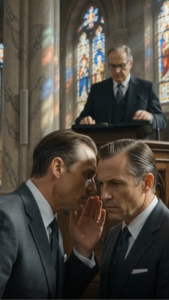
Young Captain Bellamy confronts her father over a forgotten family charter at a lavish gala.


The old charter felt like a living thing in my hands, a whisper from the past demanding to be heard. I traced the elegant script with my finger, my eyes scanning the dense, archaic language. Aunt Mildred sat opposite me, watching, a quiet expectation in her posture.
“Take your time, dear,” she said, her voice soft. “It reveals itself.”
I turned the delicate pages, one after another, absorbing the formal declarations, the flowery prose, until a specific section caught my eye. It was titled, boldly, “Criteria for Legacy Leadership & Young Achiever Grant Eligibility.” My heart began to pound a frantic rhythm against my ribs. This was it. This was the section Richard had twisted.
I leaned closer, my gaze fixed on a particular paragraph. It spoke of the Foundation’s aim to foster “exceptional leadership among Bellamy descendants, whether demonstrated through significant innovation in commerce, groundbreaking advancements in science, profound contributions to the arts, or notable leadership in public service.”
My breath hitched. “Notable leadership in public service.”
The words jumped off the page, gleaming with a truth my father had actively suppressed. Public service. My military career, my command, my recent promotion – it all fell squarely within that definition. It wasn’t just compatible; it was explicitly validated. The Young Achiever Grant, according to this founding document, was meant for people like me.
I looked up at Aunt Mildred, my eyes wide with a mixture of shock and dawning comprehension.
“This… this explicitly includes my path,” I whispered, the words barely audible. “It’s not just corporate. It never was.”
Aunt Mildred nodded, a somber expression now on her face.
“Your great-grandfather, a truly enlightened man, envisioned a broader legacy,” she explained, her voice tinged with a quiet sorrow. “He saw the future as something more than just balance sheets. He had a deep respect for those who served, who led beyond the confines of business. He made sure the charter reflected that.”
“But my father…” I started, unable to finish the thought. The magnitude of his deception was crushing.
“Richard, when he became a trustee of the Foundation, saw an opportunity,” she continued, her gaze direct and unflinching. “He began a process of ‘modernizing’ the Foundation’s public documents. Amendments, he called them. Reinterpretations. He quietly removed or diluted any language that didn’t align with his singular vision of corporate success.”
“He *omitted* this?” I asked, pointing to the clause. The anger began to simmer within me, hotter and more potent than before. This wasn’t just a slight; it was a forgery of intent, a corruption of my great-grandfather’s legacy.
“Not outright,” Aunt Mildred corrected, “not in the eyes of his lawyers. He’s too clever for that. He simply emphasized certain sections, while minimizing or reinterpreting others. For instance, ‘public service’ became ‘corporate social responsibility initiatives’ in later revisions, subtly shifting the focus away from direct governmental or military service.”
“So, he didn’t technically ‘change’ it, but he effectively buried it,” I mused, the implications sinking in. This was a sophisticated, long-term manipulation, not just an impulsive act of parental disapproval.
“Precisely,” she confirmed. “He ensured that anyone reviewing the more recent versions would interpret the criteria strictly in line with his corporate agenda. Your military career became ‘unconventional,’ outside the ‘Bellamy spirit of leadership,’ because he meticulously crafted that narrative over decades.”
A wave of nausea washed over me. For so long, I had internalized his criticism, believing my path truly was somehow lesser, not “Bellamy enough.” He had instilled that doubt in me, twisted my sense of self-worth.
“He wanted you to believe that, Elara,” Aunt Mildred said, as if reading my thoughts. “He wanted you to doubt yourself, to eventually succumb to his pressure and join the corporate fold. He saw you as a prize, an heir to mold in his own image, not an independent leader.”
“He manipulated the very foundation of our family’s public legacy for his own control,” I said, my voice tight with a newfound clarity. It wasn’t just about me. It was about anyone who dared to step outside Richard’s narrow definition of success.
“It goes deeper, Elara,” Aunt Mildred revealed, her voice dropping lower. “He also ensured that the board members of the Foundation were almost exclusively individuals whose careers were intertwined with Bellamy Global Industries. People he could trust to uphold his interpretation, to not ask too many inconvenient questions about the original intent.”
This detail sent a fresh wave of realization through me. The foundation wasn’t just under his influence; it was an extension of his corporate empire, a carefully curated echo chamber designed to perpetuate his will. My request for recognition had not just been denied; it had been met with the full, entrenched machinery of his power.
“He made sure no one would ever question his version of the truth,” I said, a bitter taste in my mouth.
“He forgot about family memory,” Aunt Mildred replied, a flicker of defiance in her eyes. “He forgot about those who knew your great-grandfather’s heart. And he forgot that some truths, once written down, are harder to erase than others.”
“So, this charter… it’s the legal truth,” I stated, more to myself than to her. “It’s the original intent. It’s evidence that his actions are a perversion of what the Foundation stands for.”
“It’s more than that, Elara,” Aunt Mildred said, leaning forward slightly. “It’s your proof. It’s the weapon you need to fight him on his own terms. You aren’t just seeking personal recognition; you’re seeking to uphold the integrity of your family’s true legacy.”
The implications were profound. This wasn’t just about getting my name on a list; it was about exposing a long-held deceit, about challenging my father’s absolute authority, not just over me, but over the very spirit of the Bellamy name. It was a strategic shift, transforming my personal slight into a battle for truth and principle.
My initial feeling of betrayal now coalesced into a steel-hard resolve. My father hadn’t just slighted me; he had tried to erase the very principles my great-grandfather had fought to uphold. He had tried to redefine a legacy to fit his ego. I wouldn’t stand for it. Not for myself, and not for future generations of Bellamys who might also choose a path of service over profit. The forgotten clause in this ancient document was not just my validation; it was his undoing. And I was ready to wield it.
More Stories
















+ There are no comments
Add yours