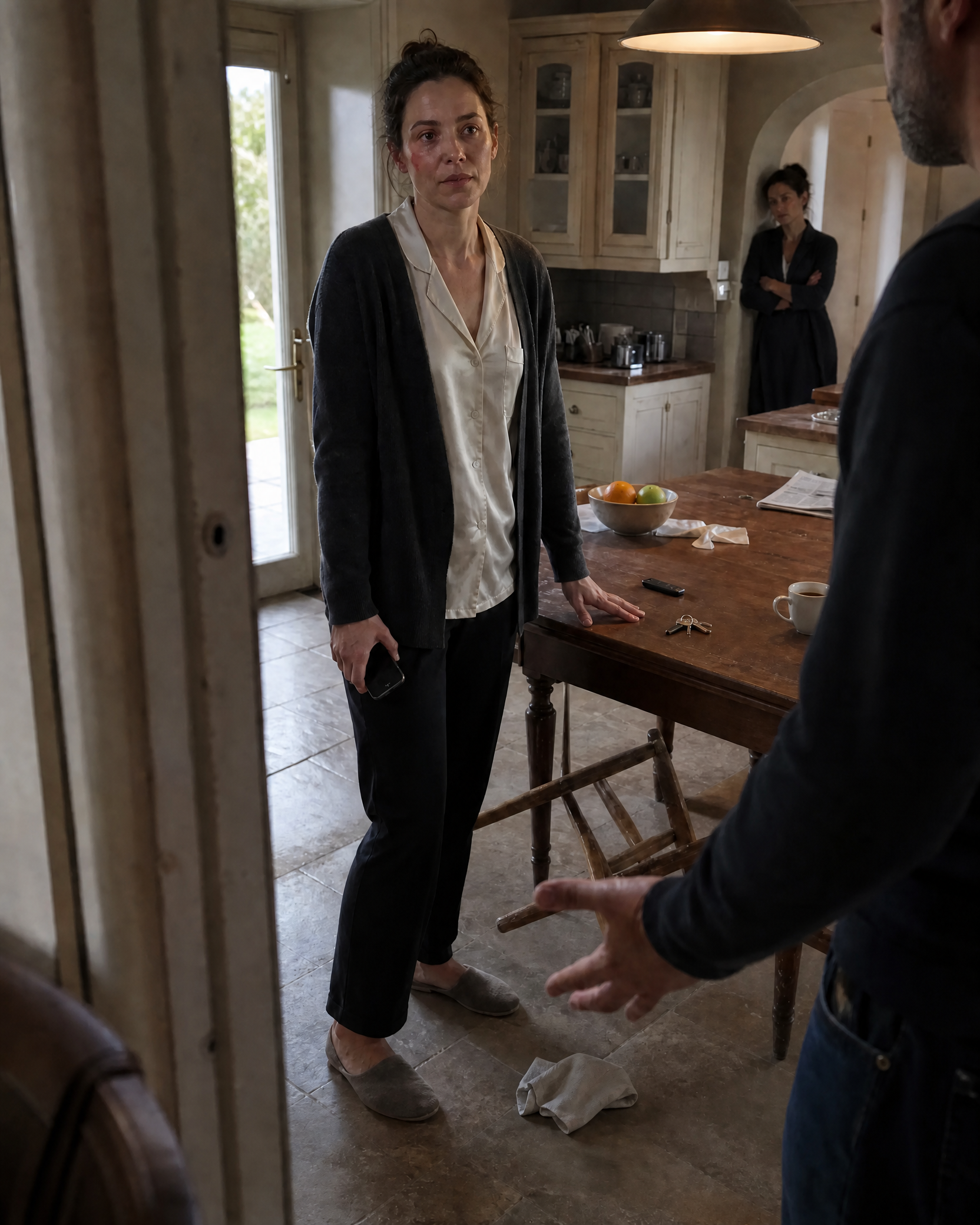
Husband Slapped Me on Wedding Day for 'Desecrating' His Haunted Villa – He Didn't Know His Ancestors’ Spirit Was Recording Everything.


The lingering scent of Eleanor’s expensive perfume still hung in the air, a subtle reminder of her unsettling visit. Her desperate pleas for me to abandon my pursuit of justice only solidified my resolve. I returned to the desk, pushing aside the chilling memory of her words, my gaze drawn back to the antique ledgers. This was where the real answers lay, far from the manufactured drama of family curses.
I reached for the oldest of the ledgers first, its leather cover cracked and brittle with age. My fingers traced the faded gilt letters, wondering about the lives of the Thorne men who had meticulously recorded these cryptic entries. The air in the master bedroom, usually stuffy, now felt thick with unspoken narratives, a palpable sense of history waiting to be unearthed.
Within the vault, I had also noticed a smaller, thin book tucked beneath the ledgers. It was a simple, leather-bound diary, without any title, secured by a rusted, ornate clasp. I had set it aside initially, but now, a powerful intuition urged me to open it. This felt like a more personal account than the dry financial records.
The clasp groaned as I forced it open, revealing fragile, yellowed pages filled with a delicate, feminine script. It was dated decades after the earliest ledger entries, and the name “Elara Thorne” was written on the inside cover. This was *her* diary. A direct voice from the past, the subject of the portrait.
I began to read, slowly, carefully, my eyes straining in the dim light. Elara’s entries painted a vivid picture of life in the villa, of love and loss, but also of a growing unease surrounding her husband, Alaric Thorne. She wrote of his increasing obsession with “the family’s luck,” and his strange, secretive meetings.
One entry, dated October 14th, 1887, leaped out at me: “Alaric has taken Mother’s emerald brooch. Says it is a ‘payment to ward off the blight on the crops,’ a necessary sacrifice to secure our fortune. My heart aches; it was the last thing I had of her. He dismisses my grief as foolish, says I do not understand the Thorne burden.”
A cold wave washed over me. Mother’s emerald brooch. It wasn’t an abstract financial maneuver, it was a cherished personal item, casually taken and dismissed as a “necessary sacrifice.” The specific, mundane cruelty of it felt like a punch to my gut, a direct parallel to Marcus’s casual disregard for my feelings, my money, my very physical safety on our wedding day. It was a stolen heirloom, an emotional theft, justified by the same narrative of fear.
Another entry, a few months later: “Our accounts are low. Alaric says it is the curse, manifesting due to my lack of ‘understanding.’ But I saw the ledgers today, hidden in his study. The money didn’t disappear; it was transferred. To a man he calls the ‘custodian,’ a distant cousin who lives in town. Not a spirit, but a man of flesh and blood.”
My breath hitched. A “custodian,” a distant cousin. A human agent, not a supernatural entity. Elara, even in her time, had glimpsed the truth behind the family’s façade. The curse was a smokescreen for human greed, for the systematic siphoning of family wealth under the guise of appeasement. It was a pattern, clear and horrifying.
I continued to read, tracing the evolution of Elara’s understanding. She wrote of other Thorne men, her father-in-law and uncles, making similar “payments,” always followed by a brief period of apparent prosperity before the cycle began anew. She saw it as a disease of the family, a self-inflicted wound.
“They believe the stories,” she penned, her script becoming more frantic on one page. “They tell themselves they are saving us, but they are only saving their own pride, their own pockets. The ‘curse’ is just an excuse to take what is not theirs, to justify their avarice. It is a cycle of theft, disguised as devotion.”
This was the core of the twist. The “Thorne curse” wasn’t a supernatural haunting. It was a carefully constructed narrative, passed down through generations, to excuse financial manipulation and outright theft. The “legacy payments” weren’t for spirits; they were systematic embezzlements, just like Marcus’s, used to enrich specific individuals or shore up failing family ventures.
I looked at Elara’s portrait, now uncovered. Her eyes, which had seemed mournful before, now held a fierce, knowing intelligence. She had seen through the lie, just as I was beginning to. Her spirit, bound to the villa, wasn’t seeking to enact a curse but to break one – the curse of human avarice and deception.
The ledgers, when viewed through Elara’s diary, suddenly made horrifying sense. Each “payment for warding,” each “appeasement offering,” could be directly correlated with a downturn in the family fortunes or a personal struggle, quickly followed by a substantial transfer to a “custodian” or “keeper” of the land. It wasn’t about ghosts; it was about human hands diverting funds.
One entry, from Elara’s husband Alaric, detailed a substantial “investment in the sacred trust of the land,” diverting funds from a small trust left to Elara by her own family. Her diary entry confirmed it, describing the loss of her financial independence, her despair at being stripped of her last personal asset. This mirrored my own $6 million investment, which was now in Marcus’s hands.
My breath caught in my throat. I felt a profound connection to Elara, a woman separated by more than a century, yet bound by the same thread of betrayal. We were both outsiders married into the Thorne family, both victims of their “curse” of convenience. She had lost her personal assets and her voice; I was fighting to keep mine.
This was not just Marcus’s individual failing. This was an intergenerational pattern of financial control and abuse, cloaked in the terrifying veil of superstition. The men of the family, under the sway of this manufactured “curse,” felt justified in taking from their wives, their relatives, or their businesses, always for the “greater good” of the family, always to “ward off ill fortune.”
The room felt colder now, despite the warmth of the afternoon sun filtering through the gaps in the drapes. It wasn’t the chill of a supernatural entity, but the icy realization of systemic, human cruelty. The weight of generations of calculated deception pressed down on me.
I closed Elara’s diary, placing it gently atop the ledgers. The sheer hypocrisy of the Thorne family, who touted their ancient traditions while perpetuating a cycle of fraud and emotional abuse, was staggering. My task was no longer just about recovering my money; it was about exposing a century-old lie and breaking a very human curse. The ghost of Elara Thorne was not a threat; she was my silent ally, a warning from the past.
More Stories















+ There are no comments
Add yours