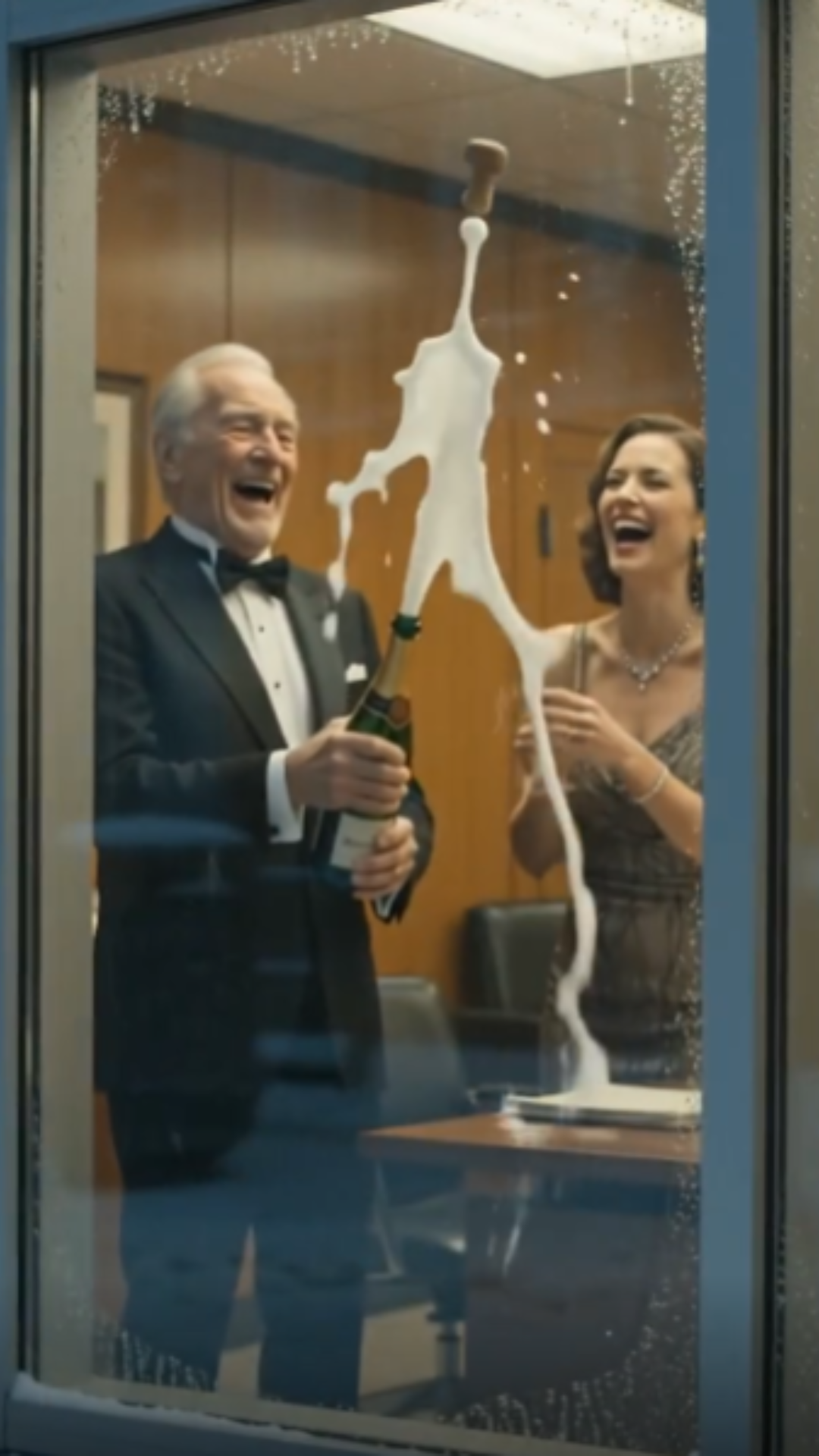
When my ex-husband and former architectural partner locked me out of our firm's flagship site in minus-three-degree Chicago weather to celebrate his illegal $14.5 million buyout with his young asso...


The GPS led me to an abandoned industrial yard in South Chicago, a sprawling wasteland of rusting corrugated metal and defunct machinery. Snow, thick and undisturbed, blanketed everything. This was not a place one retired to.
A single, smoke-stained trailer stood near a collapsing warehouse, a wisp of grey exhaust curling from its stovepipe. A battered Ford pickup, at least twenty years old, was parked beside it. This had to be it.
I knocked on the trailer door, the sharp rap echoing in the eerie silence. After a long moment, the door creaked open a few inches. A man’s eye, wary and bloodshot, peered out.
“Frank Kowalski?” I asked.
The man flinched, pulling the door tighter. He was older, thinner than I remembered, his once-burly frame stooped. His face was etched with hard lines, and a hacking cough racked him for a moment.
“You got the wrong address, lady,” he rasped, his voice gravelly. “I don’t know no Kowalski.”
“My name is Audrey Higgins,” I said, keeping my voice soft but firm. “I know who you are, Frank. I also know you haven’t been seen since the North River project collapse, 12 years ago.”
His face paled, the lone visible eye wide with alarm. He started to close the door.
“Julian Karr,” I said, stopping him. “He told Commissioner Croft that you helped him out on a ‘tricky structural issue’ back then.”
The mention of Julian Karr’s name made him pause. He leaned against the doorframe, his shoulders hunched. The lingering cough made his breath sound wet. He looked truly unwell.
“What do you want?” he muttered, finally opening the door enough to reveal himself fully. He wore an old, faded flannel shirt and work pants. His living room was cramped, filled with old newspapers and the smell of stale coffee.
“I want the truth, Frank,” I said, stepping inside, not waiting for an invitation. “About the North River project. About those concrete density logs.”
He shuffled back, collapsing onto a worn armchair. He looked at me, then away, his gaze falling on a dusty old framed photo on a small table. A younger Frank, smiling, arm around a woman.
“Julian came to me,” he began, his voice barely above a whisper, “right after the initial structural reports came back for the North River office tower. Said there were… discrepancies. Weakness in the foundation pours.”
He rubbed his temples, a pained expression on his face. “He said if the truth got out, the firm would be ruined. He said it would come back on me, too, as foreman. He offered me a way out.”
“A way out?” I prompted.
“He gave me a suitcase. Cash. Two hundred thousand dollars.” He closed his eyes, a look of profound weariness on his face. “In exchange, I signed new concrete density logs. Falsified them. Made it look like the initial reports were wrong, that the concrete was up to spec.”
My stomach churned. The North River project. A fatal site failure. A structural beam had sheared, collapsing a section of the lower levels. One worker had died, and several had been injured. Julian had blamed “unforeseen ground settling” and “unavoidable material inconsistencies.” I remembered the investigation, the intense scrutiny, the eventual acquittal of the firm.
“You signed off that the concrete was fine,” I said, the words feeling heavy. “When it wasn’t.”
He nodded, his gaze fixed on the floor. “He told me he’d ‘handled’ the building inspectors. He said the foundation issues would be blamed on your original design. Said it was faulty and caused the stress.”
My original design. That had been my first major solo project, years before Julian became partner. He had used a worker’s death to frame me, to make me doubt my own judgment. He’d done it to clear his name and set the stage for his rise within the firm.
“He pinned it on me,” I said, the realization hitting with full force. “He manufactured a crisis to boost his own standing and discredit my work.”
Kowalski looked up, shame etched on his face. “He told me to disappear after that. Said he’d make sure I was taken care of, but I couldn’t be found. Said I was retired, moved to Florida. Two hundred thousand dollars was a lot of money back then. It felt like my only choice.”
He coughed again, a deep, rattling sound. “I’m sick, Ms. Higgins. Real sick. Not much time left. This guilt… it’s eaten at me for 12 years.”
He pushed himself up slowly, moving towards a small, padlocked metal box tucked under his cot. “I kept something, just in case. Something I thought I’d take to my grave.”
More Stories





+ There are no comments
Add yours