
Teenage creator locks down her viral studio after a desperate neighbor star tries to steal her comeback and platform.


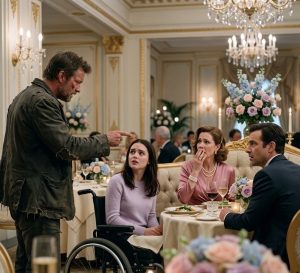
The air in my studio was thick with unspoken tension. Cassidy Finch stood before me, her usual bravado replaced by a brittle, forced politeness. I had sent her a carefully worded invitation: “A final, private discussion to resolve the misunderstanding.” She had accepted, likely confident she could charm or intimidate me into submission. She expected a child, easily swayed.
“Elara, honey,” Cassidy began, her voice dripping with practiced sweetness, “we need to put this behind us. This whole ‘misunderstanding’ has gotten out of hand. Your mother and I agree, it’s best to just smooth things over.”
I met her gaze, my expression unwavering. I wouldn’t be swayed.
“There’s no misunderstanding, Cassidy,” I said, my voice steady, despite the tremor in my hands. “There was a plan. A plan to take my platform, steal my audience, and drain my earnings.”
Her smile faltered, replaced by a flicker of annoyance. “Now, Elara, that’s a serious accusation. You’re a talented girl, but you’re letting your imagination run wild. These things are complex. Industry standard, even.”
“Is it industry standard to steal an API key?” I asked, pushing the first item across the table on my tablet screen. It displayed the financial records, the systematic rerouting of my sponsorship payouts. “$5,800. Every payment, meticulously rerouted to your shell company.”
Her eyes darted to the screen, a muscle ticking in her jaw. She took a step back, her composure beginning to crack. “Preposterous! I’ve never seen these figures. This is fabricated. Your amateur accounting means nothing.”
“And is it industry standard to frame a ‘troubled teen’?” I continued, displaying the chat logs from the burner phone’s cloud backup. The conversation with her PR consultant, detailing every malicious step, every planned lie. Her face, frozen in a rictus of denial, stared back from the screen.
“‘Her youth is our biggest weapon against her credibility,’” I quoted, my voice low. “‘Create a narrative that she’s a troubled teen, easily manipulated, perhaps even having a breakdown.’ You planned this, Cassidy. Before you even set foot in my studio, you planned to destroy me.”
Cassidy’s face drained of color. Her eyes flicked from the tablet to my face, then frantically around the studio, as if searching for an escape. “This is insane! A complete fabrication! Someone’s feeding you lies, Elara. This is illegal, accessing private communications. You’ll be in serious trouble for this!”
She lunged forward, snatching at the tablet. I pulled it back, out of her reach.
“These are from your burner phone’s cloud backup,” I stated, making sure the words landed. “The same burner phone you used for that post calling me a ‘sociopathic schemer.’ The metadata confirms it.”
Her breath hitched. For a moment, she was speechless, her carefully constructed facade crumbling. Her eyes widened, a flicker of genuine panic replacing the performative anger.
“This is ridiculous!” she finally managed to stammer, her voice rising. “You’re delusional! This whole place, your little studio, it’s all just… fantasy! None of this is real!”
Just as the words left her mouth, the studio lights flickered violently. My monitors went blank, then sputtered to life with static. The hum of the servers died. My phone, sitting on the table, went dark. The air crackled, almost physically.
A sudden, jarring silence fell over the room, broken only by the distant, faint sound of car alarms wailing in the neighborhood.
“What was that?” Cassidy gasped, looking around wildly. Her voice was thin, laced with genuine fear. “What’s happening?”
I stared at my dead phone, then at the blank screens. A localized solar flare. Marcus had mentioned the possibility in passing, a rare but intense burst of solar energy that could wreak havoc on digital signals. It was a bizarre, almost surreal coincidence. Everything was offline. All digital connection, severed.
Cassidy’s eyes, wide with terror, met mine. She saw the dead screens, the silent technology. The proof, the digital evidence, was now inert, invisible.
A manic, almost hysterical laugh bubbled up from her. “It’s gone! It’s all gone, Elara! Your little ‘proof,’ your ‘evidence’ – it’s all just static now! Nobody heard a thing! Nobody can prove a thing!”
And then, convinced that the digital blackout meant absolute impunity, she broke. The words spilled out of her, a torrent of raw, unvarnished truth.
“You think you’re so smart, you little brat!” she shrieked, her voice echoing in the sudden quiet of the studio. Her face contorted, all pretense of a ‘false mentor’ stripped away. “I needed this! I’m drowning in debt! They were going to take my house! I had to do it! Your little platform was just sitting there, ripe for the taking! A few thousand dollars here, a few thousand there, who would miss it? You were just a kid playing with computers! I saw an opportunity, and I took it!”
She paced frantically, her words coming faster, louder. “I saw your potential? Please! I saw an easy mark! Your naive little fans, your ‘organic growth’ – it was exactly what I needed to buy myself another year! I needed the exposure, the audience, the *money*! Do you have any idea what it’s like to be irrelevant, Elara? To watch everything you built crumble? I even told Marcus to make sure he set up that burner cloud backup, for ’emergency communications,’ just in case I needed to ‘manage narratives’ later. He was so easy to manipulate, the fool, always doing what I told him, forging those minor documents for the shell company without question. He thought he was being loyal! He thought he was helping *me*! Ha!”
She threw her head back and laughed, a hollow, desperate sound. “It’s all gone now! My confession, your ‘proof,’ everything! Just static in the void! You have nothing! You can’t touch me!”
My heart was pounding, not just from fear, but from the raw shock of her confession. Every detail, every cruel intent, laid bare. It was overwhelming.
But then, out of the corner of my eye, I saw it. A faint, almost imperceptible flicker in the dim light coming from just outside the studio door. Marcus. He was there. I had told him to wait, just outside, to make sure she arrived. And I had subtly mentioned to him, in an encrypted message, that “sometimes, old tech works best in new situations.”
He wasn’t holding a phone. He was holding something small, metallic, and distinctly old-fashioned. An ancient, non-digital voice recorder, the kind with a tiny microphone and a play/record button. He always carried it, he once told me, for “emergency memos” when his phone battery died.
He stood perfectly still, his eyes wide, listening. His finger was pressed firmly on the record button. He had heard everything. Every desperate, incriminating word. The solar flare had indeed wiped out our digital world, but in doing so, it had tricked Cassidy into a full, detailed, perfectly audible, and now permanently recorded, analog confession.
The revelation hit me with the force of a physical blow. Cassidy, still ranting, oblivious to Marcus’s silent vigil, continued to detail her scheme, convinced she was safe in the digital silence. I just stared at her, then at Marcus, the truth settling in. She had dug her own grave, and the universe, in its bizarre way, had provided the shovel.
More Stories
















+ There are no comments
Add yours