
My Boss Forced Me To Approve Defective Armor For Frontline Soldiers—When His Enforcer Grabbed Me In The Base Washhouse, I Put Him On The Floor And Uncovered His Darkest Secret


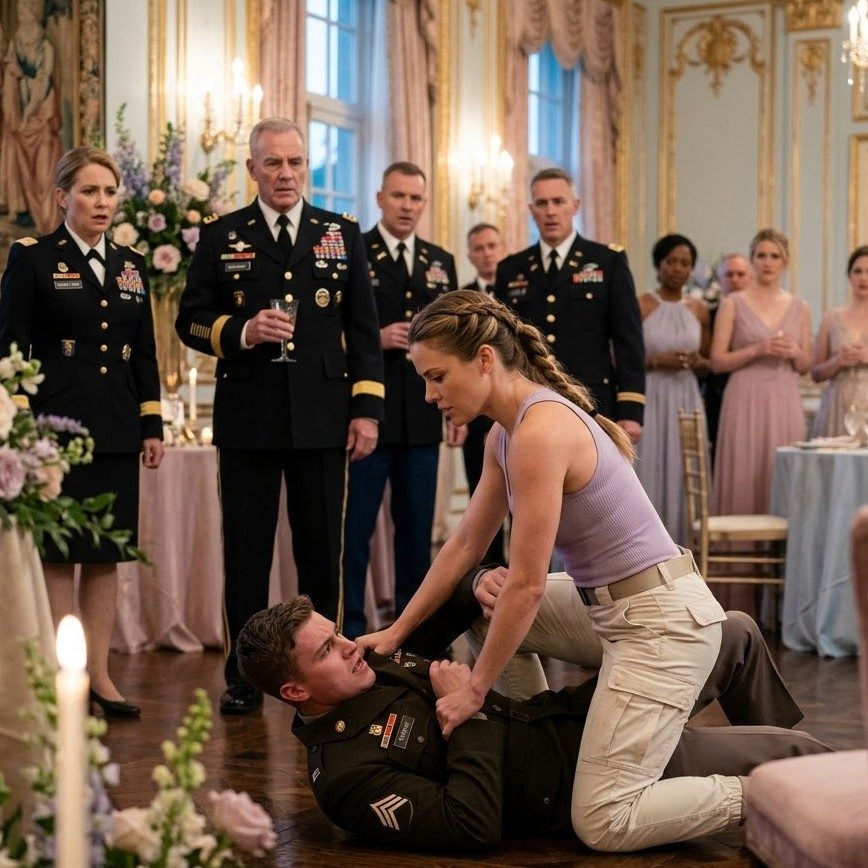


The abandoned motor pool workshop provided a semblance of safety, but I knew it was temporary. Callahan’s warning about the immunity clause left me reeling. Legal channels were dead ends. I needed something outside the system.
I scavenged a old, battered ham radio from a pile of spare parts, miraculously finding enough functioning components to cobble together a crude transmitter. My hands, usually precise with blueprints and schematics, worked with frantic urgency. The air crackled with static as I fiddled with the dial.
“CQ… CQ… this is Nightingale calling Blue Jay. Over.” I repeated the call sign, a secret family code, into the microphone.
A long pause, then a faint, crackling voice. “Nightingale? Is that you, Evie? You’re coming in like a dying cat on a rusty fence.”
It was Uncle Silas Kincaid, my mother’s brother. A retired WWII Army quartermaster sergeant, sharp as a tack, despite his 68 years and failing health.
“Uncle Silas, it’s me,” I said, my voice thick with relief. “I’m in trouble. Deep trouble.”
I quickly explained the situation: the defective armor, the murdered private, Finch’s smear campaign, the immunity clause. I left out no detail.
Silence stretched across the airwaves, punctuated only by the distant hum of the Da Nang base.
“He’s running protection detail for war profiteers, then,” Silas said finally, his voice hard. “Always a few snakes in the grass. What do you need from an old man, Evie?”
“I need to know everything about Garrison Finch,” I told him. “His real name, his background, his history. Anything before he joined Vanguard Logistics.”
“Finch, you say?” Silas mused. “That’s a good name. Solid. Sounds like a general’s son. But sometimes the best names are the ones that don’t belong.”
I could almost see him, sitting in his cluttered study in Ohio, surrounded by stacks of old military records and dusty maps. He knew more about the logistics and personnel movements of World War II than most historians.
“It will take time,” Silas warned. “Archives are slow. Lots of red tape. Even for an old-timer with friends in high places.”
“Time is something I don’t have, Uncle,” I replied. “Finch wants me gone. Or dead.”
“Understood,” he said. “Keep that contraption running. I’ll call you when I have something.”
I spent the next two days hiding in the workshop, meticulously documenting the few remaining metallurgical findings I had, trying to rebuild what Finch’s men had destroyed. The accusation of treason was broadcast repeatedly, isolating me completely. I ate cold C-rations scrounged by O’Brien and slept fitfully on a cot amidst tools and grease.
On the third night, the ham radio crackled to life again.
“Nightingale, this is Blue Jay,” Silas’s voice rasped, sounding even more tired. “I found him. Or rather, I found who he isn’t.”
My hand tightened on the microphone. “What do you mean?”
“The Garrison Finch you know,” Silas began, his words slow and deliberate, “he didn’t exist before 1945. Not officially, anyway.”
“Explain,” I urged, my heart pounding.
“I pulled every record I could find for a Garrison Finch, service number, birthplace, parents. Every one led to the same man: Lieutenant Garrison Finch, US Army. Killed in action, Normandy, France, July 17, 1944. Body recovered, buried in the American Cemetery at Colleville-sur-Mer.”
A shock went through me, like a jolt of electricity. “He’s dead?”
“The real one is,” Silas confirmed. “The man you’re dealing with… he’s an imposter. A ghost. A man who assumed a dead soldier’s identity.”
“His real name?” I asked, my voice barely a whisper. This was the key.
“Took some digging,” Silas said, a hint of satisfaction in his tone. “Cross-referenced all the men reported missing or AWOL in that sector, around that time. Found a match. A quartermaster clerk, actually. Private Gerald Albright. Disappeared from his unit near Le Mans, August 1944. Never officially reported found. Never reported dead.”
Gerald Albright. The name felt wrong, an ugly, common name for the polished, ruthless man I knew. Finch was an alias, a stolen identity from a fallen hero. The man who had sent a private to his death and was now sending recycled scrap metal to the front lines was a fraud, a thief of identity and life itself. This was bigger than I ever imagined.
More Stories








+ There are no comments
Add yours