
After ER Shift, Father Finds Daughter Injured and Security Footage Deleted — Exposes Wife's Corporate Betrayal


My professional life became a minefield of averted gazes and hushed conversations.
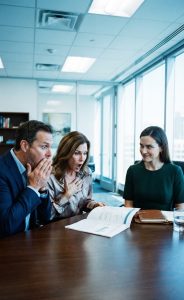
The official ‘wellness check’ meeting felt like an interrogation, with Sarah Chen and another HR representative asking leading questions about my “stress levels” and “recent emotional struggles.” I calmly refuted their insinuations, maintaining my composure, but I knew their minds were already made up. It felt like walking into a trap with no exit.
I spent my evenings, fueled by a simmering rage and determination, digging deeper into Veridian Health. Robert Maxwell’s company wasn’t just a corporate entity; it was a shadow. The more I pulled on the threads, the more intricate and disturbing the tapestry became.
I started with public records, wading through years of financial statements, SEC filings, and archived news articles. Veridian, under Robert’s leadership, had a history of aggressive market practices. There were numerous instances of smaller biotech startups being acquired, then mysteriously dissolving after their key innovations were absorbed. It was a pattern of ruthless corporate predation.
Then came the clinical trials.
I found several archived reports of past trials that had raised red flags. One particular device, a glucose monitor from five years ago, had been fast-tracked through regulatory approval despite a statistically significant number of adverse event reports during its initial trials. These reports, buried deep in obscure appendices, spoke of “unexplained skin irritations” and “localized tissue inflammation” that were quickly dismissed as minor side effects. The data analysis, clearly skewed, downplayed the severity.
It was a chilling parallel to Lily’s symptoms, a pattern of “minor” issues being swept under the rug for the sake of market speed. This specific, repeated pattern of dismissive cruelty toward patient welfare was now clear. I found a quote from Robert Maxwell in an old industry magazine, proudly stating that “innovation sometimes requires bold steps and accepting calculated risks for the greater good.” That “greater good” apparently meant ignoring adverse effects.
The further I delved, the more I understood the scale of Robert Maxwell’s amorality. Veridian wasn’t just a company; it was a machine built on cutting corners and exploiting loopholes. There were countless lawsuits from former employees, all settled out of court with non-disclosure agreements, hinting at a culture of intimidation and fear.
I remembered Claire’s trembling voice, her fear of Robert ruining them. It wasn’t just empty rhetoric. Her brother was known for crushing anyone who stood in his way, personally and professionally. He had built his empire on a foundation of ruthlessness.
I pulled up an archived photo from a corporate gala, showing Robert Maxwell beaming, accepting an award for “Biotech Innovator of the Year.” Standing beside him, smiling proudly, was Claire. It was a small, personal cruelty to see her so happy, so aligned with him, knowing the true nature of his operations. It reinforced the disturbing hidden connection: Claire’s ambition, once something I admired, was being ruthlessly exploited by Robert.
This wasn’t about a new medical breakthrough; it was about market dominance at any cost.
I started collecting everything, meticulously organizing the evidence: financial records, redacted trial reports, news clippings, legal settlements. Each document added another layer to the dark truth of Veridian Health. It wasn’t just unethical; it was actively dangerous.
And Claire. My wife. She wasn’t just a victim of Robert’s coercion, as I had initially tried to rationalize. She was the head of the “Innovation Lab” where this new device, the “Oculus Project,” was being developed. She was intimately involved in this culture of reckless disregard for safety. The denial I had desperately clung to, the hope that she was merely a panicked participant, was crumbling under the weight of the evidence.
Her denial during our confrontation, her insistence on the “harmlessness” of the device, now rang hollow and manipulative. She knew what Veridian was. She knew Robert’s tactics. She had chosen to be a part of it, to lead part of it.
The realization settled in my chest like a block of ice: Claire wasn’t just negligent. She was actively complicit. She had bought into Robert’s vision, his ambition, or was so terrified of him that she was willing to sacrifice everything, even Lily’s well-being, to remain in his orbit. The thought was a bitter pill, one I struggled to swallow.
The image of Lily’s small, sore arm flashed in my mind, juxtaposed with Robert’s triumphant grin in that old photo, and Claire’s proud smile beside him. The scale of the betrayal expanded, encompassing not just our family, but potentially countless others. The “Oculus Project” wasn’t just an experiment; it was part of a larger, systemic pattern of disregard.
I was no longer just protecting my daughter. I was a whistle-blower, whether I liked the title or not. The path ahead was dangerous, leading straight into the heart of a corrupt corporate empire, and the battle against Robert Maxwell would be a brutal one. But now, armed with the horrifying truth of Veridian’s shadow, I knew I had no choice but to fight.
More Stories















+ There are no comments
Add yours