
At a Cult Leader's Son's Funeral, His 8-Year-Old Son Revealed Her Hypocrisy Through His Father's Phone


Days blurred into a routine of forensic digital archaeology and quiet, strained meals. Arthur and I continued to dissect the forum, building an irrefutable case against Bethany. But amidst this intense focus on the past, my present concern, Leo, remained a silent, aching void.
He spent most of his time in his room, the door often closed, clutching Thomas’s phone. It had become an extension of himself, a small, black rectangle that contained his father’s last whispers. I worried about him, desperately. He was usually a talkative child, bright and inquisitive, but since the memorial, a heavy veil of quietude had fallen over him.
One afternoon, I found him sitting on his bed, tracing patterns on the phone’s screen. The light from the window illuminated the dust motes dancing in the air, creating a soft, almost ethereal glow around his small figure. He looked so vulnerable, so lost in his own world of grief.
I sat gently beside him, the springs creaking softly. He didn’t look up, his fingers still moving slowly across the glass.
“Leo,” I began, my voice as soft as I could make it. “Can we talk about Daddy?”
His shoulders stiffened almost imperceptibly. He shook his head, a small, quick movement.
“I just want to play with his phone,” he mumbled, his voice muffled.
A pang shot through me. I reached out, resting a hand on his arm. His skin felt cool beneath my touch.
“Is there anything else on the phone, sweetie?” I asked gently, trying to keep my voice neutral. “Anything else Daddy wanted us to hear?”
He flinched, pulling his arm away slightly. His grip on the phone tightened.
“No,” he said, his voice sharper now, a defensive edge to it. “Just his games. And that one message for Grandma.”
I felt a surge of frustration, quickly followed by a wave of guilt. Was I pushing him too hard? Was Bethany’s indoctrination already taking hold, making him fear revealing anything that might go against her narrative? He had been spending more time at the community center, ostensibly for “grief counseling” led by Sister Agnes, but I knew Bethany was pulling strings, ensuring he was surrounded by her influence.
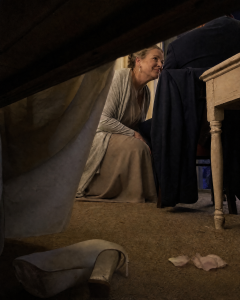
I remembered finding a small, wooden bird Thomas had carved for Leo, left carelessly on the floor near his bed. It was a beautiful, intricate piece, a symbol of their shared love. Now, it looked abandoned, uncherished, a detail that twisted my heart. I saw it as a sign of Leo pulling away, of the community subtly encouraging him to shed “worldly attachments.”
“I just miss him so much,” I confessed, my voice thick with unshed tears. “And I want to understand.”
Leo finally looked up, his big, brown eyes swimming with a grief that mirrored my own. But there was also something else there, a flicker of something I couldn’t quite place – defiance? Determination?
“I miss him too, Grandma,” he said, his lower lip trembling. “But… Grandma Bethany says he’s with the Light now.”
His words, meant to be comforting, stung. They were Bethany’s words, a simplified, cult-approved explanation for Thomas’s death, designed to gloss over the complexities and silence any questions. She was clearly using his grief to further indoctrinate him, twisting his sorrow into a weapon against me.
“Yes, he is,” I said, trying to keep my composure. “But sometimes, people have reasons for things that aren’t always easy to understand.”
He hugged the phone to his chest, his gaze dropping back to the patterned bedspread. He was a small, impenetrable fortress of grief and unspoken thoughts. I felt the invisible wall rising between us, constructed brick by brick by Bethany’s influence.
“Grandma, can you just… let me be?” he asked, his voice small, weary.
I sighed, a wave of helplessness washing over me. How could I fight Bethany’s pervasive influence over my grandson when he wouldn’t even talk to me? I wanted to grab him, to shake him gently, to tell him everything we had discovered, to warn him against Bethany’s lies. But I knew that would only push him further away.
I smoothed his hair, a silent gesture of love and reassurance.
“Of course, sweetie,” I said, forcing a gentle smile. “I’m always here if you want to talk.”
I stood up, leaving him to his solitude, to his phone, and to his silent, complicated grief. My heart ached, not just for Thomas, but for the precious bond with Leo that felt like it was slipping through my fingers. I was acutely aware that Bethany’s attempts to “integrate” Leo into the community were, in fact, attempts to erase me from his life, to replace my influence with her own.
As I walked out, I glanced back. Leo was still sitting there, quiet and still, his small figure framed by the soft light. He looked so fragile, yet something in his posture, a rigid stillness, hinted at an inner strength I hadn’t fully understood. He wasn’t just grieving; he was processing, observing, perhaps even planning.
I remembered the fierce determination in his eyes at the memorial, the unwavering way he had held out his father’s phone. Maybe his silence wasn’t a sign of indoctrination, but a quiet resolve. Maybe he was not retreating, but preparing.
But the uncertainty gnawed at me. I was losing him, one silent moment at a time. The battle for Thomas’s truth was inextricably linked to the battle for Leo’s heart and mind. And I was, for the moment, powerless to break through his careful, protective silence.
More Stories







+ There are no comments
Add yours