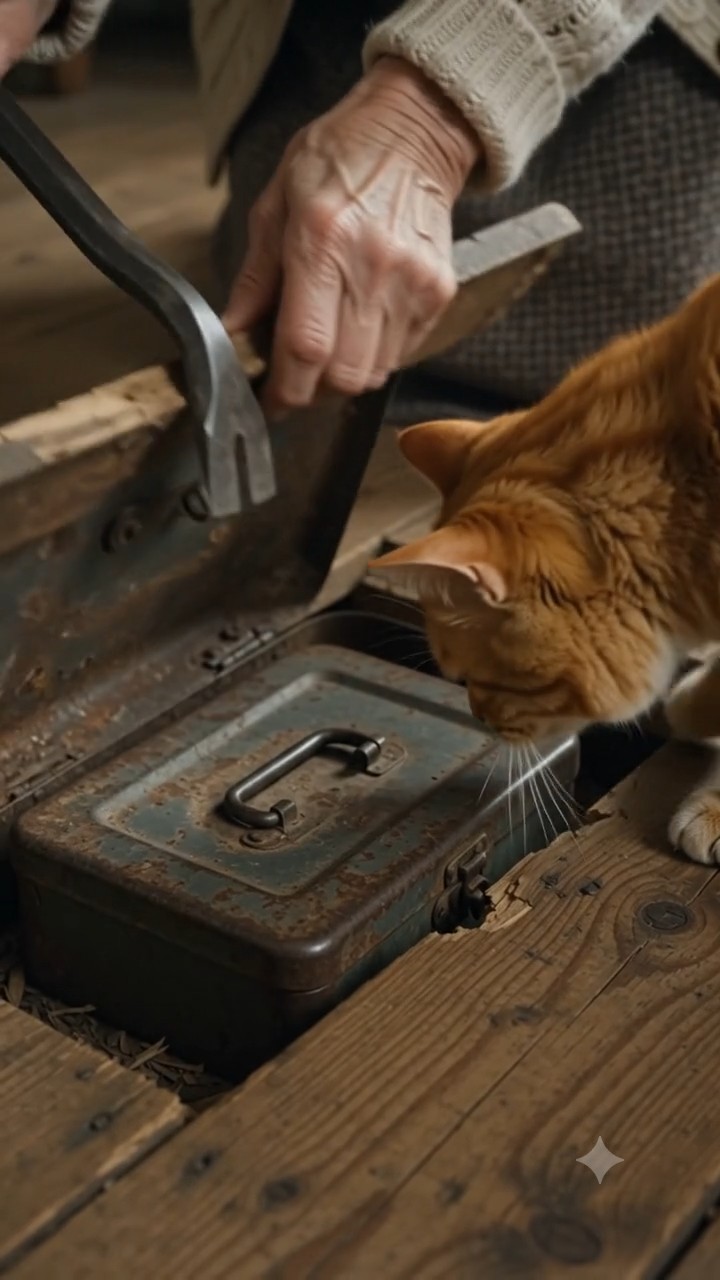
If you leave that stray cat in your house, Martha, you'll be smelling her dead owner till spring, the deputy told me on the porch.


Forty-eight hours. Julian’s words were a countdown, echoing in the biting silence of my cabin. My hands were already clumsy with cold, my fingers stiff, but my mind was clearer than it had been in days. He had given me a deadline. I would meet it, but not on his terms.
I limped to the woodstove, adding another precious log, coaxing a bit more heat from the embers. Barnaby watched me, his tail giving a slow thump against the floor.
Then I pulled out Clara’s tin box, the one I’d found under the floorboard. Inside, alongside the cashier’s checks and the adoption decree, was the stack of papers Clara had hidden. Tax filings, property maps, but also obscure historical land grant records. Records I recognized from my decades as a document archivist.
Julian Kross had underestimated me. He knew I’d taught him document appraisal, how to assess historical value. But he forgot I’d also taught him how to *find* the weaknesses, the hidden clauses, the forgotten claims in the oldest records.
My fingers, stiff and slow, began to sort through Clara’s meticulously kept papers. I pulled out old county deeds, faded surveys, and, most importantly, the original land grant numbers for Clara’s parcel.
I knew the county clerk’s office better than Julian knew his own shadow. I’d spent forty years there, indexing, cross-referencing, preserving. I knew the exact forms, the precise language, the hidden bureaucratic levers that could freeze a property.
Under a flickering lantern, I began to draft. Not a legal brief. Not a plea to a useless deputy.
I wrote formal notices of cloud-of-title dispute.
These weren’t simple objections. These were carefully constructed challenges based on the original, ancient land grant numbers Clara had preserved. They referenced obscure easements, historical claims, and boundary ambiguities that, once formally recorded, would instantly make her property a “disputed asset.”
A disputed asset. That was the key.
Julian’s entire $14 million commercial land deal depended on a clean title for every parcel. His $3.8 million construction loan, I knew from my past work on similar appraisals, would have a standard clause: any encumbrance or dispute on collateral assets would halt the loan drawdown. Immediately.
He was leveraged to the hilt. This was his weakness.
Each notice was short, precise, and irrefutable, citing specific document numbers and survey coordinates from Clara’s box. I even drafted a brief cover letter, using the formal language of a seasoned archivist, explaining the legal implications of these “newly discovered historical ambiguities.”
I worked through the night, fueled by cold coffee and a grim determination. My left foot, which had been numb all day, was starting to throb with a dull ache. My head pounded. But I didn’t stop.
By dawn, I had five identical, ironclad notices, each addressed to a different entity: Julian Kross’s company, the county recorder, the bank holding his construction loan, and two of his primary private equity lenders in Boston.
I sealed them in envelopes, the thick paper feeling like a weapon in my hand. I needed to get them mailed, certified, today. Before Julian’s twenty-four hours were up.
He thought I had no cards. He was about to learn that my deck held a very specific, very dangerous ace.
More Stories





+ There are no comments
Add yours