If you leave that stray cat in your house, Martha, you'll be smelling her dead owner till spring, the deputy told me on the porch.


Part 1
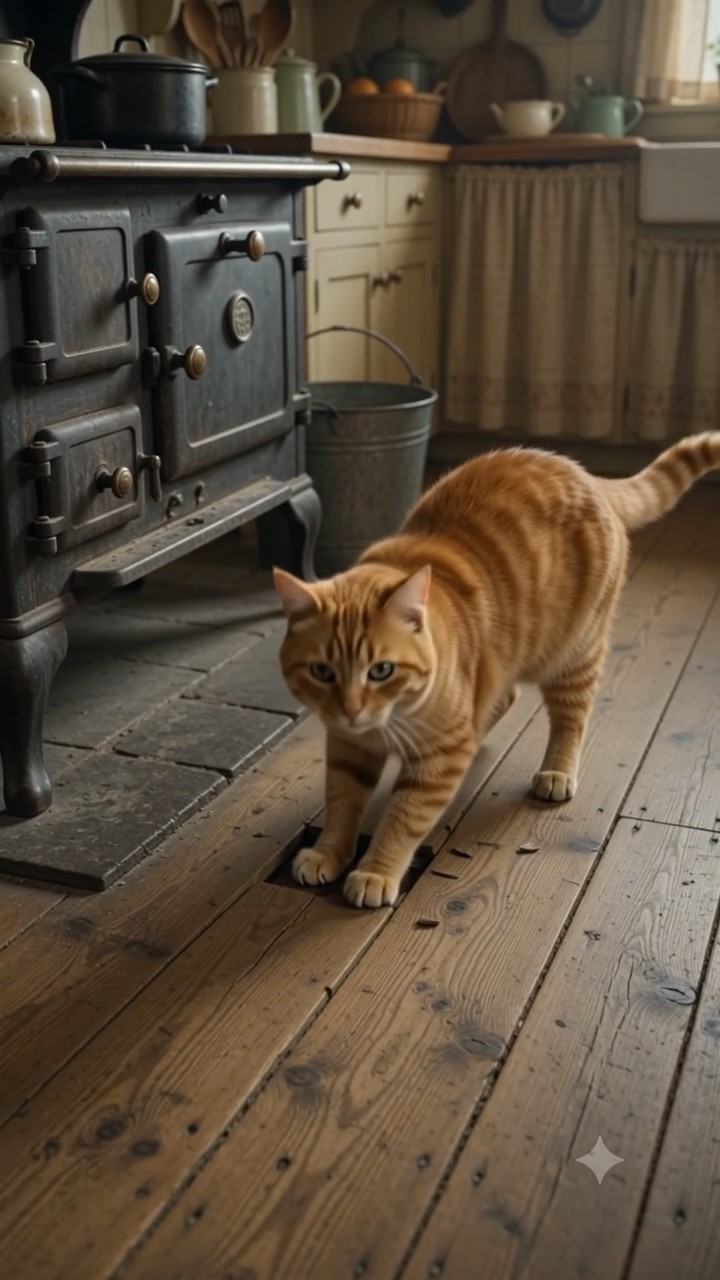
Fourteen days after my eccentric neighbor Clara Sallow froze to death in her unheated cabin, her orange tomcat Barnaby refused to leave my kitchen, clawing obsessively at a buckled pine floorboard behind my woodstove.
When I pried the board up with a crowbar, I found a rusted metal cashbox containing $42,000 in uncashed cashier’s checks, an adoption decree from 1968 proving Clara was my long-lost sister, and a ledger detailing a private equity land-grab operation run by my former apprentice, Julian Kross.
The old Ford pickup crunched on the icy gravel of the driveway, its engine idling for a moment before Deputy Dean Vance finally cut it. He was a broad man, his uniform already straining at the seams this early in the winter.
He didn’t bother to knock, just walked right up to the porch railing and called out, his breath pluming in the crisp Maine air.
“Martha! You still got that stray from Clara’s place?”
I had been watching him from the kitchen window, a cup of chamomile tea steaming in my hand. Barnaby, the orange tomcat, was curled up on the rug directly in front of the woodstove, pretending to sleep, but his ears twitched at the deputy’s voice.
“He won’t leave,” I called back, stepping out onto the small enclosed porch. The cold instantly bit at my exposed hands.
Deputy Vance squinted at me, his eyes already glazed with the familiar rural indifference I’d seen a thousand times. He’d come out here to Clara’s cabin after the snowplow driver reported her driveway hadn’t been cleared for days. He was the one who found her, still as a stone, wrapped in blankets on her porch.
“If you leave that stray cat in your house, Martha, you’ll be smelling her dead owner till spring,” he said, and then spat a stream of tobacco juice into a snowdrift.
He didn’t wait for a reply, just turned and ambled back to his truck, the radio crackling to life as he opened the door. The sound of tires on gravel faded quickly, leaving only the sharp winter silence.
I shivered, pulling my thin shawl tighter. Barnaby watched me from the kitchen, a glint in his amber eyes.
He was a big cat, shaggy and a little wild-looking, but he had settled into my kitchen like he owned it. For the last fourteen days, ever since the deputy dropped him off, he had rarely moved from the spot in front of the woodstove.
He had started it the first night.
A low, persistent scratching that had kept me awake, a sound of claw on wood, endlessly rhythmic. I had tried to shoo him away, thinking he was just trying to get under the stove for more warmth.
But he wouldn’t budge.
He’d glare at me, then return to his task, digging his claws into a specific pine floorboard, his whole body tensed with an almost manic energy. It was the third board from the edge, directly behind the stove’s iron legs, barely visible unless you were looking for it.
I walked back into the kitchen, the warmth a welcome relief after the deputy’s visit. Barnaby stretched, then resumed his determined scratching.
Scratch. Scratch. Pause. Scratch.
It wasn’t a playful scratch. It was purposeful, almost desperate. As if something vital lay beneath that particular piece of wood.
“What is it, Barnaby?” I murmured, walking over.
I knelt, wincing as my old knees protested. The floorboard was indeed buckled, raised slightly at one end, as if it had been repeatedly pried or warped by moisture. His claws had dug deep grooves into the softened pine.
A small, unsettling curiosity began to gnaw at me. Clara had been a strange woman, secretive to a fault, but meticulous in her eccentric way. Why would this one board be loose?
I retrieved the old crowbar from the utility closet, its weight familiar in my hands. The cat watched, his head cocked, his tail giving a slow, deliberate swish on the rug.
I positioned the flat end of the crowbar under the raised edge of the board. My muscles, long accustomed to lighter work, strained with the effort.
The wood groaned, protesting.
With a final, sharp crack, the board lifted, tearing free from the nails that had held it. A cloud of fine dust puffed up, smelling faintly of old pine and something else – something metallic and earthy.
Barnaby immediately nudged his head into the gap, sniffing excitedly.
Underneath, nestled in the dark, cool cavity, sat a rusted metal cashbox. It was old, probably from the 1950s, its once-green paint faded and flaking.
My heart gave an unexpected thump.
Clara, who hadn’t used a bank in twenty years and paid for everything with crisp hundred-dollar bills she kept in mason jars, had clearly hidden something important here.
I pulled the box out, the metal cool and gritty against my fingertips. It felt heavy. The latch was stiff with rust, but after a moment of struggling, it gave way with a faint click.
Inside, neatly stacked, were dozens of uncashed cashier’s checks. My eyes scanned the top one: $500, then $1,000, then another $500. They were all made out to ‘Clara Sallow’ and dated over the last few years.
The amounts added up quickly. $5,000 here, $2,500 there. My fingers trembled as I counted. There was no way to be sure without going through every single one, but a rough estimate quickly pushed past forty thousand dollars.
A fortune for Clara. Forty-two thousand dollars in total, all uncashed.
Underneath the checks, wrapped in brittle wax paper, was an official-looking document. The paper was yellowed with age, its creases softening. I unfolded it carefully.
The heading was stark: “Decree of Adoption, State of Maine, 1968.”
My breath hitched.
I smoothed the paper, my eyes scanning the formal language, the precise dates. It detailed the legal separation of two young sisters from their parents, following a farm bankruptcy.
One name jumped out, stark and undeniable: Martha Gable.
My name.
And below it, the name of the child being adopted: Clara Gable.
My eyes snapped back to the top of the page. Clara Sallow. The woman who had frozen to death in her unheated cabin, the woman whose cat I now harbored, was not Clara Sallow.
Her real name was Clara Gable.
My younger sister. Separated from me when I was a child. The sister I had never known I had.
I traced her name on the paper, my mind reeling. All these years, she’d been my neighbor, less than a mile away.
Below the adoption decree, tucked into a slim, black, leather-bound book, was a small, handwritten ledger. The first page read: “Timber Parcel 27-B – Sallow Acquisition Strategy.” On the next page, in crisp, familiar handwriting, was the name: Julian Kross.
My former apprentice. My protégé in document archiving and estate appraisal, a young man I had taught everything I knew about land records and financial forensics.
The ledger detailed a precise, systematic plan for “pressure and acquisition.” A land grab, targeting specific properties, including Clara’s 180-acre timber parcel. A $14 million commercial deal, to be finalized only when the “Sallow” property was secured.
A cold dread began to seep into my bones, a deeper chill than the Maine winter could ever deliver. My sister, found dead of exposure just a few weeks ago, had been a target.
Julian.
The man I had trusted, the man I had mentored, was at the heart of it. And the proof was right here, in my hands, hidden under my own floorboard.
Part 2
I lifted the black ledger, my fingers tracing the familiar loops of Julian’s precise script. Below the “Sallow Acquisition Strategy” title, the entries grew more insidious.
Pages detailed a timeline of fabricated property tax disputes. Small, deliberate errors in Clara’s annual filings.
Each entry was a step in a calculated process. A missed payment here, an incorrect assessment there. All designed to trigger county notices.
Foreclosure warnings. Default proceedings. Julian had been steering Clara’s property toward a forced auction for months.
He hadn’t just *targeted* her land. He had actively *undermined* her ownership, chipping away at her legal standing with every false record.
My old eyes scanned the dates. This had been going on for over a year. Long before Clara’s death.
It wasn’t just a land grab. It was a calculated siege against my own sister. A sister I had only just discovered.
A sudden, sharp pop echoed from the kitchen wall.
The single bulb hanging above my counter flickered, then died. Darkness engulfed the room, save for the weak glow from the woodstove’s glass door.
My breath caught in my throat.
Barnaby, who had been purring at my feet, let out a low growl, his hackles rising slightly. He stared at the kitchen entrance, his eyes reflecting the dying light.
I instinctively reached for the old rotary phone on the counter. The dial tone was usually a comforting, steady hum.
Nothing. Just a dead silence.
I pressed the receiver to my ear, hoping for static, anything. The line was completely inert.
My gaze drifted to the window. Outside, the last vestiges of twilight were fading into a starless, inky black.
A shiver ran through me, colder than any draft. The heat from the woodstove already felt less potent, the cabin air growing heavy.
I knew the temperature. The radio had warned of a deep freeze.
Three degrees Fahrenheit. Barely above zero.
And now, no electricity, no phone. Only the deepening cold and the terrible knowledge I clutched in my hands.
More Stories







+ There are no comments
Add yours