
Quiet Seattle Pediatric Fellow Discovers Her Next-Door Neighbor and Mother-in-Law Sabotaged Her Brakes for a $1.2M Insurance Payout, Swaps the Cars, and Confronts the Traitor in a Dark ER Corridor.


The garage was a hive of activity. Paramedics rushed in, their gurneys rattling, followed by hospital security personnel, their radios crackling with urgent commands. The air was thick with the scent of antiseptics, exhaust, and a faint, acrid smell of hydraulic fluid.
Thomas, his face pale but determined, moved with surprising speed. While the emergency crews converged on Garver’s crumpled SUV, he slipped away, heading towards the security office. He knew where the paper trail was, where the digital logs were stored. The printouts of the forum thread, already in his pocket, were the key. He just needed official timestamps.
I stayed near the periphery, watching. It felt surreal, like an out-of-body experience. The man who had meticulously plotted my demise was now being extracted from the wreckage of his own design.
Garver was groaning, his face contorted in pain as paramedics carefully maneuvered him onto a backboard. His right arm was at an odd angle, and a cut bled above his eye. Non-lethal, as I had intended. Just enough to ensure he couldn’t walk away.
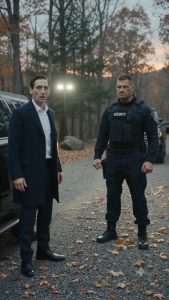
Two Seattle Police Department officers arrived, their blue lights flashing, reflecting off the metal and concrete. They secured the scene, pushing back curious hospital staff. One officer, a tall woman with sharp eyes, knelt beside the damaged vehicle, her flashlight tracing the ground beneath it.
“We have a fluid leak here,” she announced, her voice cutting through the din. She pointed to the dark, fresh stain on the concrete. “Looks like brake fluid.”
Another officer began inspecting the vehicle’s underside, methodically working his way around the wheels. He paused at the rear driver’s side.
“Got a clean break here,” he called out, his voice grim. “The hydraulic line. Looks like it was tampered with. Fresh tool marks around the fitting.”
A gasp rippled through the small crowd of onlookers. Tampering. Not an accident. Not equipment failure.
That’s when Thomas reappeared, looking a little rumpled, but holding a discreetly folded printout in his hand. He caught my eye, a silent confirmation. He had secured the timestamped security logs from the garage. He had done his part.
The sharp-eyed officer, now equipped with a camera, meticulously documented the scene. She called for a forensic team. Then, her gaze fell on Garver, still being stabilized on the gurney.
“Sir,” she said, approaching him, her voice firm. “We need to know what happened here. And we found this.”
She held up a small, greasy wrench. It was identical to the one Thomas had described, the one found in Garver’s toolbox, the one with fresh oil on it. It had been found in the trunk of the crumpled SUV. His own tool, used for his own sabotage, left behind in his own vehicle.
Garver’s eyes, glazed with pain and shock, widened as he saw the wrench. A flicker of recognition, then pure, unadulterated terror crossed his face. He knew. He realized his trap had not only failed but had turned catastrophically against him.
“This is Dr. Garver’s vehicle, isn’t it?” a hospital security guard asked, confused, pointing to the damaged SUV with my parking permit on the dash. “His reserved spot.”
The sharp-eyed officer looked at the permit, then back at Garver. “The permit on the dash has a Dr. Clara Albright’s name on it, but the VIN matches a hospital fleet vehicle registered to Dr. Richard Garver’s department,” she stated, cutting through the confusion with clinical precision.
My parking permit, with my photo and name, in his car. But the car, physically, was his. And the damage, the tool, the evidence of sabotage, was all there.
“Dr. Albright,” the officer said, turning to me, her gaze piercing. “Can you shed any light on this?”
I stepped forward, my voice steady. “Yes, Officer. I can. But perhaps,” I suggested, gesturing subtly toward the gurney where Garver lay, now being prepped for transfer. “A private word with Dr. Garver, before he’s moved, might clarify things more quickly.”
The officer considered me for a long moment, then nodded. The puzzle pieces, though scattered, were already forming a recognizable picture. And I held the last, crucial piece.
More Stories











+ There are no comments
Add yours