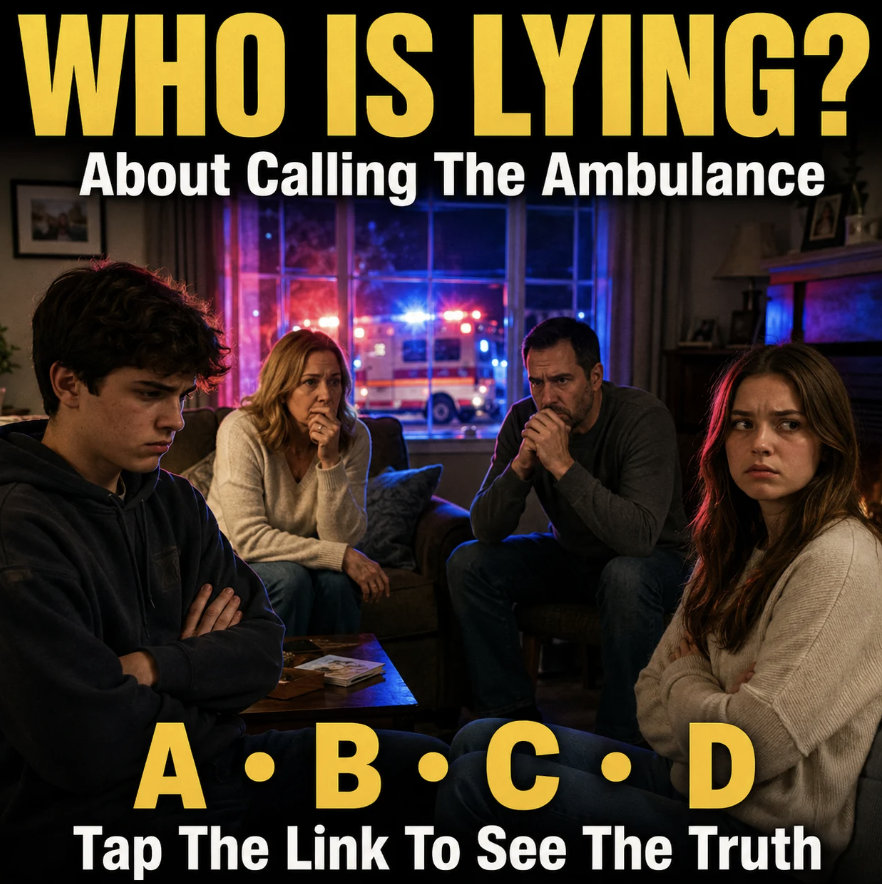
Three minutes changed an entire murder investigation.
A woman lay dying at the bottom of a staircase.
Everyone claimed it was a tragic accident.
But detectives discovered an ambulance had been called before the fall supposedly happened.
And suddenly, the question was no longer how she died.
It was who already knew she was going to die.
Margaret Holloway was sixty-eight years old, active, healthy, and known throughout her neighborhood as the woman who never missed church and never forgot a birthday.
On a rainy Thursday evening, she was found unconscious at the bottom of the staircase inside her home.
Her husband, Daniel, called for help.
Or at least that was what everyone believed.
According to the family’s account, Margaret slipped while carrying laundry downstairs shortly after 9:15 p.m. Daniel heard the crash and rushed over. Their daughter Emily arrived moments later. The family’s live-in caregiver, Rachel Torres, ran from the kitchen after hearing screams.
By the time paramedics arrived, Margaret was barely breathing.
She died less than an hour later at the hospital.
At first, police saw no reason to investigate.
It looked like a terrible accident.
Then Detective Brian Keller reviewed the emergency call records.
And something didn’t fit.
Daniel claimed he called 911 immediately after finding Margaret.
The call log showed the emergency call was placed at 9:08 p.m.
Seven minutes before the family said the fall occurred.
Detective Keller assumed it was a clerical error.
But dispatch recordings confirmed the timestamp.
The call had definitely happened at 9:08.
That meant someone knew an emergency existed before Margaret supposedly fell down the stairs.
The case was reopened.
Four people quickly became suspects.
First was Daniel Holloway.
The grieving husband insisted he was confused about the timeline.
He claimed the shock made him remember events incorrectly.
But detectives discovered Margaret had recently updated her estate documents. Nearly five million dollars would pass directly to Daniel if she died first.
The motive looked obvious.
Then there was Emily.
Margaret’s daughter had been arguing with her mother for months over money. Investigators learned Emily secretly withdrew funds from a joint account and had accumulated large gambling debts.
More troubling was the fact that Emily initially refused to hand over her phone.
When detectives finally obtained it, several messages from that evening had been deleted.
The third suspect was Rachel Torres, the caregiver.
Rachel changed her story three times.
First she said she heard the fall.
Then she said she heard Daniel scream first.
Then she claimed she was outside taking trash to the curb when everything happened.
Each version contradicted the previous one.
The final suspect was the neighbor, Frank Miller.
Frank appeared at the house unusually fast.
In fact, he arrived before paramedics.
When detectives questioned him, he said Daniel called him for help.
The problem was Daniel supposedly called 911 first.
So why contact Frank before emergency services?
The deeper investigators dug, the stranger the case became.
Security cameras from nearby homes showed Frank’s truck pulling into the Holloway driveway at 9:06 p.m.
Two minutes before the ambulance call.
Even stranger, Frank parked as though he already expected a crisis.
Detectives began wondering if multiple people were involved.
A forensic reconstruction of the scene produced another surprise.
Margaret’s injuries were consistent with a fall.
But medical experts estimated she remained conscious for several minutes afterward.
If someone had called immediately after the accident, she might have been able to speak.
No witness reported hearing her say a single word.
That suggested the timeline was still wrong.
Then detectives obtained the dispatch recording.
The operator answered.
“911, what’s your emergency?”
A male voice responded.
“We need an ambulance. Elderly female. Serious fall.”
The dispatcher asked for the address.
The caller provided it.
Then something unusual happened.
The dispatcher asked, “Is she conscious?”
There was a pause.
Then the caller replied:
“Not yet.”
The recording stopped everyone cold.
Not yet.
Those two words changed everything.
A person describing an accident would normally say yes or no.
But “not yet” implied the victim had not fallen unconscious at that moment.
It sounded as though the caller expected it to happen.
Voice analysis identified the speaker.
It wasn’t Daniel.
It wasn’t Frank.
It was Rachel Torres.
The caregiver.
Suddenly all attention shifted toward her.
Rachel denied everything.
She claimed she panicked and misspoke.
But detectives uncovered a critical fact.
Three weeks earlier, Margaret had privately informed Rachel she intended to terminate her employment. A professional agency would be taking over full-time care.
Rachel would lose her housing, salary, and healthcare benefits.
Still, that wasn’t enough to explain the bizarre emergency call.
Then investigators found deleted internet searches on Rachel’s laptop.
How long after head injury does unconsciousness occur?
Signs of brain bleeding after a fall.
Emergency response times in rural counties.
The searches were made the day before Margaret died.
Detectives believed they finally had their culprit.
Until the final piece of evidence arrived.
Margaret’s smartwatch.
The device recorded movement, heart rate, and location.
At 9:03 p.m., Margaret was still upstairs.
At 9:05 p.m., she entered her bedroom.
At 9:07 p.m., her heart rate spiked dramatically.
At 9:08 p.m., Rachel called the ambulance.
At 9:11 p.m., Margaret rapidly descended the stairs.
At 9:12 p.m., the fatal fall occurred.
Everyone had been focused on the wrong mystery.
Rachel had indeed called before the accident.
But why?
The answer emerged from a recovered voice memo on Margaret’s phone.
Earlier that evening, Margaret had secretly recorded an argument.
Rachel was threatening to expose a family secret unless Margaret gave her money.
Margaret refused.
The confrontation escalated.
Rachel became frightened when Margaret suddenly grabbed her chest and appeared disoriented. Believing Margaret was about to suffer a medical emergency, Rachel secretly called 911 before informing anyone else.
She feared being blamed because of the argument.
Then panic took over.
Margaret recovered briefly, left the room, attempted to walk downstairs, became dizzy, and fell.
Rachel realized calling before the accident made her look guilty.
So she lied.
She altered her timeline.
She changed her story repeatedly.
She tried to hide the fact that she had already contacted emergency services.
The investigation ultimately revealed something even darker.
Margaret had not died from the fall alone.
A previously undiagnosed brain aneurysm had ruptured during the argument.
The dizziness caused by the rupture led to the fatal fall minutes later.
Rachel never pushed Margaret.
She never attacked her.
But she concealed critical information from investigators because she feared being blamed for the death.
The person who lied was Rachel Torres, the caregiver.
She called the ambulance before the accident because she believed Margaret was already experiencing a medical crisis.
When the fall happened minutes later, Rachel hid the truth, creating a mystery that made everyone suspect murder.
In the end, the biggest lie was not about failing to call for help.
It was about calling too soon.


