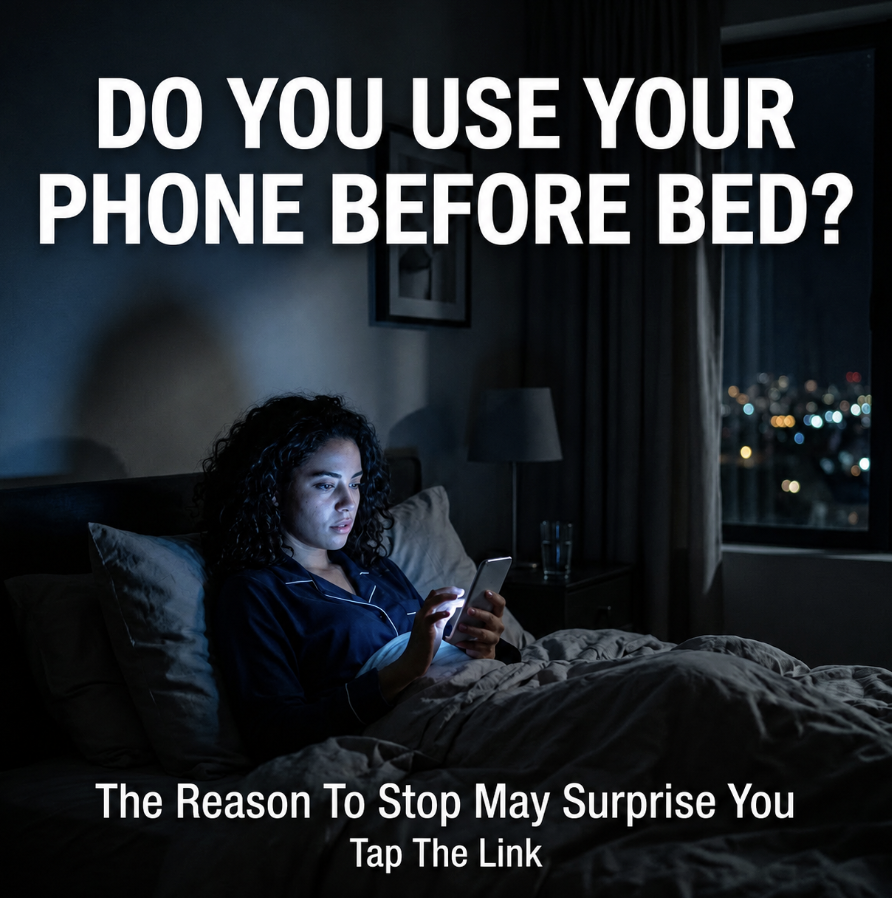
Have you ever climbed into bed feeling exhausted, only to find your mind racing an hour later?
You check one notification.
Then another.
A news headline.
A social media post.
A short video.
Before you realize it, your body is lying in bed, but your brain is still running a marathon.
What many people don’t realize is that the problem may not be the lack of sleep itself.
It may be what you’re teaching your brain to associate with bedtime.

For millions of people, grabbing a phone before sleep feels completely normal. It has become part of the nightly routine, just like brushing teeth or turning off the lights. Some people scroll through Facebook. Others watch videos, read news stories, answer messages, or check email one last time.
At first, it feels relaxing.
After a long day, the phone becomes an escape from stress.
The problem is that the brain often doesn’t experience it that way.
Every notification, headline, image, and video is another piece of information your brain has to process. Even when you’re not actively thinking about it, your nervous system is still reacting. A political argument online, a sad news story, a financial worry, a family disagreement, or even seeing someone else’s seemingly perfect life can trigger emotional responses that linger long after the screen goes dark.
For people who already struggle with anxiety, the effect can be even stronger.
During the day, distractions compete for your attention. Work, family responsibilities, errands, conversations, and daily tasks keep your mind moving from one thing to another.
At night, everything becomes quieter.
The brain suddenly has room to focus.
If the last thing you feed it is worry, conflict, bad news, or endless comparison, those thoughts often become the dominant voice in the room.
Many people recognize this pattern.
They put the phone down and close their eyes.
Then the replay begins.
The article they just read.
The medical symptom they searched.
The argument they saw online.
The bill they forgot to pay.
The vacation someone else can afford.
The political story that made them angry.
The message they haven’t received.
The future problem they haven’t solved.
What started as harmless scrolling becomes an hour of overthinking.
The body is ready for sleep.
The mind is not.
Scientists have spent years studying the relationship between screens and sleep. One factor often discussed is blue light. Bright screens can interfere with the body’s natural production of melatonin, a hormone that helps regulate sleep. When the brain receives signals that it is still daytime, it becomes harder to transition into deep rest.
But for many people, especially those who struggle with worry, the bigger issue isn’t the light.
It’s the mental stimulation.
Imagine trying to fall asleep immediately after watching a stressful movie, arguing with someone, checking your bank account, and reading ten emotional news stories.
That is essentially what many people do every night through their phones.
The brain doesn’t automatically know that scrolling is supposed to be relaxing.
It only knows it has been given more information to process.
Another hidden problem is that smartphones can turn bedtime into a state of anticipation.
People check for messages.
Refresh notifications.
Look for updates.
Wait for responses.
Without realizing it, they train themselves to stay alert.
Instead of preparing for rest, the brain remains on standby.
This can create a cycle where the bed becomes associated with mental activity rather than sleep.
Psychologists often talk about the importance of associations. Over time, the brain links certain environments with certain behaviors.
A dining table becomes associated with eating.
An office becomes associated with work.
A gym becomes associated with exercise.
Ideally, a bed becomes associated with sleep.
But when someone spends every night scrolling, worrying, reading, watching, and reacting while lying in bed, the brain starts building a different connection.
The bed becomes associated with thinking.
With planning.
With comparing.
With worrying.
With consuming information.
With stress.
That association can become surprisingly powerful.
Many people notice that they become sleepy on the couch but suddenly feel more awake once they get into bed.
Part of the reason may be that the brain has learned a different bedtime routine than the one they intended.
The effect can be subtle at first.
A few extra minutes to fall asleep.
A little more restlessness.
A little more anxiety.
Then weeks become months.
Eventually, people begin saying things like:
“My mind won’t shut off.”
“I feel tired but can’t sleep.”
“I overthink everything at night.”
“I always feel anxious before bed.”
The phone may not be the only cause.
But it can become fuel for the cycle.
The good news is that small changes often make a noticeable difference.
Many sleep experts recommend creating a short transition period before bedtime. Instead of moving directly from social media to sleep, the brain benefits from a calmer landing.
Some people read a physical book.
Others listen to quiet music.
Some write in a journal.
Others simply sit in silence for a few minutes.
The goal isn’t perfection.
The goal is helping the brain understand that the day is ending.
Even setting the phone aside 20 to 30 minutes before sleep can create a meaningful difference for some people.
Dimming screen brightness, avoiding emotionally charged content, and resisting the urge to check notifications one last time can also help reduce mental stimulation.
Perhaps the most important lesson is this:
The danger isn’t only that your phone keeps you awake longer.
The deeper issue is what your brain learns night after night.
If every evening ends with worry, comparison, conflict, fear, or endless information, your brain begins to expect those things when you climb into bed.
And eventually, the place meant for rest becomes the place where anxiety feels most at home.
That’s the real hidden risk.
You aren’t just losing sleep.
You may be teaching your mind that bedtime is when it should stay alert, keep searching, keep comparing, and keep worrying.
And once that habit becomes strong enough, the phone is no longer just a device.
It’s become part of the reason your brain never fully learns how to rest.
Do you put your phone away before bed, or do you usually scroll until the moment you fall asleep?


