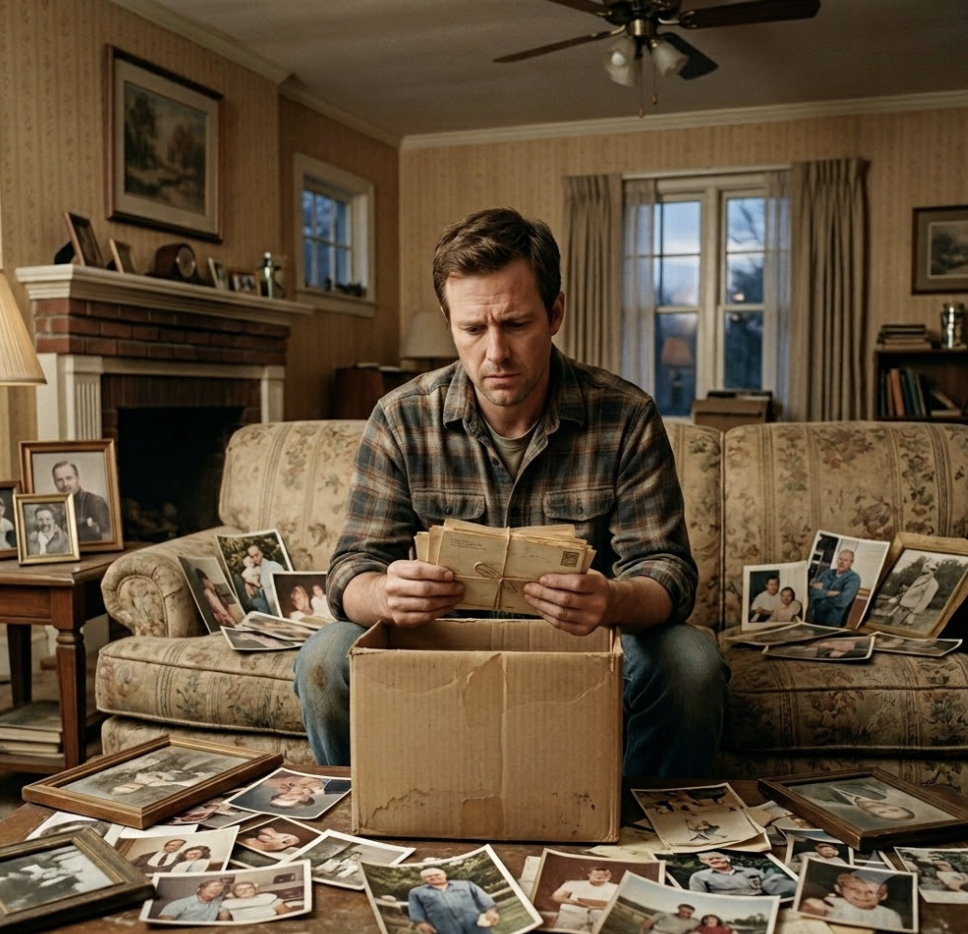
Three Lines That Changed Everything
For twenty years, I believed my father was a coward.
He disappeared on the day we buried my little brother.
Then I opened a box of unopened letters and discovered he hadn’t run away at all.
My father became the villain of our family before I was old enough to understand what that really meant.
By the time I turned thirteen, everyone had already told me the story so many times that it felt like a fact carved into stone.
My father couldn’t handle grief.
My father broke under the pressure.
My father abandoned us.
And worst of all, he abandoned us on the very day we buried my little brother.
Nobody ever questioned that version of events.
Not my grandparents.
Not my aunts and uncles.
Not the neighbors.
Not even me.
Especially not me.
Because when you grow up hearing the same story over and over again, eventually it becomes part of your identity.
I hated him.
I hated him for leaving my mother alone.
I hated him for forcing her to raise me by herself.
I hated him for making me answer questions at school whenever someone recognized my last name.
Most of all, I hated him because my brother Noah had loved him more than anyone.
And he left anyway.
At least that’s what I believed.
For twenty years.
My name is Daniel Harper.
And this is the story of how everything I thought I knew about my father turned out to be a lie.
It started on a hot afternoon in July.
I was thirteen.
Noah was eight.
He was the kind of kid everyone adored.
The kind who made friends in grocery store lines.
The kind who laughed with his entire body.
The kind who never seemed afraid of anything.
That afternoon he rode his bike toward the old road outside town.
He never came back.
A farmer discovered him hours later near the bottom of a steep embankment.
His bicycle was twisted.
His helmet had cracked.
The police concluded he had lost control while riding downhill.
Accidental death.
Case closed.
Simple.
Clean.
Tragic.
The adults accepted it.
The town accepted it.
Everyone accepted it.
Everyone except my father.
At first nobody noticed.
Grief affects people differently.
Some cry.
Some shut down.
Some become angry.
My father became obsessed.
He returned to the scene repeatedly.
He took photographs.
He asked questions.
He interviewed people himself.
He argued with officers.
He demanded reports.
He spent hours staring at maps spread across our kitchen table.
I remember hearing him argue with my mother late at night.
Their voices carrying through the walls.
My mother’s voice breaking.
My father’s voice growing harder each day.
“It doesn’t make sense.”
Those words became his obsession.
It doesn’t make sense.
I heard him say it dozens of times.
Maybe hundreds.
Eventually everyone stopped listening.
Including me.
The funeral happened four days later.
Rain fell from sunrise until sunset.
The church overflowed with flowers.
People whispered condolences.
Children from Noah’s school left drawings beside the casket.
My mother barely spoke.
She looked hollow.
Like something essential had been removed from her.
I kept waiting for my father to sit beside us.
He never did.
At first people assumed he was outside.
Then they assumed he was running late.
Then someone discovered his truck was gone.
Along with several suitcases.
And the money from our savings account.
By evening, the conclusion was obvious.
William Harper had disappeared.
My mother collapsed when she heard.
Literally collapsed.
An ambulance had to be called.
I remember sitting alone on a church bench while relatives rushed around me.
The world already felt broken because Noah was gone.
Now my father was gone too.
That night, my grandfather called him a coward.
The word spread quickly.
Coward.
By the end of the week, everyone was using it.
By the end of the month, nobody used his name anymore.
Just coward.
Traitor.
Monster.
Abandoner.
My mother never remarried.
Never dated.
Never even seemed interested.
She worked two jobs.
Sacrificed everything.
And every year, the bitterness inside our family grew.
Birthdays passed.
Christmases passed.
Graduations passed.
My father missed all of them.
No calls.
No letters.
No explanations.
Nothing.
As the years went on, my hatred matured alongside me.
It stopped being emotional.
It became permanent.
A scar.
Whenever someone mentioned forgiveness, I rejected it.
Whenever someone suggested there might be another side to the story, I shut them down.
There wasn’t another side.
A good father doesn’t disappear.
Simple.
End of discussion.
Then my mother got sick.
The diagnosis came when I was thirty-two.
Pancreatic cancer.
Advanced.
Aggressive.
The doctors were honest from the beginning.
We didn’t have much time.
I moved closer.
Spent as many evenings with her as possible.
Yet even during those final months, she never mentioned my father.
Not once.
Sometimes I wanted to ask.
Sometimes I almost did.
But the pain in her eyes stopped me.
Whatever happened between them belonged to a wound that never healed.
She died nine months after her diagnosis.
Peacefully.
Quietly.
At home.
The funeral was smaller than Noah’s.
Most of the older generation had already passed away.
The house felt unbearably empty afterward.
I stayed behind to organize her belongings.
At first it was routine.
Clothes.
Documents.
Photographs.
Old receipts.
The ordinary archaeology of a life.
Then, on the eighth day, I discovered a wooden box hidden beneath blankets inside the back of her closet.
I had never seen it before.
It was locked.
Dust covered every inch.
Something about it immediately caught my attention.
My mother wasn’t secretive.
At least I hadn’t thought she was.
The key sat inside her bedside drawer.
Hidden beneath an old Bible.
The moment I unlocked the box, my entire understanding of my family began to collapse.
Inside were dozens of envelopes.
Maybe forty.
Maybe more.
They were tied together with faded blue ribbon.
Every envelope carried the same name.
Margaret Harper.
My mother.
And every envelope listed the same sender.
William Harper.
My father.
For several seconds I simply stared.
My brain refused to process what I was seeing.
Because it was impossible.
Completely impossible.
My father never contacted us.
Everyone knew that.
It was one of the central facts of my life.
Yet here sat proof that he had written repeatedly.
For years.
Maybe decades.
I grabbed the oldest envelope.
The postmark dated nineteen years earlier.
My hands trembled as I opened it.
The paper inside had yellowed with age.
The handwriting was unmistakable.
I recognized it immediately.
I had seen it on birthday cards when I was a child.
The first sentence hit me like a punch.
“Margaret, Noah did not die in an accident.”
I stopped breathing.
The room suddenly felt smaller.
I read the sentence again.
Then again.
The words never changed.
Noah did not die in an accident.
I continued reading.
“I found the man who was near the hill that day.”
“The man police ignored.”
“I cannot explain everything yet, but I have to follow this lead.”
“If I stay here, he will disappear forever.”
My pulse thundered inside my ears.
I grabbed another letter.
Then another.
Then another.
Hours passed.
Sunlight faded.
Darkness filled the room.
Still I kept reading.
Every letter revealed another piece of the story.
My father had spent years tracking a stranger.
A man driving a blue pickup truck.
A man seen near the scene where Noah died.
Several witnesses mentioned him.
Yet somehow their statements never appeared in official reports.
My father couldn’t understand why.
Neither could I.
The letters described years of searching.
Different towns.
Different states.
False names.
Dead ends.
Near misses.
Obsessions.
My father sounded exhausted.
Driven.
Consumed.
But never indifferent.
Never uncaring.
Never like a man who abandoned his family because he stopped loving them.
The opposite, actually.
Every letter contained updates about me.
About school.
About birthdays.
About milestones.
He knew things he shouldn’t have known.
Which meant he had been watching from a distance.
Following our lives.
Loving us.
Without ever returning.
Then I reached the final letter.
The most recent one.
Written only months before my mother’s death.
And the final paragraph changed everything.
“Margaret, I finally found him.”
“I know what happened to Noah.”
“And I finally know why.”
My heart pounded.
I kept reading.
“The worst part isn’t what he did.”
“The worst part is that you were right to keep Daniel away from this.”
“If he learns the truth now, he’ll spend the rest of his life hunting the same ghost I’ve chased for twenty years.”
I lowered the letter slowly.
My hands were shaking.
Because one realization suddenly became unavoidable.
My mother knew.
She had known all along.
She knew my father hadn’t abandoned us.
She knew why he left.
She knew Noah’s death wasn’t an accident.
And somehow…
She had kept that secret for twenty years.
I thought discovering my father’s letters was the biggest shock of my life.
I was wrong.
Because hidden beneath the final envelope was something even more devastating.
A photograph.
And the man standing beside the blue pickup truck was someone I recognized.
Someone I had known my entire life.
For a long moment, I couldn’t breathe.
The photograph trembled in my hands.
I stared at it.
Then looked again.
Then moved closer to the lamp.
Hoping I was wrong.
Praying I was wrong.
I wasn’t.
The man standing beside the blue pickup truck wasn’t a stranger.
He wasn’t some drifter passing through town.
He wasn’t a criminal with a face I’d never seen before.
I knew him.
Everyone in town knew him.
His name was Richard Calloway.
For most of my childhood, he had been one of the most respected men in the county.
He owned a construction company.
Sponsored local baseball teams.
Donated money to churches.
Sat on community boards.
People trusted him.
My family trusted him.
Hell, he’d attended Noah’s funeral.
I suddenly remembered seeing him there.
Standing beside my grandfather.
Shaking hands.
Offering condolences.
Telling my mother how sorry he was.
The memory made me physically sick.
I turned the photograph over.
My father’s handwriting covered the back.
“Richard Calloway. Taken three years after Noah’s death.”
“He changed trucks twice. Changed addresses four times. But he keeps running.”
I sat in silence.
The room around me seemed to disappear.
Because for the first time in twenty years, Noah’s death no longer felt like a tragedy.
It felt like a crime.
And if my father was right, everyone had missed it.
Or ignored it.
I spent the next three days reading every letter again.
This time more carefully.
Looking for details.
Dates.
Names.
Patterns.
My father had documented everything.
Every lead.
Every witness.
Every conversation.
He had practically built an investigation by himself.
The deeper I read, the more horrifying the story became.
According to the letters, Noah wasn’t alone near the hill that day.
A witness saw him arguing with a man.
That man matched Richard Calloway’s description.
Another witness reported seeing a blue truck parked near the road shortly before Noah’s death.
Again, Richard owned a blue truck.
Then there was the bicycle.
The official report claimed Noah lost control.
But my father repeatedly pointed out something strange.
The damage didn’t match a simple crash.
Several parts appeared bent before impact.
Almost as if the bicycle had been struck.
Or forced.
He raised these concerns repeatedly.
Police dismissed them every time.
At first, I assumed my father had become obsessed.
Grief can do that.
Then I found something else.
Tucked inside one of the later letters was a photocopy of an insurance report.
I read it twice before understanding its significance.
The report described repairs made to Richard Calloway’s truck two days after Noah died.
Front bumper damage.
Fresh paint.
Replacement headlight.
My stomach dropped.
Noah died near a roadway.
A blue truck suffered front-end damage immediately afterward.
Yet nobody investigated further.
Why?
That question haunted me.
The answer arrived inside another envelope.
A much later one.
Nearly fifteen years after Noah’s death.
In it, my father described finally locating a former deputy who had worked the original case.
The deputy had retired and moved to Arizona.
Years had passed.
His health was failing.
And perhaps because of that, he finally talked.
According to the letter, evidence disappeared.
Witness statements vanished.
Reports were altered.
Not dramatically.
Just enough.
Enough to redirect attention.
Enough to ensure the investigation never looked too closely at Richard Calloway.
My father believed someone protected him.
The question was why.
Then I found the answer.
Money.
A lot of money.
Richard’s construction company had funded multiple town projects.
Sponsored political campaigns.
Donated to police charities.
Nothing illegal on the surface.
But enough influence to make people uncomfortable.
Enough influence to encourage shortcuts.
Enough influence to convince investigators that an accident was easier than a homicide.
For twenty years my father chased that truth.
For twenty years he sacrificed everything.
His marriage.
His home.
His reputation.
His relationship with me.
All for Noah.
All because he refused to accept the convenient explanation everyone else embraced.
The realization crushed me.
Because while my father spent two decades searching for answers, I spent two decades hating him.
I called him a coward.
A selfish man.
A monster.
And all along he was doing the one thing nobody else would.
Fighting for my brother.
I barely slept for a week.
Then I found the final item hidden inside the box.
A sealed envelope.
Different from the others.
Newer.
Thicker.
Across the front, my father had written only one sentence.
“For Daniel. Only if I don’t make it home.”
My hands shook as I opened it.
Inside was a letter.
And a flash drive.
The letter was short.
Painfully short.
“Daniel,”
“If you’re reading this, then your mother is gone and I failed to return before she left this world.”
“I’m sorry.”
“There isn’t a day that passes that I don’t regret leaving you behind.”
“But every time I came close to coming home, I remembered Noah.”
“And I remembered the promise I made beside his grave.”
“Find the truth.”
I had to stop reading.
My vision blurred.
Because suddenly I wasn’t reading words.
I was hearing my father’s voice.
The voice I hadn’t heard in twenty years.
The voice I’d spent most of my life trying to forget.
The letter continued.
“Your mother knew more than you realize.”
“She understood why I left.”
“She hated it.”
“Sometimes I hated it too.”
“But she knew that if I stopped, Noah would become another forgotten child buried beneath an accident report.”
Tears rolled down my face.
Then came the sentence that shattered me.
“She asked me never to tell you the whole truth while you were young.”
“She was afraid grief would turn into obsession.”
“She was afraid you would become me.”
I closed my eyes.
Because suddenly I understood.
The secret wasn’t kept because my mother doubted my father.
The secret was kept because she loved me.
She had watched what the search did to him.
Watched it consume him.
Watched it steal twenty years of his life.
And she refused to let it steal mine too.
The flash drive contained hundreds of files.
Photographs.
Recorded interviews.
Insurance records.
Witness statements.
Everything.
More than enough to reopen the case.
And that’s exactly what happened.
The investigation that followed lasted nearly eighteen months.
Old evidence was reexamined.
Witnesses came forward.
Former officials testified.
The truth emerged piece by piece.
Richard Calloway never intended to kill Noah.
At least not according to prosecutors.
On the afternoon Noah died, he struck the bicycle with his truck.
Witnesses suggested he had been drinking.
Instead of calling for help, he panicked.
He left.
And by the time anyone found Noah, it was too late.
The cover-up came afterward.
The lies.
The missing reports.
The altered statements.
The pressure.
The influence.
The decades of silence.
Those choices transformed a fatal accident into something much worse.
Richard died before formal charges could be filed.
A heart attack.
Two years before the case reopened.
Part of me hated that.
Part of me wanted him alive.
Wanted him sitting in a courtroom hearing Noah’s name.
Wanted him to face what he had done.
Instead, justice arrived differently.
The town finally learned the truth.
The official cause of death was amended.
The case records were corrected.
Noah was no longer listed as the victim of a simple accident.
And my father’s name was finally cleared.
The newspapers printed new headlines.
The same town that once called him a coward now called him a grieving father.
A determined father.
A hero.
I hated those articles.
Not because they were wrong.
Because they came too late.
Twenty years too late.
The thing nobody tells you about redemption is that it doesn’t erase lost time.
It doesn’t bring people back.
It doesn’t undo damage.
My father lost twenty years with his family.
My mother lost twenty years with her husband.
I lost twenty years with my father.
No newspaper could fix that.
Then, nearly six months after the investigation ended, I received a phone call.
A hospital in Oregon.
An elderly man had been admitted after collapsing.
No identification.
No close relatives.
Only one emergency contact listed in an old notebook.
My name.
I drove eleven hours.
The entire trip, I prayed.
Not for explanations.
Not for justice.
Not for answers.
Just one chance.
One chance to see him again.
When I entered the hospital room, I barely recognized him.
Age had transformed him.
His hair was completely white.
His face was thinner.
Older.
Tired.
But when his eyes opened, I saw him immediately.
My father.
For several seconds neither of us spoke.
Twenty years of silence stood between us.
Twenty years of grief.
Twenty years of anger.
Twenty years of misunderstanding.
Then he whispered three words.
“I’m sorry, son.”
I started crying before I even realized it.
Not because the pain disappeared.
Not because everything was fixed.
Because for the first time in my life, I finally understood.
He hadn’t abandoned us.
He had sacrificed us.
There is a difference.
A terrible difference.
One made out of love.
The other made out of indifference.
My father chose the first.
And he paid for it every single day.
We talked for hours.
Then days.
Then weeks.
Not enough to recover twenty years.
Nothing could do that.
But enough to begin.
Enough to become father and son again.
Years later, after he passed away peacefully, I visited Noah’s grave with my own son.
The cemetery was quiet.
The wind moved gently through the trees.
My son asked me about the man buried nearby.
The older grave.
My father’s grave.
I looked at the headstone for a long moment.
Then smiled sadly.
“That’s your grandfather.”
“What was he like?”
I thought about the question.
About the stories people told.
About the lies.
About the truth.
Then I answered.
“He loved his family so much that it broke him.”
And for the first time since Noah died, that answer felt complete.


