Three Lines That Changed Everything
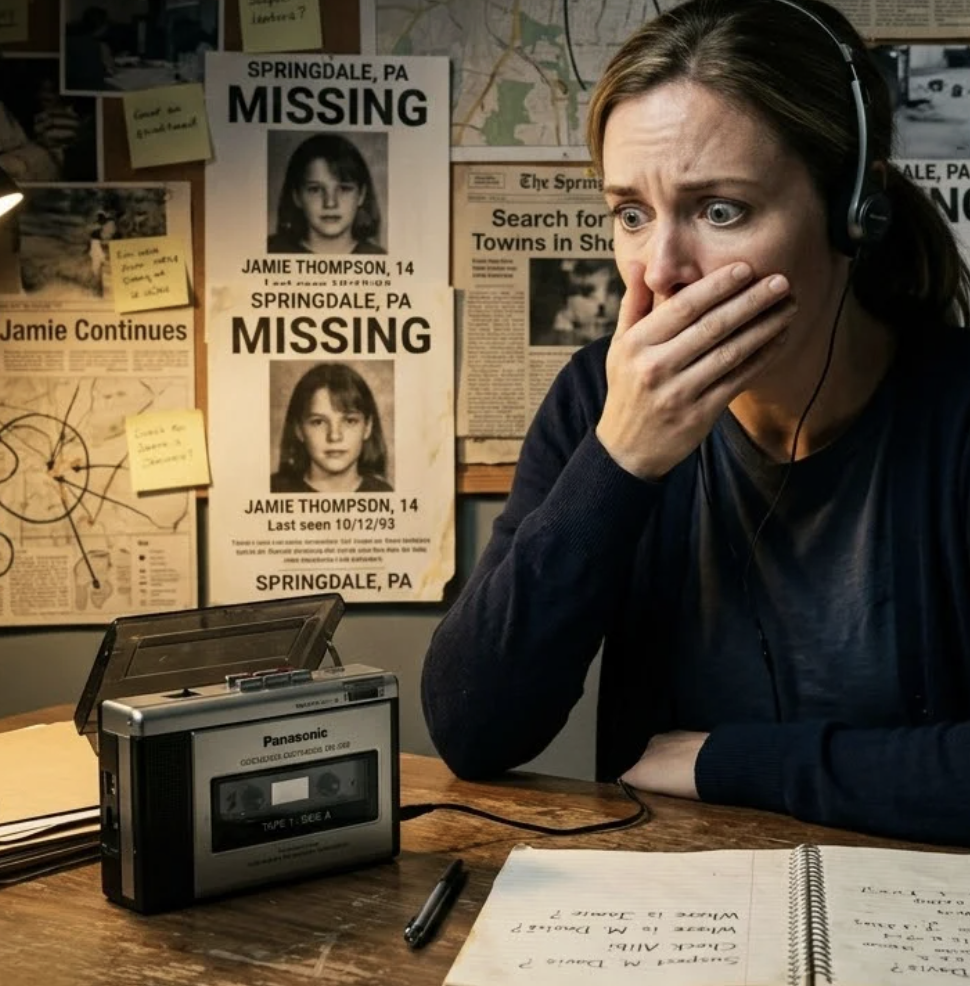
I bought an old cassette player because it reminded me of my childhood.
I didn’t know there was still a tape inside.
And I definitely didn’t expect that tape to reopen a thirty-year-old murder case everyone in town had tried to forget.
The cassette player cost twelve dollars.
That was the only reason I bought it.
Well, that and nostalgia.
The machine sat on a dusty shelf near the back of Miller’s Secondhand Store, buried beneath broken radios and old VCRs nobody wanted anymore.
I almost walked past it.
Then I saw the familiar gray plastic casing and remembered sitting on my bedroom floor as a kid, recording songs off the radio and pretending I was a famous DJ.
For a moment, I was twelve years old again.
So I bought it.
Twelve dollars.
A stupid impulse purchase.
The kind of thing you laugh about later.
At least that’s what I thought.
If I had known what was hidden inside, I probably would have left it exactly where it was.
My name is Ethan Brooks.
I was thirty-eight years old when I bought that cassette player.
I lived in the same small Pennsylvania town where I grew up.
The same town where people remembered everything.
Or pretended to forget certain things.
Especially the story of Melissa Grant.
Even thirty years later, everyone still knew her name.
Melissa disappeared during the summer of 1994.
She was seventeen.
Popular.
Kind.
The type of girl who volunteered at church and remembered everyone’s birthday.
One Friday night she attended a community fair.
Then vanished.
Just disappeared.
For months the entire county searched.
Volunteers combed forests.
Divers searched rivers.
Investigators followed hundreds of leads.
Nothing.
No body.
No suspect.
No answers.
Eventually the search ended.
The case went cold.
People moved on.
At least publicly.
Privately, nobody ever forgot.
My mother used to lock the doors earlier after Melissa disappeared.
Every parent in town did.
Melissa became a warning.
A ghost story rooted in reality.
The girl who never came home.
Thirty years later, her case remained unsolved.
Which is why I nearly dropped the cassette player when I heard her name come through the speakers.
It happened three days after I bought it.
The machine worked surprisingly well.
I cleaned the dust off.
Replaced the batteries.
Pressed eject.
Nothing happened.
The compartment was stuck.
After a few minutes of tinkering, it finally opened.
Inside sat an old cassette tape.
No label.
No markings.
Just a plain black tape.
I assumed it was blank.
Or perhaps contained old music.
Out of curiosity, I inserted it and pressed play.
At first there was only static.
A loud hiss.
Then silence.
Then breathing.
Heavy breathing.
The sound of someone struggling to find courage.
I almost stopped the recording.
Then a man’s voice appeared.
Old.
Shaky.
Nervous.
“I don’t know if anyone will ever hear this.”
A long pause followed.
More breathing.
Then came the sentence that changed everything.
“I should have told the truth about Melissa Grant.”
I froze.
Completely.
For several seconds I thought I had misheard.
Melissa Grant?
The Melissa Grant?
The missing girl?
The voice continued.
“I’ve waited too long already.”
My pulse accelerated.
I sat down immediately.
The tape crackled.
Then the man began speaking again.
He never introduced himself.
Never gave a name.
Only fragments.
Memories.
Regrets.
At first, the recording sounded like a dying man confessing to guilt.
But the deeper I listened, the stranger it became.
According to the recording, he wasn’t the killer.
He was a witness.
Someone who had seen what happened.
Someone who had remained silent for three decades.
The man’s voice trembled repeatedly.
Sometimes he stopped speaking entirely.
As though remembering hurt.
As though carrying the secret had exhausted him.
Then he described the night Melissa disappeared.
Details emerged slowly.
The community fair.
The parking lot.
A confrontation near an abandoned storage building.
A truck.
A scream.
Then silence.
The man claimed he watched everything from a distance.
Too frightened to intervene.
Too frightened to report it later.
At first I didn’t believe him.
People make things up.
Old recordings can be fake.
Stories grow over time.
But then he began describing details never publicly discussed.
Specific clothing.
Specific locations.
Specific injuries.
Things ordinary townspeople shouldn’t know.
Things only investigators—or someone present that night—could have known.
The longer I listened, the colder I felt.
Because the voice sounded genuine.
Not dramatic.
Not attention-seeking.
Broken.
The kind of broken that takes decades to develop.
At one point he started crying.
Actually crying.
The microphone captured every painful breath.
“I watched her die.”
The words barely emerged.
“I watched it happen.”
I remember staring at the cassette player.
Unable to move.
Unable to stop listening.
Unable to understand why this recording existed.
The confession continued for nearly twenty minutes.
By the end, the man revealed something even worse.
The reason he never contacted police.
The reason he remained silent.
The reason Melissa’s family never got answers.
Because according to him, the killer wasn’t an ordinary man.
The killer was powerful.
Respected.
Influential.
Someone capable of destroying lives.
The witness believed nobody would believe him.
And perhaps he was right.
Small towns have a strange relationship with power.
Certain people become untouchable.
Certain families become institutions.
Certain names become impossible to challenge.
The voice repeatedly hinted at this.
Never speaking the killer’s name directly.
Always circling around it.
Always sounding terrified.
Even after thirty years.
That terrified me more than anything else.
Because fear doesn’t survive three decades unless something created it.
The tape eventually neared its end.
The man’s voice grew weaker.
Older.
More exhausted.
Then he said something that made my blood run cold.
“If you’re hearing this, then I’m probably gone.”
Silence followed.
A long silence.
Then came the final confession.
“I should have spoken sooner.”
“I should have saved her.”
“I should have gone to the police.”
Another pause.
Then one final sentence.
A sentence that changed everything.
“Before you trust anyone… look at the man who sold you this machine.”
I sat bolt upright.
My heart nearly stopped.
The man who sold me the machine?
What did that mean?
The recording wasn’t finished.
There were still several seconds remaining.
Then the voice spoke one final time.
And the room suddenly felt ten degrees colder.
“Because he’s the son of the man I’m talking about.”
The tape clicked.
Stopped.
And the silence afterward felt deafening.
I stared at the machine.
Unable to breathe.
Unable to think.
Because only three days earlier, the owner of Miller’s Secondhand Store had personally sold me that cassette player.
His name was Jacob Miller.
A man I’d known casually for years.
A man whose father had died nearly a decade earlier.
A man who had no idea there was a tape hidden inside that machine.
Or maybe he did.
And suddenly, for the first time since hearing Melissa Grant’s name on that recording, I realized something horrifying.
The confession wasn’t the biggest mystery.
The biggest mystery was how that cassette tape ended up inside a player sitting on a shelf in Jacob Miller’s store.
Because if the recording was telling the truth…
Then someone had wanted it found.
I didn’t sleep that night.
The cassette player sat on my kitchen table while I replayed the recording over and over again.
Every time I listened, I noticed something new.
A hesitation.
A background noise.
A name almost spoken but never fully revealed.
Most importantly, I noticed the fear.
The man on the tape wasn’t pretending.
You can’t fake that kind of fear.
Not for thirty years.
Not alone in a room with a recorder.
By sunrise, I had made a decision.
I needed to know where the cassette came from.
And I needed answers from Jacob Miller.
The store opened at nine.
I was waiting outside at 8:45.
When Jacob unlocked the front door, he looked surprised.
“Ethan?”
I held up the cassette player.
His expression immediately changed.
Not guilty.
Confused.
Concerned.
“You sold me this.”
“Yeah.”
“There was a tape inside.”
He frowned.
“A tape?”
I nodded.
“Can we talk?”
A few minutes later, we sat in the back office.
I played the recording.
Jacob listened quietly.
At first he looked curious.
Then uncomfortable.
Then pale.
By the end of the tape, he looked like someone who had just been punched.
For nearly a minute after it finished, neither of us spoke.
Finally he whispered:
“My God.”
“You’ve never heard this before?”
“No.”
His answer came instantly.
Without hesitation.
Without calculation.
I believed him.
Then he said something unexpected.
“That voice sounds familiar.”
My pulse quickened.
“Who?”
Jacob swallowed.
Then looked away.
“My father.”
The room went silent.
His father had died eight years earlier.
Heart failure.
Respected businessman.
Former town council member.
The kind of man who received a large funeral and a glowing obituary.
The kind of man everyone described as generous.
The kind of man nobody ever suspected.
I watched Jacob carefully.
“You think that’s him?”
“I don’t know.”
But he sounded terrified.
Because he already knew.
At least part of him did.
Over the next several days, we worked together.
Not because we trusted each other.
Because neither of us could walk away.
The tape had become too important.
Too disturbing.
Jacob searched through old family belongings.
I contacted a retired investigator who had worked Melissa Grant’s case.
We started comparing timelines.
Then the first crack appeared.
The voice on the tape mentioned an abandoned storage building near the county fairgrounds.
Most people assumed those buildings had been demolished years ago.
One hadn’t.
The structure still stood behind overgrown trees near the edge of town.
Jacob and I drove there together.
The place looked abandoned.
Rotting wood.
Broken windows.
Collapsed roofing.
Nothing unusual.
Until we entered.
Near the back wall, hidden beneath debris, we found something.
A metal box.
Rust-covered.
Locked.
The lock broke easily.
Inside sat several items sealed in plastic.
Old photographs.
Newspaper clippings.
And a journal.
The handwriting matched samples from Jacob’s father.
There was no doubt.
The journal belonged to him.
Jacob’s hands shook as he opened it.
The first few pages discussed ordinary life.
Business meetings.
Town events.
Family matters.
Then everything changed.
One entry dated August 1994 began with six words:
“I saw what happened tonight.”
My stomach dropped.
The journal described the same events heard on the cassette.
Melissa leaving the fair.
A confrontation.
A powerful local man.
A struggle.
A murder.
And then fear.
Page after page of fear.
The more we read, the worse it became.
Jacob’s father hadn’t committed the crime.
But he witnessed enough to identify the killer.
Yet he stayed silent.
Not because he approved.
Because he was terrified.
The journal repeatedly mentioned threats.
Warnings.
Pressure.
People following him.
Anonymous phone calls.
Then one name appeared.
The first actual name.
Not the killer.
Someone protecting him.
Sheriff Leonard Price.
The sheriff who led the original investigation.
I recognized the name immediately.
Everyone did.
Price had been considered a local legend.
He served for nearly three decades.
His photograph still hung inside town hall.
The journal painted a very different picture.
According to Jacob’s father, Price intentionally buried evidence.
Discarded witness statements.
Redirected investigators.
Protected the real killer.
But why?
The answer came twenty pages later.
Money.
Again.
Always money.
The killer happened to be one of the wealthiest developers in the county.
A man whose projects generated millions.
A man connected to politicians.
Business leaders.
Law enforcement.
A man named Charles Whitmore.
Even thirty years later, the name carried weight.
Whitmore had died five years earlier.
Honored.
Respected.
Praised.
The journal described a different man entirely.
A violent man.
A dangerous man.
A man who believed influence could solve every problem.
And for thirty years, it had.
The evidence kept growing.
Photographs placed Whitmore near the fairgrounds that night.
Financial records connected him to Sheriff Price.
Witness statements disappeared after entering official files.
The deeper we dug, the uglier the truth became.
Then we found the final journal entry.
Written only weeks before Jacob’s father died.
The handwriting looked weaker.
More fragile.
The entry ended with a sentence that made Jacob cry.
“I don’t deserve forgiveness, but maybe the truth deserves freedom.”
That sentence changed everything.
Because suddenly we understood why the tape existed.
Jacob’s father spent thirty years carrying guilt.
Thirty years watching Melissa’s family suffer.
Thirty years knowing the truth.
The cassette wasn’t just a confession.
It was an act of redemption.
A final attempt to do what he should have done decades earlier.
The discovery triggered a new investigation.
State authorities became involved.
The old case reopened.
Reporters flooded the town.
Former officials faced questioning.
Forensic teams reviewed evidence long forgotten.
The story exploded across national media.
People wanted villains.
Heroes.
Simple answers.
Reality was messier.
Melissa Grant had been failed by many people.
Not just one killer.
Not just one corrupt sheriff.
An entire chain of silence.
A chain stretching across decades.
Some people protected careers.
Some protected reputations.
Some protected power.
And one frightened witness protected himself.
The result was the same.
A seventeen-year-old girl never received justice.
At least not while she was alive.
Six months later, the official findings were released.
Investigators concluded that Charles Whitmore was the most likely killer.
The evidence was overwhelming.
Though both Whitmore and Price were dead, the state formally acknowledged the cover-up.
Melissa’s case was finally reclassified.
Not as a disappearance.
Not as a mystery.
As a solved homicide.
Thirty years late.
But solved.
The day the announcement became public, hundreds of people gathered outside the courthouse.
Among them stood Melissa’s younger sister.
She had been twelve when Melissa vanished.
Now she was in her forties.
When reporters asked how she felt, her answer stayed with me forever.
“We didn’t need revenge.”
She paused.
“We needed the truth.”
That was the moment I understood something.
The cassette wasn’t really about exposing a killer.
It was about ending a lie.
Because lies grow larger with time.
They become history.
Then memory.
Then accepted fact.
Until someone is brave enough to break them.
A month later, Jacob and I returned to the abandoned building one final time.
The place was scheduled for demolition.
The journal had been archived.
The evidence secured.
The mystery finished.
As we stood there, Jacob stared at the empty room.
“My father should have spoken.”
I nodded.
“Yeah.”
“He could’ve stopped all this.”
“Maybe.”
Jacob looked down.
The guilt on his face reminded me of the guilt I heard in the recording.
A burden passed from father to son.
Then I told him something I believed.
“Your father failed.”
He nodded silently.
“But he eventually told the truth.”
Jacob didn’t answer immediately.
Finally he asked:
“Do you think that matters?”
I thought about Melissa.
About thirty lost years.
About grief.
About silence.
About fear.
Then I looked at the old cassette player sitting in the back seat of my car.
The twelve-dollar purchase that changed everything.
And I answered honestly.
“Not enough.”
I paused.
“But it matters.”
Because the truth is strange.
Sometimes it arrives immediately.
Sometimes it takes decades.
Sometimes it hides inside evidence lockers.
Sometimes it sleeps in forgotten journals.
And sometimes…
It waits inside an old cassette tape gathering dust on a secondhand store shelf.
Waiting for someone to press play.


