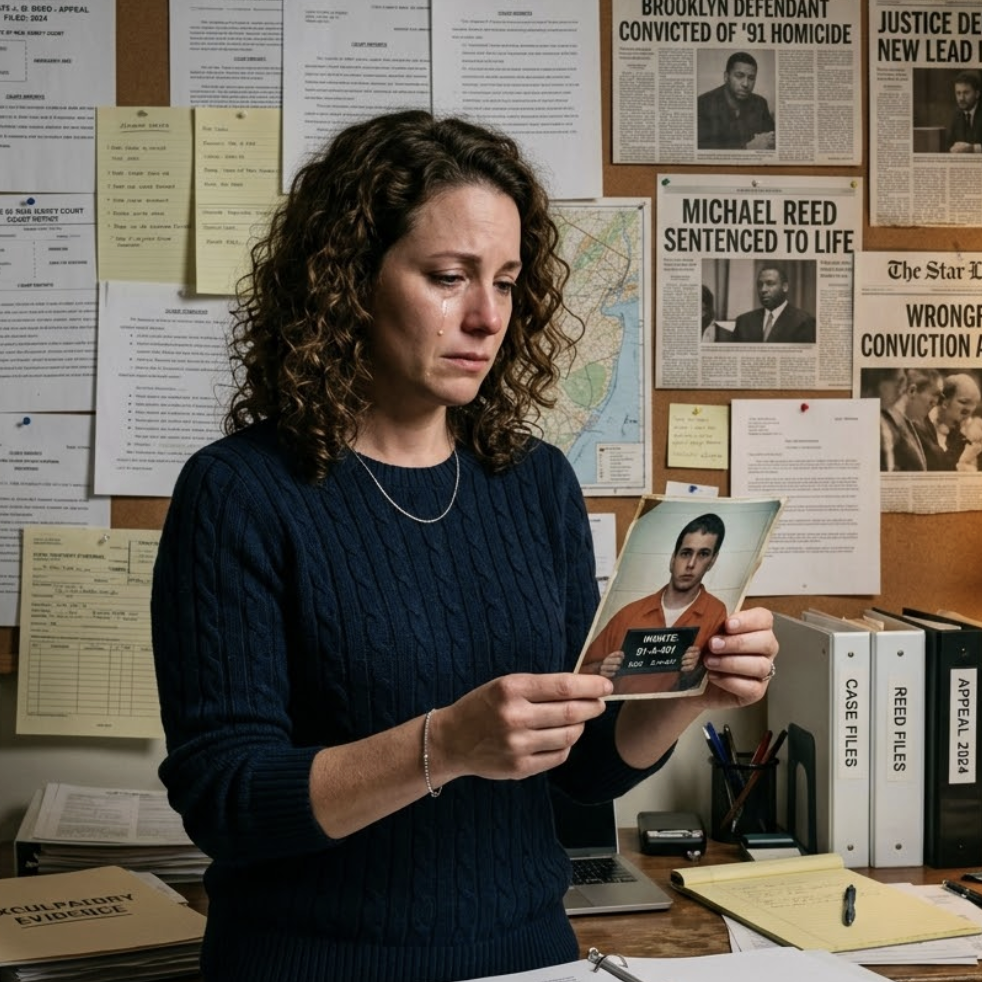
The whole town called my brother a monster.
They said he murdered a young woman, ran from the scene, and lied until the very end.
Eighteen years after his execution, a dying man confessed the truth.
And the person who helped bury my brother alive in that lie was the sheriff everyone trusted.
My brother’s name was Samuel Reed.
To most people in Millstone, Georgia, he became a warning.
Parents lowered their voices when they spoke about him.
Teachers stopped saying our last name during roll call unless they had to.
Neighbors who once ate at our kitchen table crossed the street when they saw my mother coming.
By the time I was twelve, I understood something no child should have to understand.
A family can be punished for a crime even after the person accused is locked away.
Samuel was eight years older than me.
To the town, he became a killer.
To me, he was the boy who taught me to ride a bike, burned grilled cheese because he always used too much butter, and let me sleep on his floor during thunderstorms because I was afraid of the dark.
Those memories became painful after the trial.
People did not want me to remember him as kind.
They wanted me to remember him as guilty.
The night everything changed began with a girl named Laura Bennett.
She was twenty-one, beautiful in the gentle way small towns remember dead girls, and working part-time at her aunt’s bakery while studying nursing at the community college. Everyone liked Laura. Even people who barely knew her spoke about her as if she belonged to them.
On a Friday night in October, Laura was found dead near the old grain mill.
Samuel was arrested before sunrise.
The evidence came too quickly.
That was what people later ignored.
A witness claimed he saw Samuel arguing with Laura outside the bakery. Blood was found on Samuel’s jacket. Sheriff Dale Whitcomb told reporters Samuel had tried to flee through the woods when officers arrived at our house. By Monday morning, before my brother had even met properly with a defense attorney, the town had already decided.
Guilty.
My mother kept saying there had to be a mistake.
My father said less and less until silence became his only language.
I remember the first time I saw Samuel after the arrest. He sat behind glass in the county jail wearing an orange jumpsuit too large for his body. His face was bruised. His eyes looked older than eighteen years should have been able to make them.
“Tell Mom I didn’t do this,” he said.
“She knows.”
“Tell her again.”
I nodded even though I was crying too hard to speak.
The trial lasted six days.
Six days to destroy a life.
The prosecution painted Samuel as jealous, angry, rejected. They said he had wanted Laura and killed her when she refused him. They showed the blood on his jacket. They brought in the witness from the bakery. They let Sheriff Whitcomb sit on the stand in his pressed uniform and tell the jury that Samuel ran when deputies came to question him.
“He knew what he had done,” the sheriff said.
I remember the way people in the courtroom nodded.
They trusted him.
Everyone trusted Sheriff Whitcomb.
He had coached Little League, led the Fourth of July parade, and delivered Christmas baskets to elderly widows. His son, Travis, was a few years older than Samuel and had been one of those boys adults described as “troubled but good-hearted.” He had drinking problems, fights at bars, and a habit of getting saved from consequences by his father’s badge.
But nobody talked about Travis during the trial.
Not publicly.
Not loudly.
Samuel’s court-appointed attorney tried to raise doubts. He pointed out that the blood evidence had been handled by the sheriff’s department before going to the state lab. He questioned why the witness waited nearly six hours before coming forward. He asked why Laura’s missing bracelet, mentioned by her aunt, had never been found.
The jury didn’t care.
The town didn’t care.
They wanted a killer.
The sheriff gave them one.
When the verdict came back, my mother screamed.
Not a loud dramatic scream like in movies.
A broken animal sound.
My father sat still, his hands folded, staring at nothing.
Samuel turned around and found me in the courtroom.
He mouthed one sentence.
I didn’t do it.
He received the death penalty.
In the years that followed, appeals came and failed. Lawyers changed. Dates were postponed. Hope appeared briefly, then vanished. My mother wrote letters to innocence groups, reporters, ministers, judges, anyone whose address she could find. Most never answered. A few answered politely and did nothing.
The town moved on.
We did not.
Our grocery store account was closed because the owner said customers complained.
My father lost contracts.
I was shoved into lockers at school.
Someone spray-painted KILLER BLOOD on our garage door.
My mother scrubbed it until her hands bled.
She died nine years after Samuel’s conviction.
Heart failure, the doctor said.
But I knew better.
Grief killed her slowly, one appeal denial at a time.
My father never spoke Samuel’s name again after she died.
Not because he believed Samuel was guilty.
Because saying his name reopened a wound he had no strength left to survive.
I was twenty-six when the execution date became final.
The prison allowed me one last visit.
Samuel was thirty-four by then, older than my memories but somehow still my brother. He smiled when I entered, and that smile almost broke me because it was the same one he used to give me when he found me hiding during storms.
“You look like Mom,” he said.
“Don’t.”
He nodded.
We sat across from each other with a table between us and guards near the wall.
“I’m sorry I couldn’t save you,” I said.
His face changed.
“Ellie, listen to me.”
My full name is Eleanor, but he was the only person who called me Ellie.
“One day, you’re going to know I didn’t do this.”
“I know now.”
“No,” he said softly. “You believe me now. One day, you’ll know.”
He told me not to let hatred eat me alive. He told me to live. He told me to leave Millstone if I could. Then, just before the guards took him away, he said something strange.
“Find the bracelet.”
“What bracelet?”
“Laura’s bracelet. It matters.”
Before I could ask more, the visit ended.
Samuel was executed three days later.
I did not watch.
I sat in my car outside the prison until sunrise, gripping the steering wheel while the radio played old gospel songs because I could not bear silence.
After that, I left Millstone.
I moved to Atlanta.
Changed jobs.
Changed apartments.
Tried to become someone other than the sister of an executed man.
But no matter how far I moved, Samuel followed me.
In background checks.
In awkward conversations.
In my dreams.
In the way people’s faces changed when they recognized my last name.
Eighteen years passed.
Then a lawyer called me on a Tuesday afternoon.
His name was Andrew Mills, and he represented a dying man named Russell Pike.
I had never heard of him.
“He says he needs to speak with you regarding your brother,” the lawyer said.
My first instinct was to hang up.
People had used Samuel’s name before.
Reporters.
True-crime bloggers.
Cruel strangers.
But then the lawyer said, “He claims Samuel Reed was innocent.”
I drove back to Millstone for the first time in eleven years.
Russell Pike was in hospice, yellow-skinned and hollow-eyed, dying of liver cancer in a narrow bed that made him look already halfway gone. His lawyer sat beside him. A nurse adjusted his oxygen and left the room.
Russell looked at me and began crying.
“I’m sorry,” he whispered.
I said nothing.
He swallowed hard.
“I killed Laura Bennett.”
The room seemed to tilt.
He described the night in pieces.
He had been drinking with Travis Whitcomb, the sheriff’s son. Laura had seen something she was not supposed to see near the grain mill. Not drugs, not an affair, not some small-town scandal. She had seen Travis and Russell unloading stolen medical supplies from a county storage truck, part of a theft operation the sheriff’s department had been quietly covering.
Laura threatened to report them.
Travis panicked.
Russell said the confrontation turned violent.
Laura tried to run.
Travis struck her first.
Russell helped.
By morning, Sheriff Whitcomb knew.
And instead of turning in his son, he built a case against Samuel.
Russell described details never released publicly.
The broken clasp on Laura’s bracelet.
The small blue button torn from Travis’s shirt.
The fact that Laura had scratched someone’s left hand badly enough to draw blood.
Samuel had no scratches.
Travis did.
Russell’s voice weakened.
“The sheriff took the bracelet.”
I leaned forward.
“What?”
“He took it off her before the coroner came. Said it had Travis’s skin under the clasp. Said nobody would miss one piece of jewelry.”
My brother’s last words came back.
Find the bracelet.
Russell closed his eyes.
“He kept it.”
“Where?”
The dying man began to shake.
“In the hunting cabin. Behind the stove. Metal tin.”
His lawyer opened a folder.
Russell had already signed a sworn confession.
But a confession from a dying man was not enough to bring back my brother.
I needed proof.
And for the first time in eighteen years, proof had a location.
PART 2
Sheriff Dale Whitcomb had been dead for four years when Russell Pike confessed.
That should have made the truth easier to face.
It did not.
A dead man cannot be cross-examined.
A dead sheriff cannot explain why he chose his son over justice.
A dead official leaves behind paperwork, reputation, old friends, and people who would rather protect a memory than admit they worshiped a lie.
Russell Pike’s lawyer immediately contacted the state attorney general’s office. I expected urgency. Apologies. Action.
What I got was caution.
A dying man’s confession had to be verified. Evidence had to be located. Chain of custody had to be established. Old case files had to be reviewed. Officials spoke in careful sentences that made me want to scream.
My brother had been executed.
Careful felt obscene.
Still, two investigators agreed to search the Whitcomb hunting cabin.
It stood eight miles outside town, deep in pine woods near a creek where local boys used to hunt deer. Travis Whitcomb inherited it after his father died, but according to property records, he had not paid taxes in two years. He had drifted through life the way men like him often do after being protected too long—DUIs, failed jobs, bar fights, quick apologies, and second chances handed out by people who remembered his father fondly.
The cabin smelled of dust, old smoke, and mildew.
Behind the woodstove was a loose brick.
Behind the brick was a rusted metal tin.
Inside was a bracelet.
Silver.
Small.
Delicate.
With a broken clasp.
Laura Bennett’s name was engraved on the back.
L.B.
The investigator photographed it in place before touching it. I stood outside on the porch because they would not let me inside during collection. Through the open door, I heard one of them say, “My God.”
That was the first time anyone in authority sounded human.
The tin contained more than the bracelet.
A blue shirt button.
Several Polaroid photographs of the original crime scene.
And a folded note in Sheriff Whitcomb’s handwriting.
Do not destroy unless necessary.
Necessary.
That word nearly made me collapse.
My brother had died because the sheriff considered truth optional until necessary.
Forensic testing took months.
The bracelet was old and degraded, but modern DNA methods recovered enough material from the clasp to compare against known profiles. Laura’s DNA was present. So was male DNA. Not Samuel’s.
Travis Whitcomb’s.
The blue button matched a shirt visible in an old photograph of Travis taken two days before Laura’s death. In that photo, his left sleeve cuff had a missing button.
The old case file showed no mention of the bracelet.
No mention of a blue button.
No mention of scratches on Travis.
But buried in archived medical records, investigators found a clinic visit for Travis the morning after Laura died. Reason listed: “lacerations to left hand from fence wire.”
Fence wire.
That lie had waited eighteen years to be read properly.
Then came the review of Samuel’s evidence.
The blood on his jacket had indeed belonged to Laura, but new analysis suggested transfer contamination. His jacket had been stored in the same evidence room as Laura’s clothing before testing, under improper conditions. The witness who claimed Samuel argued with Laura had died years earlier, but handwritten notes from the sheriff’s file showed his original statement had been different.
He first reported seeing Laura arguing with “a tall blond man.”
Samuel had dark hair.
Travis was blond.
The statement was later changed.
Initialed by Sheriff Whitcomb.
Every page became another betrayal.
Every correction.
Every omission.
Every missing item.
Every convenient fact.
The town that had demanded certainty now faced the ugliness of how certainty was manufactured.
The attorney general announced a formal posthumous review of Samuel’s conviction. Reporters returned to Millstone. The same courthouse steps where my mother once begged people to listen now hosted cameras and microphones.
People began calling me.
Former neighbors.
Classmates.
Church members.
Some apologized.
Some cried.
Some said they always had doubts.
That angered me most.
Doubts do not comfort the dead.
If you always had doubts, where were you when my mother was scrubbing paint from our garage? Where were you when my father stopped speaking? Where were you when Samuel sat in a cell waiting to die?
Travis Whitcomb was arrested six months after Russell’s confession.
Not for Laura’s murder at first.
For evidence concealment, conspiracy, and obstruction connected to the reopened case. Prosecutors moved carefully because so many years had passed and Russell, the confessing co-perpetrator, died two weeks after giving his statement. But the bracelet changed everything.
Travis looked older than I expected when he entered court.
Gray hair.
Soft body.
Eyes that kept avoiding cameras.
He had lived eighteen years my brother did not get.
Eighteen years of meals, birthdays, mornings, arguments, bad TV, second chances.
Samuel got a last meal and a needle.
I sat behind the prosecutor during the hearing.
Travis’s attorney argued that his father might have planted evidence without Travis’s knowledge. He suggested Russell Pike, desperate for spiritual peace, had invented parts of his confession. He said DNA on a bracelet did not prove murder.
Then the prosecutor played a recording.
Russell’s hospice confession.
His voice filled the courtroom, weak but clear.
“Travis hit her first.”
Travis stared at the table.
His face did not change.
That made me hate him more.
Then the prosecutor introduced the clinic record.
The changed witness statement.
The hidden Polaroids.
The sheriff’s note.
Do not destroy unless necessary.
By the end of the hearing, no one in that courtroom still believed my brother had received anything close to justice.
The state formally vacated Samuel’s conviction eight months later.
Posthumously.
That word is one of the cruelest words in the English language.
It means the truth arrived after the person who needed it most was no longer alive to hear it.
The judge read the order aloud in a packed courtroom.
Samuel Thomas Reed is hereby exonerated of the conviction entered against him.
My brother’s name sounded different without guilt attached to it.
Lighter.
But he was still dead.
My father attended the hearing in a wheelchair.
He had not been back to that courthouse since Samuel’s sentencing. For years, he refused to speak my brother’s name, but when the judge said Samuel was innocent, my father made a sound I had never heard from him before.
Not crying.
Not relief.
Something older than both.
Afterward, he asked me to drive him to the cemetery.
Samuel’s grave sat beside our mother’s.
For eighteen years, the stone had been vandalized repeatedly. Killer. Monster. Burn in hell. I had cleaned it whenever I visited, but some scratches never fully came out.
My father placed one hand on the headstone.
“I’m sorry, son,” he whispered.
Those were the first words I had heard him speak to Samuel in nearly two decades.
I walked away to give him privacy.
From a distance, I watched an old man apologize to a grave for surviving the lie that killed his child.
Travis eventually accepted a plea deal.
Manslaughter.
Conspiracy.
Evidence concealment.
He admitted he caused Laura’s death during a confrontation and that his father helped redirect the investigation toward Samuel. He claimed he had been drunk, terrified, and under his father’s control.
I did not care.
Maybe that sounds harsh.
But at some point, explanations become another kind of theft.
He had taken Laura’s life.
His father had taken Samuel’s.
And the town had taken the rest of us.
At sentencing, Laura Bennett’s sister spoke first.
She turned toward me before reading her statement.
“For eighteen years, our family thought your brother killed Laura. We hated him. We hated all of you. That hatred was built on a lie, and I am sorry.”
I did not know what to do with that apology.
Part of me needed it.
Part of me resented needing it.
When it was my turn, I unfolded a piece of paper I had written and rewritten for weeks.
“My brother’s last words to me were that one day I would know he didn’t do it. He died knowing the truth but not being believed. That is a loneliness I hope none of you ever understand. You did not only frame an innocent man. You made a town comfortable with cruelty. You taught people that once someone is called a monster, they no longer have to be treated as human.”
My voice shook, but I kept going.
“Samuel Reed was my brother. He was not perfect. He was not powerful. He was not protected. But he was innocent. And innocence should not have to wait eighteen years to be useful.”
Travis cried during sentencing.
I felt nothing.
That frightened me at first.
Then I realized numbness is sometimes the body’s way of refusing to give another piece of itself away.
The state paid compensation to our family later.
A settlement.
A formal apology.
A press conference.
A plaque.
Money came with paperwork full of language like wrongful conviction, prosecutorial review, and systemic failure.
Systemic failure.
Another phrase too clean for what happened.
My mother died believing most of the world thought her son was a killer.
My father lost his voice inside shame.
I lost my childhood to other people’s certainty.
Samuel lost everything.
No check could balance that.
Still, I used part of the money to replace his headstone.
The new one reads:
Samuel Thomas Reed
Beloved Son. Beloved Brother.
Innocent.
That last word matters.
Not because Samuel needed it.
Because the living do.
The old sheriff’s portrait was removed from the courthouse lobby after months of debate. Some residents argued he had done decades of good work and should be remembered “in full context.” I attended the town meeting where they said that.
When it was my turn to speak, I brought the photograph of Samuel from his high school graduation.
“He didn’t get to be remembered in full context,” I said. “He was reduced to the worst lie ever told about him. If the sheriff gets context, so does my brother.”
The portrait came down.
Not unanimously.
But it came down.
People ask whether I forgive the town.
I don’t know.
A town is not one person.
Some people were cruel.
Some were afraid.
Some were lazy.
Some trusted authority because trusting felt easier than questioning.
Some apologized.
Some still avoid my eyes.
Forgiveness, I’ve learned, is not one decision. It is a weather system. It changes.
There are days I can walk through Millstone and feel almost peaceful.
There are days I see the courthouse and want to burn the whole memory of it to the ground.
I do not apologize for either feeling.
Laura Bennett’s family and mine eventually met privately.
Not for cameras.
Not for closure.
For truth.
Her sister brought photographs of Laura. I brought photographs of Samuel. We sat in a church basement and cried over two people who should have grown older.
Laura had wanted to become a nurse.
Samuel had wanted to open a small engine repair shop.
Both futures were stolen by one night and protected by one badge.
That meeting did not heal everything.
But it shifted something.
For years, our families had been placed on opposite sides of a lie.
In truth, we had both been robbed.
Today, I keep Samuel’s final letter in a box beside my bed.
The prison gave it to me after the execution, but I could not read it for years.
When I finally opened it after the exoneration, I found no bitterness.
That almost hurt more.
Ellie,
If you are reading this, then I am gone.
I need you to live more than you grieve.
Do not spend your whole life trying to prove I mattered.
I already mattered.
I mattered because Mom loved me.
Because Dad taught me to fish.
Because you cried when I left for basic training even though I only went two states away.
I mattered before they called me guilty.
Remember me from before.
That is the line I return to most.
Remember me from before.
Before the trial.
Before the headlines.
Before the prison glass.
Before a sheriff decided his son’s future was worth more than my brother’s life.
So that is what I try to do.
I remember Samuel burning grilled cheese.
Samuel singing off-key.
Samuel carrying me through puddles.
Samuel promising that thunder could not get inside the house.
Samuel turning around in court to mouth, I didn’t do it.
Samuel telling me that one day I would know.
Now I know.
But knowing did not bring him back.
It only gave me the terrible gift of being able to say his name without letting the lie answer first.
Do you think a town that helped condemn an innocent man through silence and judgment can ever truly make amends, or are some wrongs too deep for apologies to reach?


