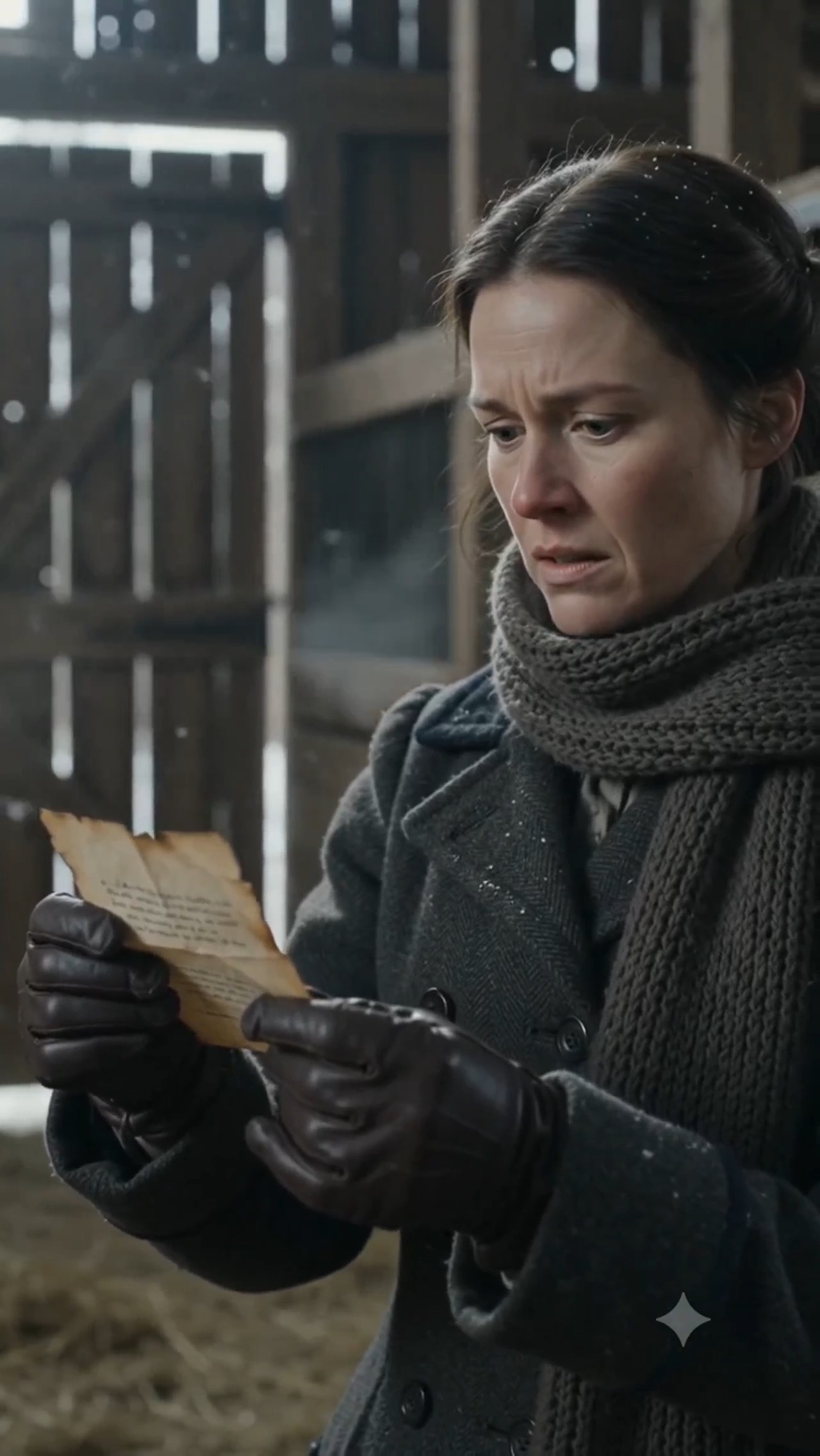
I Took a Caretaking Job in Calder Flats to Save a Bedridden Patient — Until I Found Her Real Medical File and What Our Neighbor Did to Her


Part 1
I drove out to a quiet, isolated homestead owned by a taciturn man named Jonah, where I walked straight into a makeshift medical bay and found his twenty-four-year-old sister, Rue, suffering from severe, unexplained wasting illness while six months pregnant.
I told Jonah to his face that her organs were failing and she had exactly six weeks left before her March delivery date unless someone intervened immediately.
My direct medical assessment got me hired on the spot, but as soon as I took the job, I realized our wealthy neighbor had spent months isolating them—and the nurse who had been here before me had vanished without a trace in October.
The wind bit at my face as I stepped out of my old sedan, whipping snow off the eaves of the Kincaid farmhouse. January in Calder Flats was brutal, the kind of cold that seemed to sink into your bones and stay there.
The house itself looked stoic, weathered gray wood standing firm against the elements, but a thin curl of smoke from the chimney was the only sign of life.
I pulled my worn duffel bag from the back seat, the single suitcase holding my entire life.
Every muscle in my body ached. Fourteen years of ICU shifts and hospice care had taken their toll, leaving me hollowed out, but the compulsion to help still clawed at me. This time, I promised myself, it would be different. This time, it would be a clear cut case.
Jonah Kincaid met me at the door. He was a tall man, broad-shouldered, with eyes that held the wary, watchful gaze of a wild animal. His face was etched with a quiet desperation that mirrored the lines around my own eyes. He didn’t offer a handshake, just a curt nod.
“You’re Clara,” he stated, his voice a low rumble.
“I am,” I confirmed, stepping inside.
The warmth of the house was a welcome shock after the biting wind. It smelled of woodsmoke, old linens, and something vaguely medicinal. He led me through a sparse living room, past a crackling fireplace, into what he’d called the “medical bay.”
It was a small, converted back bedroom. A hospital bed, surprisingly clean, dominated the space. An IV pole stood sentinel beside it, its clear bag empty. A few sterile instruments lay neatly on a small, wheeled cart. This wasn’t professional, but it wasn’t sloppy either.
And there she was. Rue.
She lay curled on her side, a pale ghost against the white sheets. Her twenty-four years felt like a cruel joke; she looked closer to fifty. Her skin was stretched taut over bone, her cheeks hollowed, her lips cracked and dry. Her dark hair was thin, almost translucent in places.
But beneath the gauntness, the undeniable swell of her belly was visible, a stark, painful contrast to the rest of her wasted form. Six months pregnant.
I knelt beside the bed, my clinical instincts kicking in, pushing aside the weariness. I placed a hand gently on her forehead. It was cool, almost clammy. Her pulse was thready, barely perceptible beneath my fingertips.
“Rue,” I murmured, my voice soft. “Can you hear me?”
Her eyelids fluttered, then slowly, agonizingly, opened. Her eyes, a deep, unsettling blue, focused on me with a flicker of confusion, then resignation. She tried to speak, but only a dry cough escaped her lips.
Jonah watched from the doorway, his posture rigid.
I moved with practiced efficiency, checking her vitals, listening to her chest, palpating her abdomen. Her lungs sounded clear, but her heart was struggling, a weak, uneven beat. Her reflexes were sluggish. Every system in her body seemed to be running on fumes.
This wasn’t just malnutrition, not just a difficult pregnancy. This was a catastrophic cellular breakdown.
I checked the chart lying on the bedside table. It was sparse, handwritten, mostly consisting of temperature logs and notes on what little she could eat. No extensive medical history, no lab results beyond a basic blood count from months ago.
I stood, turning to face Jonah. My voice was calm, steady, devoid of emotion. This was the hardest part of my job, delivering the blunt truth.
“Her organs are failing,” I stated, the words hanging heavy in the air.
Jonah flinched as if struck. His eyes, though, remained dry.
“She’s in severe metabolic wasting. Her body is consuming itself. The pregnancy is accelerating it, putting an unbearable strain on her already compromised system.”
I paused, allowing the grim reality to sink in.
“She has six weeks, Jonah. Six weeks until her delivery date in March, maybe less. If we don’t intervene immediately, neither she nor the baby will survive.”
The silence that followed was thick, suffocating. The only sound was the distant whine of the wind outside. Jonah’s jaw worked, a muscle ticking violently in his cheek. He looked from me to Rue, then back again.
“What do you need?” he finally rasped.
“Resources,” I said. “Medications. Proper nutrition. Labs. A full medical history. And cooperation.”
He nodded, slowly, deliberately. “You’re hired.”
It was as simple as that. The relief that washed over me was immediate, but fleeting. The real work was just beginning.
I spent the rest of the afternoon meticulously examining everything in the makeshift bay. Jonah brought me a small, chipped ceramic mug of lukewarm coffee, then left me to it. He was a silent presence, but I felt his watchful gaze whenever I moved towards the door.
I started with Rue’s current medications, lining up the small bottles on the cart. A prenatal vitamin, an iron supplement, and a clear, unlabeled liquid in a dropper bottle that Jonah referred to as her “daily tonic.”
“What’s in this?” I asked, holding up the dropper.
Jonah shrugged, looking uncomfortable. “Just a vitamin mix. From the last nurse, Evelyn.”
“Did you ever see the label?”
“No. She said it was easier to just mix it in.”
I made a mental note. Unlabeled substances were always a red flag. But the bigger puzzle was Rue herself.
Her wasting was profound, undeniably severe, but there was a subtle, almost imperceptible tremor in her hands. It wasn’t the coarse tremor of profound weakness, but a fine, almost internal vibration, a neurological signature that felt… off.
I checked her skin again, running my fingers lightly over her forearm. Her pallor wasn’t just anemic; it had a strange, almost translucent quality, a faint, waxy sheen that seemed unnatural. It wasn’t typical of the genetic wasting diseases I’d seen in my career. Those usually came with distinct familial patterns, a specific set of markers. Rue had none of those.
I looked at the notes from the previous nurse, Evelyn Ward, who had vanished in October. They were brief, almost cursory, with no detailed diagnostic information. Only a notation that Rue was suffering from a “congenital metabolic defect.”
But that tremor. That waxy pallor. The unusual rapidity of her decline. They gnawed at me. My gut, honed by years of seeing every form of human suffering, screamed that something was wrong. This wasn’t just a defect. It was too specific, too… manufactured.
I uncapped the “daily tonic” bottle, tilting it towards the weak light from the single window. The liquid inside was crystal clear, completely odorless. Jonah said it was just a vitamin mix. But as I swirled it gently, I noticed a subtle, almost imperceptible viscosity, a thickness that felt out of place for a simple supplement.
My mind flashed back to a case from years ago, a child accidentally poisoned by an industrial chemical. The symptoms were subtle at first, almost indistinguishable from a severe illness, but the body’s metabolic pathways had slowly, silently shut down.
I pressed my lips together, a cold dread seeping into me that had nothing to do with the Calder Flats winter. Rue’s deterioration wasn’t following the textbook pattern of a natural genetic illness. It was following a pattern I recognized from another, much darker chapter of my medical career.
Someone, I realized with a jolt, had been intentionally doing this to her.
Part 2
My heart hammered in my chest. This wasn’t a natural illness. Someone was poisoning her.
A knock echoed through the house, rattling the single windowpane in Rue’s room. Jonah, who had been watching from the doorway, went to answer it.
“Silas Montgomery,” Jonah’s voice carried, laced with a forced politeness.
A moment later, a man in an expensive wool coat, radiating an artificial warmth, stepped into the medical bay. He had a practiced, benevolent smile.
“Just checking on Rue, Jonah,” Silas boomed, his gaze sweeping over me. “And welcoming our new addition.”
Jonah excused himself, muttering about coffee.
Silas leaned closer, his smile not reaching his eyes. “Calder Flats is a small town, Nurse. We don’t take kindly to outsiders meddling in local family affairs. Folks who stir up trouble here… they don’t last past spring.”
More Stories









+ There are no comments
Add yours