
Only mothers of sons are entitled to hold the family porcelain, my mother-in-law Clara announced, her spoon clicking sharply against her teacup.


Part 1
Before my two daughters could even finish their soup, she packed all twenty-four pieces of our hand-painted Haviland dinnerware into wooden crates.
She carried them straight out to her guest cottage, declaring that my daughters had no right to ancestral heirlooms.
She completely forgot that the historic four-acre property, the house, and every stick of furniture inside it legally belong to me.
I decided not to raise my voice that evening, choosing instead to let time reveal what she was truly running from.
The cold January air swirled into our warm Elm Street farmhouse kitchen as Clara Higgins stepped out the back door. Her footsteps crunched on the icy gravel path leading to her guest cottage.
The heavy thud of the door closing behind her left an unnatural silence in the dining room.
Sarah, my older daughter, stared at the empty space on the sideboard where the Haviland platter had rested just moments before. Her face was pale, her engagement glow dimmed.
Chloe, always more reserved, simply lowered her gaze to her half-eaten soup. The cream of mushroom had gone cold, untouched.
My son, Mark, cleared his throat. He looked uncomfortable, caught between the two generations, clearly wishing he was back in Boston.
“Mom,” Sarah began, her voice tight with suppressed anger. “How can she just… do that?”
I reached across the table and gently squeezed her hand. It was trembling slightly.
“It’s alright, sweetheart,” I murmured.
But I knew it wasn’t alright. Not for Sarah, who had meticulously planned her engagement dinner down to every detail, including the heirloom china. Not for Chloe, whose gentle nature recoiled from confrontation.
And certainly not for me, Eleanor Higgins, the woman who had lived in this house for forty years.
Mark pushed his chair back. The legs grated loudly on the wide plank floor, a jarring sound in the sudden quiet.
“I don’t understand,” he said, looking from Sarah to me. “Why is she doing this? It’s just… plates.”
He wasn’t entirely wrong. They were just plates. But they were also history, tradition, and a symbol of belonging that Clara had chosen to use as a weapon.
Sarah’s eyes flashed.
“They’re not ‘just plates,’ Mark! They’re part of *our* family. Great-grandmother Higgins brought them over from France.”
“From my side of the family, to be precise,” I corrected gently, though Clara’s version of history often overshadowed the truth.
I tried to keep my voice even, but a tremor of exhaustion ran through me. This was an old battle, just a new skirmish.
Clara had always been fiercely proud of the Higgins name, and of her own ancestors, who had settled Oakhaven, Vermont, generations ago. She often spoke of “bloodlines” and “entitlement.”
Especially when it came to her only son, Mark.
For years, I had quietly endured her pronouncements. Her rigid beliefs about male inheritance had always been an undercurrent, but never before had she acted so boldly.
She had stripped the table bare. Not a single hand-painted Haviland cup, saucer, or dinner plate remained.
The linen tablecloth, now showing the faint ring where a teacup had sat, seemed to emphasize the emptiness.
“I’ll go talk to her,” Mark offered, moving towards the back door. “This is ridiculous.”
He genuinely seemed to think a quick conversation would resolve it. He hadn’t lived under Clara’s shadow long enough to understand her deep-seated anxieties.
He hadn’t been here for the subtle slights, the whispered comments about “proper lineage” at every family gathering.
“No, Mark,” I said, my voice firmer this time. “Let her go.”
He stopped, his hand on the doorknob. He looked back at me, puzzled.
“But Mom, she just took all the china. What if she breaks it?”
Sarah let out a frustrated gasp.
“She doesn’t care about breaking it! She cares about making a point.”
Chloe finally spoke, her voice barely a whisper.
“It’s about Sarah and me, isn’t it? Because we’re girls.”
A fresh wave of anger pulsed through Sarah. She clenched her jaw.
“Of course, it is. Because ‘only mothers of sons’ are worthy. As if Mark is the only one who can carry on the Higgins name.”
I watched them, my heart aching. Clara’s actions had cut them deeply. They felt diminished, unwelcome in their own heritage.
But I also knew Clara. This wasn’t just about some antiquated tradition. This was about fear.
I had seen that look in her eyes before, years ago, when the Oakhaven Bank nearly foreclosed on her late brother’s farm. That same tight-lipped desperation.
Something else was at play here. Something bigger than heirloom porcelain.
Mark finally let go of the doorknob and returned to the table. He sat down heavily, looking deflated.
“What are we going to do, Mom?” he asked, his usual pragmatism giving way to bewilderment.
I looked at my children, then around the room. The farmhouse, with its wide oak beams and hearth, felt like a safe haven. It was a place I had made into a home, filled with my own memories and my own mother’s legacy.
I stood up, walked to the kitchen pantry, and retrieved a small, unassuming manila envelope from a high shelf. It was tucked behind some rarely used preserving jars.
I carried it back to the table, placing it quietly beside my plate.
My daughters looked at the envelope, then at me, their confusion deepening.
“Eleanor, what is that?” Sarah asked.
Before I could answer, the back door burst open.
Clara stood framed in the doorway, a gust of icy wind sweeping fallen leaves into the kitchen. Her face was flushed, her breath misting in the cold.
She hadn’t gone to the guest cottage after all. She had only made it as far as the small shed by the herb garden.
She gripped the top of one of the wooden crates, holding it like a shield. Her eyes, usually clouded with age, were now alight with a frantic energy.
“There’s something else you need to know,” she declared, her voice ringing with a strange mix of triumph and desperation.
She took a step into the kitchen, the cold air following her.
“This isn’t just about tradition, Eleanor.”
She paused, looking directly at me, then at Mark.
“It’s about necessity.”
A knot tightened in my stomach. This was it. The real reason.
“I pledged the Haviland,” Clara continued, her gaze fixed on Mark. “All twenty-four pieces.”
My daughters gasped. Mark frowned, trying to understand.
“Pledged it?” he repeated slowly. “To whom?”
Clara took another step, her voice dropping slightly, but still audible in the hushed room. The last remnants of cheerful dinner conversation felt a lifetime away.
“To the Oakhaven Heritage Craft Cooperative,” she said. “As collateral.”
She paused again, letting the words hang in the air. A cold shiver ran down my spine, despite the warmth of the farmhouse.
Then she delivered the final blow.
“For a loan,” she finished, her eyes gleaming, “taken out in your name, Mark. A loan for twenty-eight thousand dollars.”
Part 2
Mark stammered, his face blanching. “My name? I never agreed to that!”
Sarah gasped again, a sharp, choked sound.
Clara just stood there, defiant, her chest heaving. The icy wind still swept into the kitchen around her.
“I had no choice,” she snapped, stepping back out the door. “It was the only way.”
She began to march towards the guest cottage, clutching the crate. The cold air rushed in.
“Ellie, what is she talking about?” Chloe whispered, her eyes wide with fear.
I picked up the manila envelope from the table. Its contents felt heavy in my hand.
“Stay here,” I told my children, my voice calm despite the tremor in my chest.
I walked quickly, following Clara’s retreating figure. She didn’t look back.
The crunch of my boots on the frozen gravel was the only sound in the deepening twilight. The path to the guest cottage was short, just a hundred feet from the main house.
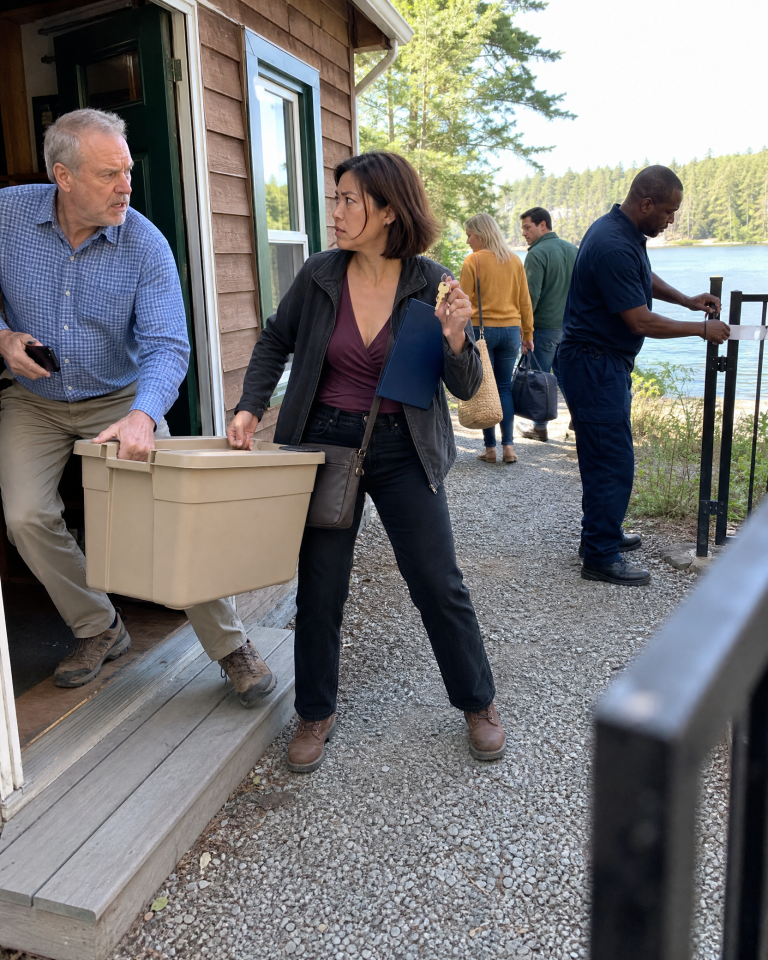
I reached the cottage door just as Clara was fumbling with the lock. She had set the wooden crate down on the small, unheated porch.
“Clara,” I said, my voice cutting through the quiet.
She spun around, her face tight, her eyes narrowed. “What do you want, Eleanor? I told you, this was necessary.”
“No,” I replied, holding up the manila envelope. “What was necessary was for you to tell the truth.”
I pulled out a folded, brittle sheet of paper. Its edges were yellowed with age, the ink faded but still legible.
“This,” I continued, unfolding it carefully, “is the original bill of sale for the Haviland porcelain service.”
Clara stared at it, her expression unreadable.
“Dated October 12, 1948,” I read aloud. “Purchased by my mother, Eleanor Mae Thompson, from an estate sale in Rutland.”
I looked up at her, letting the words sink in. “Not Great-grandmother Higgins. My mother. She bought it outright, Clara.”
Clara’s jaw tightened. She opened her mouth to speak, but no words came out.
“And this,” I added, tapping the envelope. “Is the deed to this entire four-acre Elm Street property, including the main house and this cottage.”
I paused, allowing the weight of my words to settle between us. “It all belongs to me, Clara. To my estate.”
A flicker of raw fear crossed her face, quickly replaced by a hard, cold resolve. Her eyes met mine, utterly devoid of apology.
“You think this changes anything?” she hissed, her voice low and dangerous. “You think you can just wave papers at me?”
She leaned closer, her breath smelling faintly of tea and stale desperation.
“I will turn this entire town against you, Eleanor,” she vowed.
More Stories








+ There are no comments
Add yours