
You are leaving Saint Jude Hospital with your medical license revoked and your career in ashes, my uncle declared before the ethics panel, standing beside his daughter with an arrogant smile.


Part 1
He had secretly altered surgical logs, erased my clinical trial data, and told the board I was suffering from stress-induced hallucinations.
Instead of weeping or begging, I quietly unbuttoned my lab coat and pulled back my sleeve, revealing the jagged surgical scars across my shoulder from his botched emergency procedure five years ago—a procedure he erased from official hospital registries.
Looking directly into his pale, panicked face, I informed the board that this was no longer a residency termination hearing, but the opening of a vault containing thirty years of concealed medical negligence.
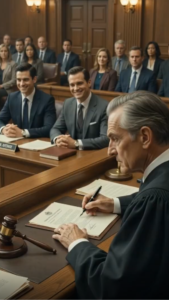
The air in the Saint Jude Hospital Ethics Committee boardroom felt unnaturally cold, clinging to the polished mahogany table and the hushed faces of the five committee members. Dr. Julian Croft, the chair, sat at the head, his eyes scanning the documents before him with a furrowed brow.
My lab coat, now buttoned again over my shoulders, felt like a costume. I stood rigid, trying to ignore the dull ache in my left shoulder, a phantom echo of the scars I’d just revealed.
Uncle Arthur DeWitt, Chief of Surgery, stood directly opposite me, impeccably dressed. His voice was smooth, regretful, almost paternal as he addressed the panel.
“Committee members,” he began, a sigh escaping his lips that seemed practiced, “it pains me deeply to bring this matter before you, especially concerning a member of my own family.”
He gestured to a large screen where a series of electronic post-operative logs rotated. Dates, patient IDs, and vital signs flashed past, clinical and unfeeling.
“Patient ID 773-C, post-op cardiac valve replacement,” Arthur narrated, his voice even. “Dr. Montgomery was responsible for monitoring the initial twenty-four-hour recovery phase.”
A specific log entry magnified on the screen, highlighting a series of blood pressure readings and medication dosages. My stomach clenched. These were not the numbers I remembered.
“As you can see,” Arthur continued, his tone shifting subtly to one of professional concern, “there was a significant drop in arterial pressure, dangerously low, that went unaddressed for nearly two hours.”
He paused, letting the implication hang heavy in the sterile room.
“Furthermore, the patient’s cardiac output remained suboptimal, requiring a secondary intervention hours later. Dr. Montgomery, unfortunately, failed to escalate this critical change.”
A collective murmur rippled through the committee members. They exchanged uneasy glances.
Arthur folded his hands, his gaze briefly meeting mine with a flicker of something unreadable – pity, perhaps, or a warning.
“I’ve observed Iris closely since she joined the residency program. She’s a brilliant young surgeon, no doubt. But the demands of Saint Jude, particularly in a high-stakes surgical fellowship, are immense.”
He turned back to the committee, his expression one of profound sympathy.
“Regrettably, I’ve noted instances of severe fatigue, memory lapses, and… a certain detachment during critical patient reviews. I believe these are symptoms of profound stress, perhaps even burnout.”
He spoke of me as if I weren’t even there, a case study laid out for their professional dissection.
My cousin, Dr. Evelyn DeWitt, Arthur’s daughter, sat beside him. Her eyes, usually sparkling with ambition, were downcast, but a faint, almost imperceptible smirk played on her lips. She nodded slowly, reinforcing every word her father uttered.
“I believe,” Arthur concluded, “that Dr. Montgomery’s judgment was severely impaired, leading to this oversight.”
A cold dread seeped into my bones. This wasn’t just a misdiagnosis; this was a deliberate fabrication, a carefully constructed narrative designed to dismantle my career. He had altered the electronic logs. I knew it with absolute certainty. I had personally verified those vitals, charted them myself.
“Dr. Montgomery,” Dr. Croft’s voice cut through the silence, formal and unyielding. “Do you have any rebuttal to these claims?”
“Yes, Dr. Croft, I do,” I said, my voice steadier than I felt.
I walked to the small terminal positioned at the corner of the table. My fingers flew across the keyboard, attempting to access the hospital’s internal system.
“I have my original handwritten shift logs from that night,” I explained, “and I can cross-reference them with the electronic charts on my secured account.”
I typed in my credentials, the familiar string of characters.
The screen flickered.
It didn’t log me in. Instead, a stark red banner appeared across the top.
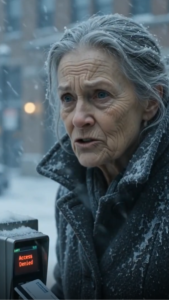
*ACCESS DENIED. ACCOUNT TERMINATED. PLEASE CONTACT SYSTEM ADMINISTRATOR.*
My blood ran cold. The words glared back at me, an impossible barrier.
I tried again, fingers trembling. The same message.
*ACCESS DENIED.*
A collective gasp swept through the room.
Arthur watched me, his arrogant smile returning, this time more pronounced. He stepped forward, his voice a low, regretful murmur meant only for me, though the committee could clearly hear.
“Iris,” he said, shaking his head slowly, “you look exhausted. We’ve tried to tell you.”
He turned to the committee. “It appears Dr. Montgomery’s access privileges have been revoked, a necessary step given the severity of the allegations.”
My mind raced, grappling with the speed and precision of his attack. He hadn’t just changed the data; he had cut off my ability to prove it.
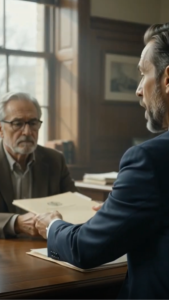
Arthur placed a folder on the table between me and Dr. Croft. It was thin, surprisingly so.
“Iris,” he continued, his tone now firm, “I’m offering you a choice. You can sign a voluntary resignation, effective immediately. We can attribute this to stress, burnout, anything but professional negligence.”
He pushed the folder closer to me. “No license suspension, no formal black mark. You walk away quietly, and we ensure your record remains unblemished. You can practice elsewhere, after some time off, of course.”
He leaned in, his voice dropping further, almost a hiss. “Or, we proceed with this hearing, and I assure you, your license will be permanently revoked. Your career will be over before it even begins.”
My eyes darted to the folder, then to his smug, confident face. The silence of the room pressed in on me. I looked at Evelyn, who finally lifted her gaze. Her eyes, devoid of any warmth, met mine, and she gave a small, almost imperceptible nod, validating every word her father had just said.
Part 2
My gaze snapped from Evelyn’s chilling nod back to Dr. Croft.
“Dr. Croft,” I said, my voice cutting through the heavy silence that followed Arthur’s offer. “I demand that you pull the hard-copy ICU binder from the fourth floor. Immediately.”
My eyes swept across the committee, trying to convey the urgency.
“Those cannot be altered like electronic files,” I asserted, feeling a surge of desperate hope.
Arthur merely shook his head, a look of tired regret on his face.
“Unfortunately, Iris, that won’t be possible,” he stated, his voice calm, almost sympathetic.
He turned to Dr. Croft and the committee members.
“Under my new department policy, hard-copy logs were phased out two weeks ago, effective hospital-wide.”
He paused, letting the information sink in.
“Everything is fully digital now.”
A cold wave washed over me. He had planned every move, every counter.
“I personally double-checked the patient’s arterial pressure,” I insisted, my hand instinctively going to my chest. “I remember the exact numbers, the specific time stamps.”
Before I could elaborate, Evelyn interjected. She held up a crisp, official-looking sheet of paper.
“Actually, Dr. Croft,” she began, her voice carefully modulated, devoid of any emotion. “I have something here that might be pertinent.”
She slid the paper across the polished table toward the committee chair.
“This is a signed peer observation sheet from that same night, noting Dr. Montgomery’s conduct.”
Dr. Croft picked up the document, his eyes scanning the contents.
My heart pounded. I watched his face as he read.
Evelyn continued, her voice flat. “It states that Dr. Montgomery was observed staring blankly at an an empty monitor for twenty minutes during a critical period, failing to respond to a nurse’s verbal query.”
My breath caught in my throat. They hadn’t just altered logs; they had created a narrative, a documented trail of my alleged instability. Weeks of careful observation, twisted and fabricated. It was an intricate web, designed to isolate and destroy.
Dr. Croft set the sheet down, his expression unreadable. He looked from Evelyn to me, then to Arthur.
“This hearing is recessed for two hours,” he announced, his voice firm, echoing in the now even heavier silence.
He pushed the voluntary resignation folder, still untouched, a few inches closer to my side of the table.
“Dr. Montgomery, you have until then to consider signing this document.”
More Stories




+ There are no comments
Add yours