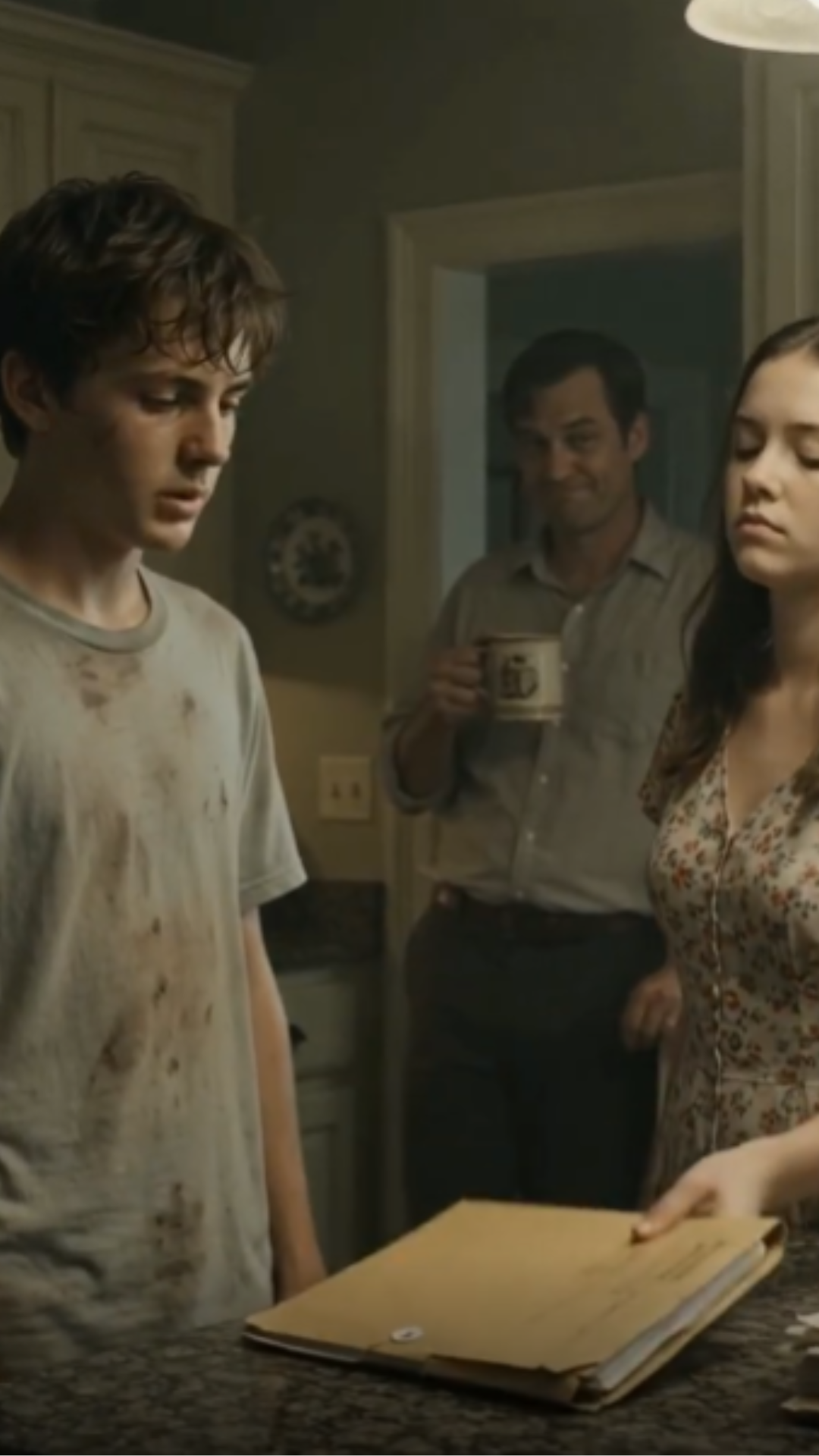
You're lucky we're even letting you sleep here, my older sister Clara said, wiping down the marble counter in our late mother's Charleston kitchen.


Part 1
Her husband leaned against the doorframe, sipping coffee from my father’s mug like he already owned every brick of the house.
I dried my hands, walked upstairs to the attic, and pulled our family’s property deeds from behind the mildewed Christmas boxes.
By sunrise the next morning, my silence had an exact expiration date.
The humid Charleston morning was already pressing against the windows. The air conditioner hummed a struggling tune, failing to fully chase away the dampness that clung to everything.
Clara, at 23, carried herself with a new kind of authority, a stiff posture she’d adopted since the accident six months ago. She looked at me, 17 and still in high school, like I was an inconvenience.
Marcus Vance-Ellis, her husband, only two years older than Clara, seemed to echo her sentiment. He took another slow sip from Dad’s favorite stoneware mug, his eyes sweeping over the high ceilings and antique cabinets as if mentally calculating their worth.
A clatter from the sink broke the quiet. Clara had finished wiping the counter, her rag now folded neatly by the faucet. She turned, her expression carefully neutral, but her eyes held a spark of something sharp.
“There’s something for you,” she said, her voice betraying none of the earlier edge.
She pushed a thick envelope across the polished granite. It slid smoothly, stopping just inches from my hand.
My fingers hesitated. The paper was heavy, cream-colored, with a legal firm’s letterhead embossed on the front: *Reynolds & Associates, P.C.* A probate lawyer.
I looked at Clara. Her gaze was fixed somewhere past my shoulder, on the window overlooking the azaleas in the backyard.
“What is this?” I asked, my voice barely a whisper.
“It’s formal notice,” Marcus interjected, stepping away from the doorframe. He leaned against the island now, arms crossed, the mug still clutched in his hand. “Regarding the house.”
Clara finally met my eyes, a fleeting, almost apologetic flicker.
“Mom left us in a mess, Leo,” she said, her tone suddenly softer, almost weary. “Medical bills. Unpaid. $140,000 worth.”
My stomach clenched. I knew our parents had died suddenly, tragically, when their fishing boat capsized in the Ashley River marsh. But Mom had always been so meticulous, so careful with their finances.
“That’s why we need a partition sale,” Marcus added, his voice regaining its earlier, possessive edge. “To cover the debt. It’s the only way.”
A partition sale. That meant selling the house. *Our* house. The only home I’d ever known, the one Dad had lovingly restored brick by brick.
I picked up the envelope. My name, Leo Holloway, was typed neatly on the front. Inside, the documents rustled, official and cold. The words “Notice of Intent to Force Partition Sale” jumped out at me.
“Where would I go?” I asked, looking from Clara to Marcus. “I still have school.”
Clara sighed, a long, exasperated sound. “We’ll figure something out, Leo. You can stay with family friends for a bit. Or maybe we can find you a small apartment.”
Marcus nodded in agreement, a tight-lipped smile on his face. He seemed unconcerned, almost relieved.
My gaze drifted to the framed photograph on the refrigerator: Mom and Dad, laughing on the old porch swing, their arms wrapped around each other. This house was their legacy.
I couldn’t breathe in that kitchen anymore. The air felt too thick, too heavy with their casual dismissal of my entire life.
Without another word, I turned and walked away. I climbed the stairs slowly, each step a protest against the reality settling in. Up past my own small bedroom, past Mom and Dad’s empty room, to the pull-down stairs that led to the attic.
The attic air hit me immediately – stifling hot, thick with the scent of old paper, cedar, and something faintly metallic. A single bulb hanging from the rafters cast a weak, yellow glow, illuminating dust motes dancing in the stillness.
I squeezed past trunks and forgotten furniture, heading for the far corner where Dad always stored his important papers. He was a dock worker, a practical man, but fiercely sentimental about the house.
Behind a stack of mildewed Christmas boxes, filled with cracked ornaments and faded tinsel, I found a small, locked wooden chest. It was Dad’s old tackle box, repurposed for documents. I remembered the key – hidden under a loose floorboard near the attic window.
A minute later, the lid creaked open. Inside, nestled beneath old photos and dried flower petals, were thick envelopes. Tax returns. Insurance papers. And then, a manila folder, slightly thicker than the rest, labeled in Dad’s looping handwriting: “Property Deeds – 14 Legare Street.”
My hands trembled slightly as I pulled it out. This was it. The proof. The history.
I flipped through the pages, careful not to tear the fragile paper. The original purchase agreement, dated decades ago. Then, a series of refinancing documents. And finally, near the bottom, a heavy vellum document with an official seal. It was dated just two years prior.
My eyes scanned the elegant script, searching for the key detail. And then I saw it, highlighted with a faint, almost invisible yellow marker in my mother’s careful hand. The section titled “Mortgage Status.”
A single, stark phrase stared back at me.
*Balance: Zero.*
Part 2
The word *Zero* echoed in my mind. Not $140,000 in debt. Not a single cent owed to the bank.
My mother had paid off the house. Two years ago.
I carefully folded the vellum deed and placed it back in the tackle box, a new kind of certainty settling in my chest. The humid attic felt less stifling now, the dust motes dancing in the weak light like tiny, triumphant stars.
The next afternoon, after my last class, I walked straight to the county records office downtown. The building was old, grand, smelling of wood polish and old paper.
A friendly clerk, Mrs. Jenkins, recognized me from my mother’s visits. She directed me to the public records terminals.
My fingers flew across the keyboard, entering the property address. I cross-referenced the deed information with recent filings.
The $140,000 figure was there, just as Clara had said. But it wasn’t medical debt. It was a private equity loan.
My breath hitched as I saw the date: just six months ago, after Mom and Dad died.
And next to it, the words that hit me like a physical blow: “Power of Attorney.” Followed by a scanned signature that was a clumsy forgery of my mother’s name.
A cold dread spread through me. It wasn’t Mom’s signature. It couldn’t be.
I printed the documents, my hands shaking slightly. Mrs. Jenkins gave me a kind smile from her desk. I barely noticed.
The walk home felt endless. The late afternoon sun beat down, but I felt a chill deep inside.
When I reached the front porch of our house, the one I now knew was fully paid for, something was different. The antique brass doorknob on my bedroom door, visible through the living room window, gleamed with newness.
My pace quickened. I pushed open the front door.
The air inside was still and cool, the hum of the AC a familiar drone. I walked down the hall to my bedroom.
The old wooden door had a brand new, shiny silver lockset. My key wouldn’t fit.
A tremor went through me. I stood there, staring at the polished metal.
Then, I saw it. Tucked neatly under the doormat, just beside my feet.
A stack of legal papers, held together with a thick rubber band. The top page was emblazoned with a court seal.
My eyes scanned the header. *Family Court of Charleston County, South Carolina.*
Below it, in bold, stark lettering: *Emergency Petition for Adult Guardianship*.
More Stories








+ There are no comments
Add yours