
Your late wife did not die of chronic heart failure, Mr. Oakley, the attorney said, placing a heavy manila folder on the mahogany desk between them.


Part 1
Three weeks after forty-eight-year-old woodworker Arthur Oakley married sixty-eight-year-old Eleanor Montgomery against his family’s furious objections, she collapsed suddenly in their kitchen and passed away.
Now, her estate lawyer revealed that Eleanor had no history of heart disease, and their sudden marriage was the sole binding condition of a twenty-year-old bequest left by her vengeful first husband.
Arthur sat frozen in the quiet office as the attorney opened a document that threatened to freeze every bank account Arthur owned.
What had felt like a miraculous second-chance romance was suddenly pulled into the dark shadows of a dead man’s financial trap.
Arthur’s breath hitched in his throat. The rich, polished surface of Samuel Garrison’s desk seemed to absorb all sound, all light.
He stared at the folder, then at the lawyer’s unreadable face. The air in the downtown Boston office was sterile, thick with the scent of old paper and expensive cleaning products.
Outside, the city hummed with the usual afternoon traffic, a distant, indifferent drone. Inside, a different kind of engine had just stalled.
“Chronic heart failure was the initial report,” Arthur managed, his voice a dry rasp. “That’s what the paramedics told me.”
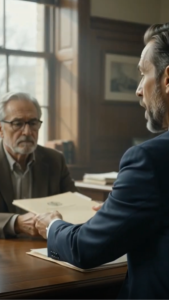
Garrison, a man whose tailored suit seemed as stiff and unyielding as his demeanor, merely nodded. His gaze was steady, professional, devoid of any sympathy.
He reached for a thick, off-white document from within the manila folder. The paper crackled faintly as he handled it.
“Indeed, Mr. Oakley. A common assumption, especially given Mrs. Montgomery’s age.”
He paused, adjusting his reading glasses. The lenses glinted, obscuring his eyes.
“However,” he continued, his tone clipped and precise, “the official post-mortem examination determined her passing was due to an acute, spontaneous cardiac arrhythmia.”
Arthur swallowed hard. An arrhythmia. It was a technical word, detached and cold. It offered no comfort, no explanation for the sudden emptiness that had swallowed his world three weeks ago.
Eleanor, vibrant and laughing, making coffee in their kitchen. Then, a sudden gasp, a collapse.
It felt like a lifetime ago. A raw wound, barely scabbed over.
Garrison pushed the document across the desk toward Arthur, stopping just short of his reach. Arthur saw the letterhead: Massachusetts General Hospital. A name he knew too well from another life, another loss.
He didn’t touch it.
“The key takeaway, Mr. Oakley,” Garrison stated, “is that there was no chronic condition. No ongoing illness. Her heart was structurally sound. This was a sudden, unpredictable event.”
Arthur frowned, a knot tightening in his chest. “Why is this relevant now, Mr. Garrison? Eleanor is… she’s gone. What does her medical history have to do with anything?”
The lawyer leaned forward slightly, his posture impeccable. He tapped the thick document with a manicured finger.
“It becomes relevant, Mr. Oakley, when we consider the terms of a very specific, and rather unusual, legal instrument.”
He then slid a second, much older-looking document from the folder. This one was bound in a pale blue ribbon, its paper yellowed with age.
Arthur felt a chill creep up his spine. The paper looked ancient, almost fragile.
“This,” Garrison announced, holding it up for Arthur to see, “is the last will and testament of Richard Montgomery. Dated November 12th, 1999.”
Richard Montgomery. Eleanor’s first husband. A man Arthur had only known through Eleanor’s brief, often painful, recollections. A man who had died twenty years ago.
“Eleanor was his sole beneficiary,” Garrison explained, “inheriting his entire estate. However, Mr. Montgomery was a man of… precise convictions.”
A faint, almost imperceptible tremor ran through Arthur. The lawyer’s voice was calm, but the words felt heavy, freighted with an unseen menace.
“His will contained an addendum. A rather elaborate contingency clause concerning Mrs. Montgomery’s future.”
Garrison straightened the document on the desk, aligning its edges with meticulous care. He adjusted his glasses again.
“It stipulated that should Eleanor—” he read, his voice clear and resonant, “—reach her sixty-ninth birthday without remarrying a working-class man, her entire inherited estate would automatically revert to a charitable trust.”
Arthur blinked, trying to process the words. “A… charitable trust?”
“Precisely,” Garrison confirmed. “A trust to benefit the Boston Historical Society.”
Arthur shook his head slowly. The pieces weren’t fitting. A dead man’s will, a requirement for remarriage?
“But Eleanor… she chose to marry me. We loved each other.”
Garrison’s expression remained unchanged. “And indeed, you did. Three weeks ago, in fact. Barely two months before her sixty-ninth birthday.”
He pointed to a specific paragraph within the aged document. His finger traced a line of dense, antique typeface.
“The conditions of Mr. Montgomery’s will were explicit. Not only did she need to marry before her sixty-ninth birthday, but her spouse had to be demonstrably ‘working-class,’ with no personal assets exceeding a threshold of fifty thousand dollars.”
Arthur felt a cold sweat break out on his forehead. He remembered Julian’s furious objections, his brother’s accusations that Eleanor was a ‘socialite’ and Arthur was being taken for a fool.
“My business,” Arthur said, his voice barely a whisper. “My workshop. It’s been building for twenty-five years.”
“Yes,” Garrison affirmed, looking up from the document. “Your custom furniture business. A clear indicator of ‘working-class’ status, as Mr. Montgomery defined it.”
Arthur’s mind raced, recalling the quiet ceremony, the simple vows, Eleanor’s radiant smile. It had felt like a new beginning, a balm to his long-held grief over his daughter.
Now, it felt like a trap.
“What does this mean, Mr. Garrison?” Arthur asked, his voice strained. “What happens now?”
Garrison picked up a third document from the folder, this one fresh, with today’s date.
“It means, Mr. Oakley, that due to the sudden and unexpected nature of Mrs. Montgomery’s passing, occurring just three weeks after your marriage, and given the extremely specific conditions of Mr. Montgomery’s will…”
The lawyer fixed Arthur with a solemn, unwavering gaze.
“…we are legally obligated to initiate a full and immediate audit of all your personal and business accounts.”
He slid the new document across the desk, its stark black print a stark contrast to the faded blue ribbon of the will.
“Under the terms of the Montgomery Trust,” Garrison concluded, “all of your existing financial assets are now subject to immediate legal holds, pending verification of your eligibility as Mrs. Montgomery’s designated spouse.”
Part 2
Arthur stared at the new document, the words blurring. His assets. Frozen.
His custom furniture business, the work of twenty-five years, suddenly held hostage.
He left Samuel Garrison’s office in a daze. The crisp autumn air of Boston did little to clear his head.
He drove back to his workshop in South End, the familiar hum of the city now feeling like a mocking echo. The scent of sawdust and fresh-cut pine usually calmed him. Today, it felt hollow.
He had a payment due to his hardwood supplier, a large order for a new client. He opened his banking app on his phone, the familiar interface a fleeting comfort.
He selected the transfer option. An error message flashed across the screen.
“Account frozen due to third-party lien.”
His heart hammered. He tried again. The same message. He checked his operational savings. Also frozen.
He scrolled through the details, his stomach clenching. Every single dollar, the $142,000 he had saved, was inaccessible.
A shadow fell across the workshop door. Julian, his younger brother, stood there, his face tight with a familiar, furious disapproval.
“I just got off the phone with Garrison,” Julian said, his voice clipped and strained. “What in God’s name have you done, Arthur?”
Julian walked further into the shop, kicking a loose block of cherry wood. His hands clenched into fists.
“The business accounts are locked. My accounts are locked. Our joint account for the new saw is frozen solid.”
Arthur just looked at him, unable to form words.
“You rushed into this,” Julian pressed, pacing in front of the workbench. “You married an old woman, a complete stranger, who had all this hidden history. I warned you.”
“She wasn’t a stranger, Julian,” Arthur said, his voice low. “She was Eleanor. I loved her.”
Julian scoffed. “Love? What kind of love cripples a family business? The one we built together, Arthur. The one Dad started.”
He stopped, pointing a rigid finger at Arthur. “You need to hire a litigator. Today. Someone who can get you out of this.”
“Out of what?” Arthur asked, though he already knew.
“Out of this marriage, Arthur!” Julian exploded. “You have to declare it a sham. Right now.”
More Stories








+ There are no comments
Add yours