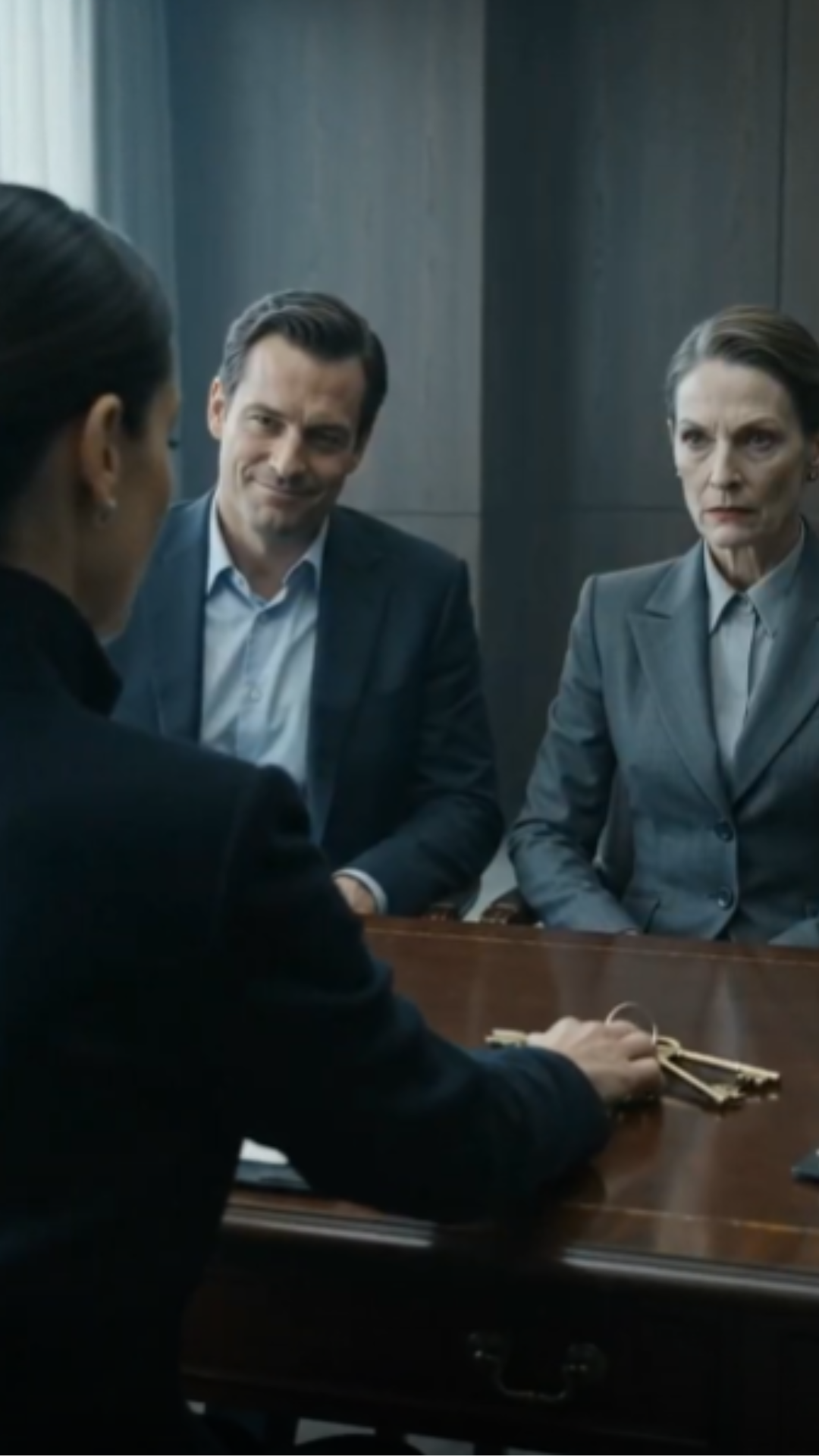
Eight minutes after our divorce papers were signed in a downtown Chicago arbitration suite, my ex-husband Bradley tossed his fountain pen onto the table and laughed. "There’s nothing left to divide...


Part 1
The air in the arbitration suite, usually so neutral and sterile, now felt thick with Bradley’s triumph. It clung to the heavy velvet drapes and the polished mahogany of the desk.
Arbitrator Samuel Reynolds, a man whose face was a study in practiced detachment, cleared his throat. He stacked the signed documents with meticulous care, his gaze flicking between us.
Bradley simply ignored him. He leaned against the ornate fireplace, a smirk playing on his lips, completely disregarding the professional decorum.
His new partner, Alyssa Danforth, stood by the window, her hand resting delicately on her slight bump. She offered a small, sympathetic smile in my direction, but her eyes held a guarded excitement.
It was a performance for an audience of one: Victoria.
Senator Victoria Garrick stood beside Bradley, a regal, unyielding presence even in this private setting. Her tailored suit was impeccable, her silver hair coiled in a severe bun.
She watched me with the predatory stillness of a hawk, her expression unreadable.
“You really thought you had leverage, didn’t you, Maya?” Bradley’s voice cut through the quiet, sharper than his laughter had been moments before.
He pushed off the mantelpiece, taking a step toward me.
“Half of the penthouse? A cut of my inheritance?” His tone dripped with condescension.
My hand tightened around the strap of my handbag, the soft leather creaking faintly. I met his gaze, refusing to flinch.
I had come into this room expecting a fight. I had prepared for arguments over assets, for battles over custody. I had even braced myself for Victoria’s quiet, cutting remarks.
What I hadn’t expected was this absolute void.
“There’s nothing left to divide, darling,” Bradley repeated, his voice laced with mock pity.
He gestured vaguely at the stacks of paper Arbitrator Reynolds had just secured.
“My mother handled the restructuring weeks ago.”
A chill snaked down my spine, colder than the Chicago winter wind outside. Restructuring. The word hung in the air, deceptively innocuous.
Victoria stepped forward then, her voice a low, silken purr. “All marital assets were wisely folded into the Garrick Family Political Trust, Maya.”
“Completely above board,” she added, a faint, unsettling smile touching her lips. “Samuel confirmed.”
Mr. Reynolds gave a curt, almost imperceptible nod. His eyes stayed glued to the documents.
I felt a sudden lightness in my chest, a bizarre physical sensation of being hollowed out. Not just my bank accounts, but all of it. My firm’s operational holdings, the investment portfolio we’d built, the very fabric of our shared financial future.
It was all gone, dissolved into a political slush fund weeks ago, right under my nose.
Bradley chuckled again, a short, sharp sound devoid of humor. “You didn’t really think we’d let you walk away with anything substantial, did you?”
He looked to his mother for approval. Victoria’s smile widened by a fraction.
I felt a wave of nausea. This wasn’t just divorce; it was a financial coup, orchestrated with ruthless precision. And I hadn’t even realized the battle had begun until it was already over.
My mind raced, trying to process the implications. Everything was gone. My $180,000 in personal accounts, which I knew Victoria had already frozen, were just the tip of this iceberg. This wasn’t about money; it was about power, about stripping me of every last shred of independence.
I looked down at the $2.4 million penthouse keys in my hand. They felt suddenly heavy and meaningless. The elegant etched ‘G’ for Garrick felt like a brand, not a belonging.
I slid the keys across the dark, gleaming surface of the mahogany desk. They landed with a soft clink, stopping just shy of Arbitrator Reynolds’ hand.
“Keep it,” I said, my voice steady, surprising even myself.
Bradley’s triumphant expression faltered for a second, a flicker of confusion crossing his face. He’d expected an argument, a plea, a fight.
I reached into my handbag, my fingers closing around the smooth leather of Leo’s passport. Then mine.
I pulled them out, one in each hand, a silent declaration of my true priorities.
My son. My freedom. My way out.
“We won’t be needing the apartment,” I clarified, looking directly at Victoria.
Her eyes narrowed, the thin veneer of her smile cracking. My composure seemed to annoy her more than any outburst could have.
I turned and walked toward the door. The sound of my heels on the marble floor echoed loudly in the sudden silence of the suite.
No one moved to stop me. No one spoke.
The heavy oak door swung shut behind me, severing the opulent room from the bustling corridor. The muffled sounds of downtown Chicago seeped in, a welcome cacophony.
I moved quickly through the building’s grand lobby, past stern-faced security and hurried lawyers. The brass fixtures gleamed under the recessed lighting, a stark contrast to the cold calculation I’d just witnessed.
Outside, the late afternoon sun cast long shadows down Dearborn Street. Taxis zipped past, horns blaring, completely oblivious to the personal earthquake that had just occurred.
A faint scent of roasting nuts drifted from a nearby street vendor, mixing incongruously with the sharp tang of exhaust fumes.
My car, a modest sedan that looked almost quaint among the luxury vehicles parked on the street, waited patiently. Its familiar dark blue felt like a small island of stability in a sea of upheaval.
I unlocked the door, the click sounding surprisingly loud in the relative quiet of the street-side parking.
As I slipped into the driver’s seat, my gaze fell to the passenger seat beside me.
There, nestled against the cream-colored leather, sat a thick, black leather folder.
Its presence was both a promise and a threat. It held a secret that could unravel everything Victoria Garrick had meticulously built.
I reached out, my fingers brushing against the cool, smooth leather.
Part 2
Through the tinted glass of the building’s revolving door, I saw Bradley and Alyssa emerge.
He had an arm around her, a possessive grip on her waist.
Senator Victoria Garrick was waiting for them at the curb, her expression softening into something almost maternal as Alyssa joined her.
They climbed into a sleek black SUV, disappearing into the late afternoon traffic.
My hand reached for the black folder on the passenger seat.
The leather was cool and smooth beneath my fingertips.
I opened it, the soft rustle of paper filling the small space of the car.
Inside, neatly organized with tabs and color-coded flags, were the municipal engineering reports.
Not a lawsuit for money, as Bradley might have assumed, but something far more volatile.
The title page bore the bold heading: “Riverfront Plaza Structural Integrity Audit – Confidential Level 3.”
My stomach clenched as I flipped to the summary page.
The words jumped out: “Critical concrete decay… compromised rebar… significant structural stress thresholds exceeded… failure imminent without immediate retrofitting.”
This was Victoria’s $42 million legacy project, the gleaming Claire Garrick Memorial Plaza, built in honor of her late daughter.
It was rotting from the inside out.
The detailed photographs showed hairline fractures widening into gaping fissures along the main support pylons.
Dates indicated the problems had been worsening for months, ignored.
Just then, my phone vibrated, a sharp buzz against the center console.
A new message from “State Bank of Illinois” flashed across the screen.
My breath hitched.
It was an alert.
“Transaction Alert: Your business account ending in **** has been placed under temporary freeze by state regulatory order. Balance: $180,000.”
Victoria wasn’t waiting. She was moving fast.
More Stories






+ There are no comments
Add yours