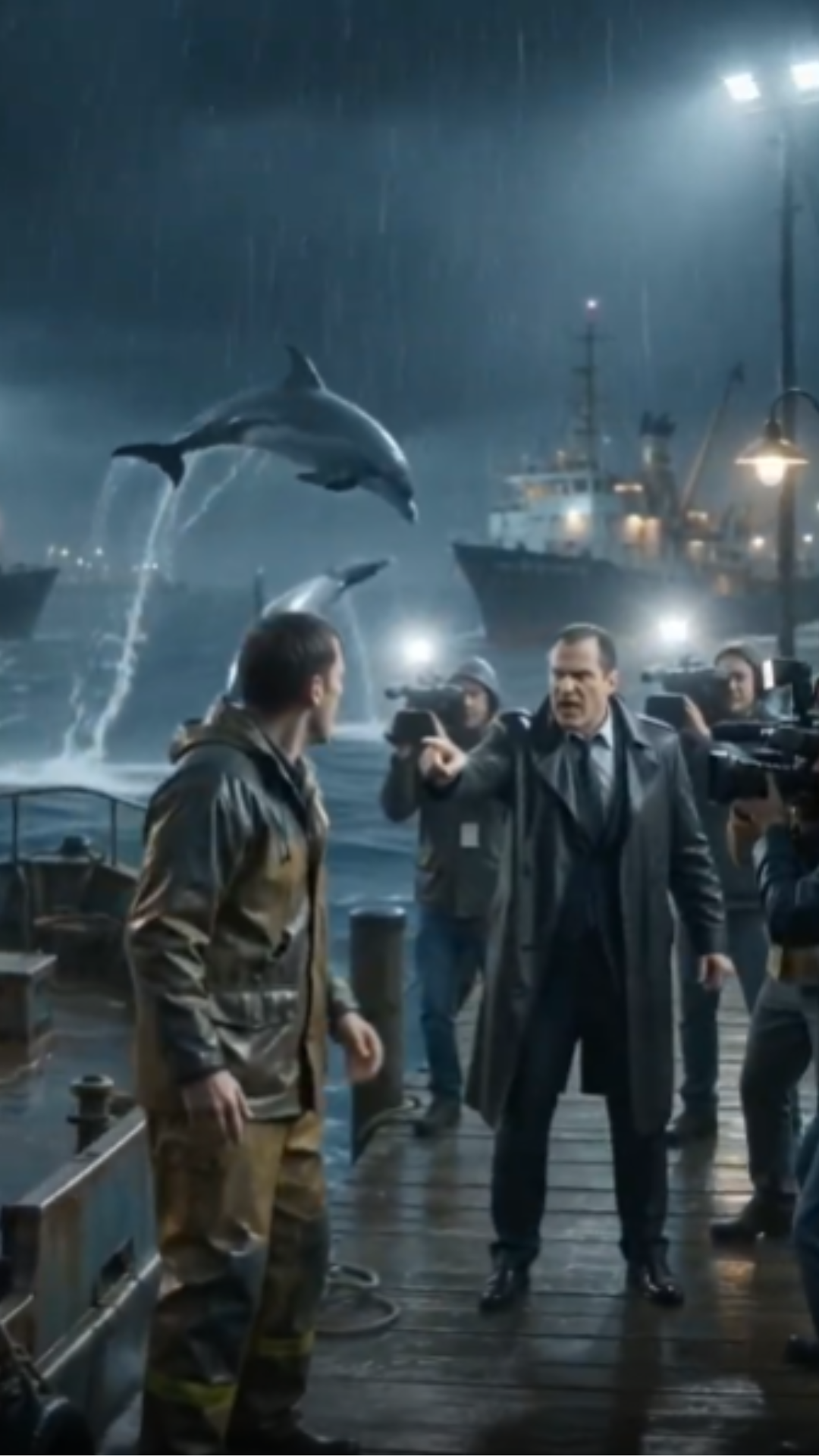
When I dragged my waterlogged boots onto the docks of Baltimore after a Category 2 gale on October 14th, my landlord and port developer Harrison Gable was already standing under the harbor lights w...


Part 1
He pointed at my empty two-man research vessel and announced to the press that I had thrown my partner, Eli Danforth, overboard to cover up $1,200,000 in missing port authority funds.
Within forty-eight hours, every tenant in my apartment building stopped speaking to me, my bank accounts were frozen, and city council stripped my marine engineering license.
They thought Eli was lost to the Atlantic forever, but they didn’t know about the five tagged bottlenose dolphins circling a precise coordinate twelve miles off the coast of Thomas Point.
***
The steel hull of my vessel, the *Storm Chaser*, groaned against the battered fenders of Pier 14. Its navigation lights, usually a beacon of defiance against the open sea, now seemed to blink in surrender. I stepped onto the wet concrete, each boot squelching, leaving dark, brackish prints.
My legs were jelly from forty-eight hours of battling hurricane-force winds and waves that threatened to swallow us whole. Or rather, to swallow *me* whole. Eli was not on board.
A chill that had nothing to do with the October air prickled my skin.
Under the harsh glare of the harbor lights, Harrison Gable stood like a predator who had found its mark. He was immaculate in a tailored dark suit, his silver hair unruffled, despite the recent storm. His usual charming smile was replaced by a grim, self-righteous mask.
Three television cameras, emblazoned with local news station logos, were trained on him. Their blinding lights seemed to cauterize the dark corners of the pier.
Reporters clutched microphones, their faces eager, reflecting the flashing camera bulbs. The air, still thick with the salty tang of the storm, crackled with an unnatural tension. It felt less like a homecoming and more like an execution.
Gable gestured dramatically towards the *Storm Chaser*, its radar dome twisted, its starboard outrigger bent at an alarming angle.
“Ladies and gentlemen,” he announced, his voice booming with a practiced gravitas, amplified by the portable sound system his team had set up. “We stand here tonight at the scene of a grave betrayal.”
He paused, letting the words hang in the air, creating a dramatic silence broken only by the distant clanging of a buoy in the channel.
My stomach clenched. I knew this man. I leased my office from him, my lab space a mere stone’s throw from his sprawling waterfront complex. But I had never seen him wield his political theater with such naked malice.
“This man,” Gable continued, his gaze sweeping over the cameras before settling on me with a look of theatrical disgust, “Caleb Ross, has returned alone.”
A collective gasp swept through the small crowd of reporters and a few curious dockworkers who had gathered.
He took a step closer to the edge of the pier, leaning into the microphones. “His partner, Eli Danforth, a dedicated marine telemetry specialist, is missing. Presumed lost at sea.”
My jaw tightened. Eli was *not* lost at sea. Eli was… I didn’t know where Eli was. The storm had separated us, but the details were still a blur of crashing waves and a sudden, violent impact.
“Mr. Ross here,” Gable said, his voice dropping to a conspiratorial whisper that carried clearly over the loudspeakers, “is responsible.”
The words hit me like a physical blow. Responsible? I staggered slightly, catching myself on a mooring bollard.
“He threw Eli Danforth overboard,” Gable declared, his voice rising again, “to cover up a massive embezzlement scheme.”
A flurry of camera flashes erupted. Reporters started shouting questions, their voices overlapping in a chaotic din.
“Mr. Ross embezzled one million, two hundred thousand dollars in Baltimore Port Authority development funds!” Gable bellowed, cutting through the noise. “Funds meant for the expansion of Pier 14, to bring jobs and prosperity to our city!”
The accusation hung heavy in the air, a poisoned dart launched straight at my career, my reputation, my very existence. The dockworkers, men I’d known for years, stared at me with open suspicion, their faces hardening into judgment.
“This man is a murderer and a thief!” Gable screamed, his face contorted in a mask of manufactured outrage. “He will be held accountable!”
I stood there, soaked and exhausted, watching my life unravel under the unforgiving glare of the news lights. My mouth opened to speak, but no words came out. What could I say against such a well-orchestrated assault?
Gable’s security detail, burly men in dark jackets, moved to block my path as I tried to step forward, to demand an explanation, to tell them the truth about the storm.
“No comment from the accused!” one of them barked at a reporter.
Another one, a man with a cold, flat stare, placed a hand on my chest, pushing me gently but firmly back towards my boat. “Time to go, Mr. Ross. You’ve had your moment.”
They didn’t want my truth. They wanted Gable’s narrative.
I retreated, stumbling back onto the deck of the *Storm Chaser*, the cameras still flashing, Gable’s accusations echoing in my ears. The world outside had already condemned me.
Hours later, the pier was deserted. The news crews had packed up their equipment, their hunger for sensationalism temporarily sated. Gable was long gone, probably celebrating his performance over a glass of expensive bourbon.
Darkness had fallen, thick and heavy, punctuated only by the distant hum of the city. I was alone, shivering, the chill now reaching into my bones. The *Storm Chaser* listed slightly, an injured beast huddled against the pier.
I couldn’t sleep. The words, *murderer*, *thief*, played on an endless loop in my head. I had to understand. I had to find out what really happened to Eli. And I had to clear my name.
My gaze fell upon the damaged hull of my research vessel. The storm had been brutal, yes. But something about the damage felt… off. It wasn’t just the organic chaos of nature.
Grabbing a powerful spotlight from the cabin, I aimed its beam at the starboard side, directly where the hull met the waterline. The raw, jagged tears in the fiberglass, the bent frame — these were consistent with extreme weather.
But underneath the superficial damage, something else caught my eye. A faint, almost imperceptible smudge of color.
I knelt, ignoring the cold, wet deck, and ran my fingers along the rough surface. Beneath the chipped paint and scraped metal, a distinct, deep blue pigment clung to the *Storm Chaser*’s white fiberglass. It was the exact shade of marine paint used on large industrial vessels.
My heart began to pound, a frantic drum against my ribs. I examined the structural indentations more closely, tracing their precise, unnatural curves. They weren’t the random, diffuse marks of waves crashing against a hull.
These were sharp. Deliberate.
The deep blue transfers and the specific, inward-curving structural dents perfectly matched the heavy, reinforced steel bow-bumper of Gable’s private tugboat, the *Harbor King*.
Part 2
Hours turned into days. The city council stripped my marine engineering license. My bank accounts were frozen, every asset locked down.
Neighbors, once friendly faces, now averted their eyes or mumbled accusations whenever I passed them on the street.
My apartment, once a haven of scientific pursuit, became a cage. The outside world had turned against me, but they couldn’t take away my gear, my knowledge.
My hydro-acoustic arrays, usually deployed in the bay, were now jury-rigged across my living room. Cables snaked over the carpet. Monitors glowed with cryptic data streams.
I spent endless hours hunched over my console, headphones clamped to my ears, sifting through the constant symphony of the bay. Every sonar return, every biological signature, every whisper of the water became my obsession.
Then, a pattern emerged. A familiar one.
Five specific signatures, robust and consistent, kept pinging from precise coordinates: 38°53’N, 76°26’W.
My heart lurched. I knew those signatures. Bottlenose dolphins, part of a research initiative I’d led two years ago.
I had personally fitted them with acoustic telemetry tags, designed to track their migration patterns. These tags emitted a specific frequency: 120 kHz.
120 kHz. The number burned itself into my mind.
Eli. My partner. He had custom-built an underwater emergency transponder, a personal beacon for deep-sea work. Its primary frequency was also 120 kHz.
A chilling clarity washed over me, cutting through the fog of grief and accusation. Eli’s transponder wasn’t drifting aimlessly with the currents, a lost signal in the vast Atlantic.
It was fixed. Stationary. Trapped. Pinging from the bay floor, twelve miles off the coast of Thomas Point, at the exact coordinates the dolphins were circling.
Eli wasn’t simply ‘lost at sea.’ He was down there, anchored to something heavy, sending out a silent scream at 120 kilohertz.
More Stories



+ There are no comments
Add yours