
I Am an Archivist Digitizing 1888 Voice Records and Just Heard My Own Voice Predicting My Murder Tonight
Part 1
Tonight at 11:15 PM, while working alone in the subterranean storage vault, I digitized an uncataloged wax cylinder from November 1888.
Through the crackle of static, my own voice came through the headphones, whispering my full name, describing the clothes I am wearing tonight, and predicting a murder in my office before midnight.
My hands are shaking as I look at the iron door of the archive, hearing heavy footsteps descending the concrete staircase.
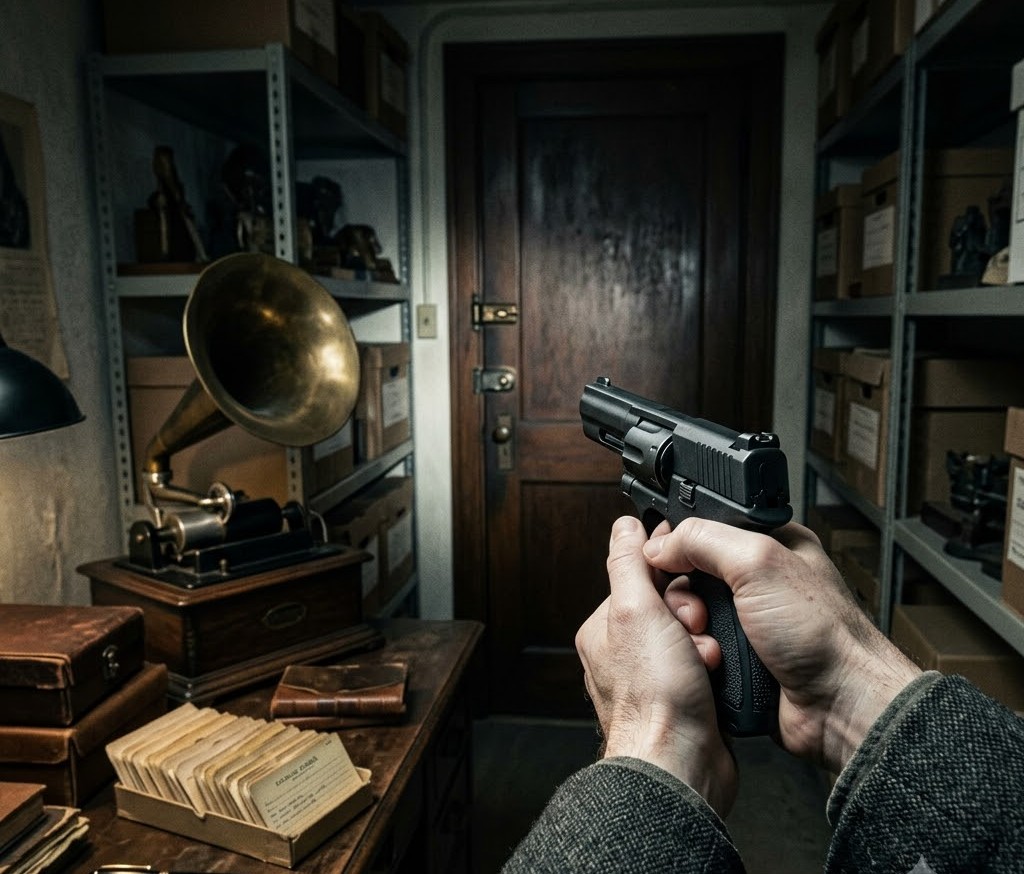
The Beacon Historical Museum’s subterranean archive vault was a labyrinth of steel shelves and tightly packed boxes, a graveyard of forgotten voices. The air, despite the building’s ancient heating system, always held a chill that bit at my exposed skin.
It was 11:15 PM. My shift was nearly over, just a few more cylinders to go before the night engineer, Samuel Oakhaven, would do his final rounds.
I was Julian Pemberton, and tonight, my only company was the hum of my workstation and the ghosts of Boston’s past.
My contract, only three weeks old, felt precious. I needed this job, a stepping stone to a permanent role, a career. Tonight, my task was mundane: take an unlabeled wax cylinder, clean it gently, and feed its fragile history into the digital age.
I reached for the next cylinder in the queue, a nondescript tube of dark brown wax. Its handwritten label, barely legible, simply read “Box 1888-B.” No name, no date, just the archival reference.
It was heavier than some, a solid, dense piece of history. I handled it with the surgical precision I’d learned in my archival studies, carefully positioning it onto the spindle of the antique phonograph.
The soft glow of my computer screen illuminated the dim space, casting long shadows across the towering rows of historical documents. Each click of the mouse, each whir of the antique machine, echoed slightly in the quiet vault.
I put on my oversized noise-canceling headphones, the kind that blotted out the world and left only the delicate, scratchy sounds of the past. The familiar static filled my ears, a low hiss preceding every recording.
I hit ‘play.’
A faint, distorted voice began, crackling as if speaking from a great distance, across a century. It was a man’s voice, gravelly and aged, typical of the 1880s recordings I’d processed countless times.
But then, a shift. The static seemed to coalesce, sharpen. The voice, still scratchy, took on an unnerving clarity.
It spoke a name. My name.
“Julian Pemberton.”
My heart gave a violent lurch, slamming against my ribs. I froze, my fingers hovering over the playback controls. It had to be a coincidence, a trick of the antique audio. An acoustic anomaly.
The voice continued, slow and deliberate.
“He wears a navy blue museum polo shirt, the official one, charcoal grey slacks, and his ID badge, number seven-three-three-eight, clipped to his left pocket.”
Every word was a hammer blow to my chest. I looked down, my gaze snapping to my clothes. The official Beacon Historical Museum polo, the charcoal slacks, the ID badge. Number 7338, clipped right where he said.
A cold dread seeped into my bones, spreading faster than any winter chill. This wasn’t a coincidence. It wasn’t an anomaly.
This was impossible.
My own voice. That was my voice, or an exact, chilling replica. It wasn’t the gravelly tone of an 1888 man anymore. It was me, whispering.
“He is alone in the subterranean archive vault, beneath the Beacon Historical Museum.”
My breath hitched. My eyes darted around the cavernous, lonely room, the only light coming from my screen. The heavy iron door, bolted from the inside, felt suddenly flimsy.
The whispering voice grew more urgent.
“Tonight. Before midnight. A violent murder will occur in this exact room.”
My hands started to tremble, an uncontrollable tremor that rattled the desk. The headphones felt impossibly heavy, pinning the terrifying prophecy directly to my brain.
My eyes fixated on the digital clock in the corner of my screen. 11:15 PM. Midnight was less than forty-five minutes away.
Every hair on my arms stood on end. I tore the headphones from my ears, the sudden silence of the vault almost as deafening as the ghostly voice. I needed air, a moment to process this impossible horror.
Just as I thought I might scream, a sharp, metallic click echoed through the absolute stillness.
It came from the concrete stairwell door. The heavy, reinforced door that was supposed to be locked and secured. The one leading down from the main museum floor.
A moment later, the distinct, rhythmic thud of heavy footsteps began descending the concrete staircase.
Part 2
The heavy footsteps echoed louder, growing closer down the long, concrete corridor. Each thud vibrated through the floor, a growing dread in the stale air of the vault. My breath hitched, a knot tightening in my stomach. I scrambled to rewind the cylinder, to hear that chilling prophecy again, to somehow understand if I had missed something vital.
My fingers fumbled with the antique playback mechanism, desperate to find an answer. That’s when I saw it. Tucked almost invisibly beneath the ornate brass arm of the phonograph, a thin, almost hair-like wire, completely out of place. It wasn’t the aged, cloth-wrapped wiring of the 19th century. This was modern, a dark, insulated strand snaking away, disappearing into the back casing of the ancient machine. A faint, almost imperceptible metallic gleam caught the dim light, revealing a tiny, almost microscopic chip. A transceiver.
Panic turned to a cold, burning certainty. This wasn’t some supernatural echo from the past. This was a fake. A meticulously crafted, high-tech deception, engineered into an antique shell. The voice, my voice, wasn’t a warning from 1888. It was a live broadcast, streamed directly to me. A setup. Someone had gone to elaborate lengths to lure me down here, to make me believe I was losing my mind.
My uncle, Arthur. It had to be him. The way he looked at me, always testing, always evaluating my reactions. He was trying to break me, to frame me for whatever disaster he had planned for tonight. The murder, the ID badge number, the description of my clothes—all of it was designed to make me question my own sanity, to orchestrate a spectacular, very public breakdown.
The footsteps stopped. Directly outside my iron door. A soft click. Then, slowly, almost deliberately, the heavy metal doorknob began to turn.
You are Julian Pemberton. The doorknob is turning, and the recording you just heard predicting your own murder was a fake, broadcast live to you by your uncle. What do you do?
A) Continue listening to the wax cylinder to decipher the remaining hidden acoustic clues → Chapter 2
B) Stop the tape, lock the iron archive door, and pull the guard’s emergency defense gun → Chapter 18
More Stories








+ There are no comments
Add yours