
You're late, Martha, my husband Julian said, dabbing his mouth with a linen napkin without even looking up from his lobster shell. "Pay the bill, would you? We're done."


Julian, his face mottled with rage and desperation, suddenly sprang from his chair. He was no longer trying to control the narrative or hide his crimes. He was simply trying to escape.
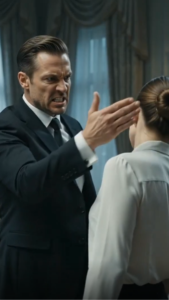
His eyes locked onto me, burning with a hatred I had rarely seen. He grabbed my wrist, his fingers digging into my skin, and yanked hard.
“You scheming bitch!” he snarled, his voice a low, furious growl, barely audible above the rising murmurs of the stunned diners. “You’ll pay for this! You’ll pay for every bit of it!”
He tried to drag me up, to pull me out of the dining room and into the street, his intention clear: to silence me, perhaps physically, away from the prying eyes of the public and the press.
My arm screamed in protest, but I stood my ground, refusing to be moved. The forged deed folder clutched in my other hand felt like a shield.
Just as Julian exerted more force, ready to haul me away, four men at an adjacent table, who had been quietly observing the escalating drama, suddenly pushed back their chairs. The collective scrape of wood on tile echoed in the hushed room.
They were impeccably dressed in dark suits, their posture erect and authoritative. Their faces were stern, unreadable.
One of them, a tall man with a neatly trimmed mustache, stepped forward. He reached out a hand, firmly but gently, and detached Julian’s grip from my wrist.
“Mr. Albright,” the man said, his voice calm, even, yet carrying an undeniable weight of authority. “I’m Agent Miller, Office of Price Administration. I believe we need to have a word.”
Julian froze, his eyes wide with a fresh wave of terror. His breath hitched.
The Office of Price Administration (OPA) was a federal agency established during the war to control prices and rationing. Their agents were federal law enforcement, tasked with preventing black-market activities and ensuring fair distribution of goods.
They hadn’t just been diners. They had been watching.
My eyes swept over the other three men. They had already produced small, official-looking badges from inside their jacket pockets, holding them up briefly for Henri Moreau and Genevieve Ross to see. They were here, officially, in their capacity as federal enforcement officers.
Julian looked at Agent Miller, then at the other agents, then back at me, his face twisting in an agony of utter defeat. His plan to use the restaurant as a trap, to publicly disgrace and incriminate me, had instead brought down the full, crushing weight of federal authority on his own head.
His hand, now free from my wrist, trembled. The bravado, the arrogance, the desperate fury—all of it drained from him, leaving behind only a shell of a man. The gilded chandelier above us seemed to mock his downfall, its glittering light exposing every ugly truth.
The diners watched in stunned silence. The entire elaborate scheme, the family betrayal, the forged documents, the black-market dealings—all had led to this moment. Julian’s world was collapsing, not in a dramatic shouting match, but with the quiet, terrifying efficiency of federal intervention.
More Stories




+ There are no comments
Add yours