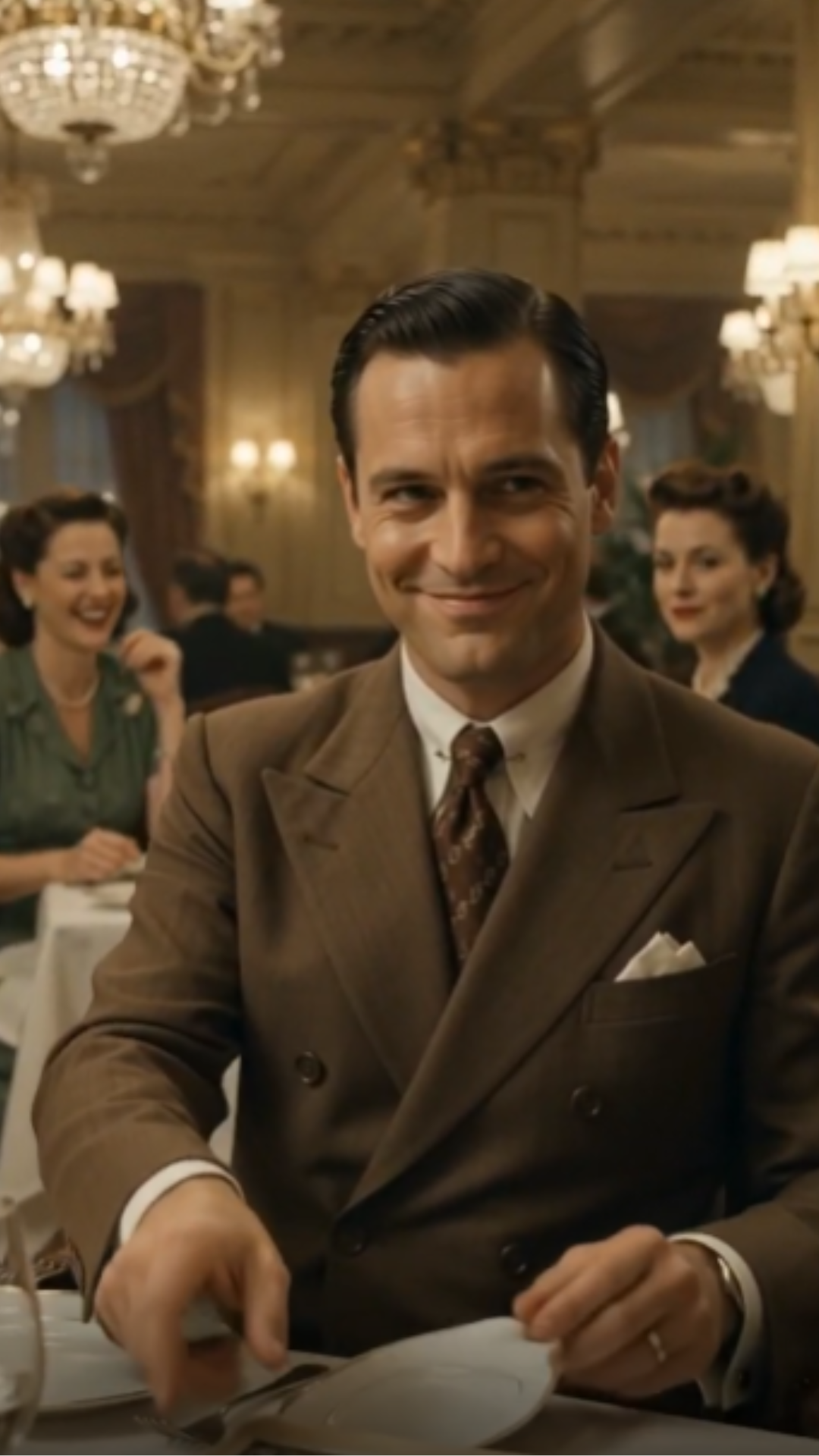
You're late, Martha, my husband Julian said, dabbing his mouth with a linen napkin without even looking up from his lobster shell. "Pay the bill, would you? We're done."


Part 1
My sister-in-law Clara let out a sharp, mocking chuckle. “Still as naive and dutiful as ever, aren’t you, Martha? Always running around doing the dirty work while the men handle real business.”
I looked down at the leather folder the waiter had left on the table. The total was $385.40—a staggering sum in November 1944, equal to three months of a factory worker’s wage—and stapled to the back were four illegal black-market wartime ration coupons bearing my deceased father’s forge-stamped signature.
Instead of reaching into my handbag for my purse, I quietly raised my hand and called for the head maître d’.
The moment the restaurant manager stepped toward our table alongside a woman holding a press notebook, Julian’s face turned completely ghost-white.
The chill of the November air bit at my cheeks as I hurried through the elegant, revolving doors of the Carlton Hotel, my worn tweed coat clutched tight around me. Washington D.C. always hummed with a different kind of energy, even during wartime, a frantic pulse that felt alien to my quiet home.
My heart hammered against my ribs, a dull ache of anxiety that had been with me since Julian’s hurried phone call. He had simply said, “Meet me at the Carlton. An emergency regarding Thomas. Be discreet.”
Discreet, always discreet. That was the mantra of our marriage, the unspoken rule that governed my every action. Fifteen years of quiet maintenance, of keeping the peace, of smoothing over Julian’s grand ambitions and petty indiscretions.
I moved through the lobby, my eyes scanning the lavish room. The scent of roasted meat and expensive perfume hung in the air, a stark contrast to the rationed austerity of our kitchen. My shoes, practical and sensible, felt terribly out of place on the thick Persian rugs.
The maître d’, a man named Henri Moreau, recognized me instantly from Julian’s frequent visits. He offered a polite, if somewhat weary, smile.
“Mrs. Albright,” he murmured, his voice hushed. “Your husband is in his usual corner table, with his sister.”
I nodded, my stomach tightening. An emergency about Thomas? Julian rarely involved me in anything he considered “business,” and certainly not in public. His words had been clipped, urgent. Dread coiled in my gut.
I threaded my way through the bustling dining room, a symphony of clinking silverware and hushed conversations, a tableau of wartime opulence I rarely witnessed. Officers in crisp uniforms laughed with women in silk dresses. Power brokers whispered over glasses of imported wine.
Then I saw them.
Julian and Clara. They weren’t whispering in concern. They were laughing.
A large, half-eaten lobster, crimson against the white tablecloth, sat between them. Crystal glasses, filled with a pale amber liquid I recognized as champagne, glittered under the chandeliers. Clara, Julian’s sister, wore a shimmering blue gown, her face flushed with mirth.
My steps faltered. This wasn’t the setting for an emergency. This was a celebration.
Clara, her head thrown back, let out a piercing peal of laughter. Julian, expansive and jovial, dabbed his mouth with a crisp linen napkin, his eyes darting around the room, always seeking to be seen.
He hadn’t even noticed me yet.
I reached the table, the small gasp of my arrival swallowed by the ambient chatter. Julian finally looked up, his smile vanishing, replaced by a flicker of annoyance.
“You’re late, Martha,” he said, dabbing his mouth with a linen napkin without even looking up from his lobster shell. “Pay the bill, would you? We’re done.”
He pushed a dark leather folder across the table, nudging it past the remnants of his extravagant meal. His tone was dismissive, as if my delay had ruined his evening, not the supposed crisis he’d invented to get me here.
Clara, ever quick to twist the knife, let out a sharp, mocking chuckle.
“Still as naive and dutiful as ever, aren’t you, Martha?” she sneered, her eyes gleaming with malicious amusement. “Always running around doing the dirty work while the men handle real business.”
My gaze dropped to the leather folder the waiter had left on the table. The weight of it, even unopened, felt heavy with expectation. My fingers brushed the cool, smooth leather.
I opened it.
The sum printed boldly at the bottom, “TOTAL: $385.40,” hit me like a physical blow. Three hundred and eighty-five dollars and forty cents. In November 1944, that was more than three months of a factory worker’s entire salary. It was an astronomical, grotesque amount. My frugal household budget for an entire quarter barely touched half of that.
My eyes scanned the itemized list, each line a fresh stab: several rounds of expensive cocktails, bottles of French champagne, multiple lobster thermidors, filet mignon. All luxury items, all heavily rationed.
Then I saw it. Stapled to the back of the bill were four small, rectangular slips of paper. Familiar in their design, but chillingly wrong in their context. Ration coupons. Meat, fuel, sugar. Four of them.
And on each one, a forge-stamped signature. Not Julian’s. Not mine.
It was my father’s. George Albright. My father, who had passed away two years ago, leaving behind his small Virginia farm and a lifetime of honest labor. His signature, meticulously recreated, a perfect imitation of the bold, looping script I knew so well.
My blood ran cold. The emergency regarding Thomas was a lie. The “dirty work” Clara mocked wasn’t just paying a bill. Julian hadn’t brought me here for an anniversary dinner, or even a quiet discussion. He had used my name, used my deceased father’s name, to illegally purchase black-market meat and other goods, creating a debt that was now, by all appearances, legally tied to *me*.
A tremor started deep in my chest. Rage, cold and precise, began to replace the exhaustion.
Julian, blissfully unaware of the storm brewing behind my calm facade, cleared his throat impatiently. “Well? Don’t just sit there. The maître d’ is waiting.” He gestured vaguely toward the empty space where Henri Moreau usually stood.
My hand, instead of reaching into my handbag for my purse, moved with a quiet, deliberate grace. It rose slowly, steadily, into the air. My gaze swept past Julian’s self-satisfied smirk, past Clara’s cruel grin, past the shimmering lobster shell.
I met the eyes of Henri Moreau, who stood near the entrance, supervising a young waiter. I held his gaze, a silent command in mine.
He registered the unexpected gesture, his professional smile faltering for a fraction of a second. Then, with an almost imperceptible nod, he began to make his way through the tables, excusing himself politely to the diners he passed.
Julian, still preoccupied with his own importance, didn’t notice at first. Clara, however, followed my gaze. Her eyes narrowed, a flicker of suspicion replacing her amusement.
As Henri Moreau approached, I saw him exchange a brief, almost imperceptible glance with a woman seated alone at a nearby table. She had been quietly observing our table for some time, her head bent over a small notebook. A journalist, I realized, recognizing the purposeful way she held her pen. Genevieve Ross, from the *Washington Daily News*, I dimly remembered from a social column.
And then, just as Henri Moreau reached our table, the journalist, Genevieve Ross, rose to her feet. She tucked her notebook under her arm and followed him, a cool, focused expression on her face.
Julian finally looked up, alerted by Clara’s sudden stiffness. His eyes landed first on Henri Moreau, then on the approaching woman with the notebook.
The color drained from his face instantly. His mouth, still curved in a patronizing half-smile, froze. His jaw went slack. The confident, arrogant mask he wore so well shattered.
Julian Albright turned completely ghost-white.
Part 2
Julian’s face, usually so composed, now looked like damp clay. His eyes darted between Henri Moreau and Genevieve Ross, a frantic animal caught in a snare.
Henri Moreau, ever the professional, stopped directly at our table. His gaze was polite, but his lips were pressed into a thin line.
“Mrs. Albright requested my presence,” he stated, his voice calm.
Julian managed to find his voice, a strained, thin sound. “Martha, darling, there’s no need to trouble Henri. We were just settling our bill.” He shot me a furious, warning look. “A private family matter, entirely.”
Genevieve Ross stepped closer, her journalist’s eyes sharp and unblinking. She did not introduce herself, but her posture spoke volumes. She was here to observe.
“Indeed, Julian,” I said, my voice steady, surprising even myself. “A family matter.”
I reached into my coat pocket. My fingers closed around the small, cold metal key Thomas had pressed into my palm an hour earlier, right before I left the house. *For Papa’s old strongbox, Mama,* he had whispered, his eyes wide and earnest. *I think you’ll need it.*
Julian watched my hand, his brows furrowing in confusion. He expected a checkbook, perhaps, or a stack of bills.
Instead, I pulled out a folded document from the pocket, its thick paper rustling softly. It was heavier than it looked, stiff with official seals and elaborate cursive. The deed to my father’s farm in Virginia. The one Julian had told me was “lost in wartime red tape” just last month.
Clara gasped, a sharp, choked sound.
Julian’s eyes widened, first in disbelief, then in dawning horror. He knew what it was. He recognized the official looking script and the thick paper. He knew what Thomas had found.
I placed the document on the table, carefully unfolding it to reveal the title. “My husband seems to have made some unusual arrangements regarding my deceased father’s estate, Mr. Moreau.”
I then turned my gaze to Genevieve Ross. “Perhaps, Miss Ross, this might be of interest to the *Washington Daily News*.” I pushed the forged deed, with its clumsy, obvious alterations, directly toward her, right over the remains of Julian’s lobster shell.
More Stories







+ There are no comments
Add yours