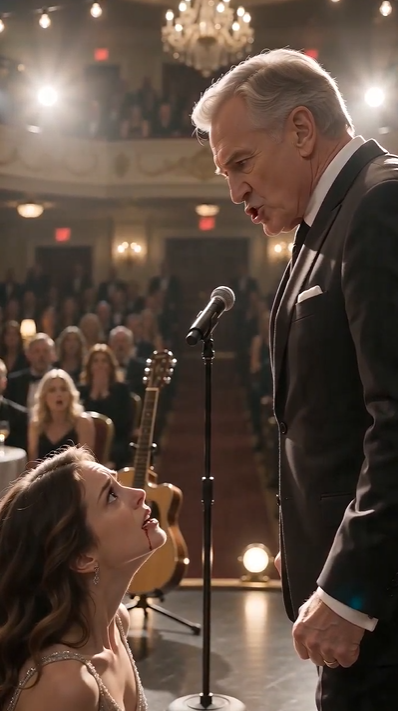
The Gilded Age Reckoning: How a Spilled Glass of Claret Exposed a Tycoon's Empire Built on Old Sins




The hospital corridors felt claustrophobic, heavy with the weight of illness and despair. I found Arthur Finch pacing nervously near the emergency exit, his face pale and drawn. He looked even more haggard than our last meeting, his usual meticulous composure completely gone. He clearly hadn’t slept since his anonymous call about Ryan.
I approached him, the crumpled map from Ryan’s coat still feeling warm in my pocket. He stopped pacing abruptly, his eyes wide with an unspoken question.
“Ryan,” I began, my voice tight with emotion. “He’s badly hurt, Arthur. But he gave me this.”
I pulled out the hastily drawn map, unfolding it for him to see. His eyes immediately darted to the network of tunnels, then to the dotted line marked with “X”s. His breath hitched.
“And he whispered something,” I continued, recounting Ryan’s broken words. “‘The old fault… the weakness… he knew…'”
Arthur stared at the map, his face draining of all color. He ran a trembling hand over his thinning hair. A profound wave of guilt washed over his features, etching lines of torment onto his already worried face. He looked like a man carrying the weight of decades of unspoken sins.
“He knew,” Arthur repeated, his voice barely a whisper, echoing Ryan’s last words. “God help us, he knew.”
He finally looked at me, his eyes filled with a desperate, crushing regret. The careful composure he had maintained for so long shattered. He leaned against the cold wall, his shoulders slumping.
“I warned him, Emily,” Arthur confessed, his voice choked with emotion. “Years ago. Before the dam was even completed. I saw the original surveys, the geological reports. They noted anomalies. Signs of instability beneath that specific tract of land. A… an ancient seismic fault, dormant but still present. A weakness.”
The specific cruelty of Charles’s actions, once again, revealed itself. Not just cutting corners on construction, but actively ignoring a fundamental, potentially catastrophic geological flaw. He had built his empire on a literal lie, cemented over an unstable foundation.
“I tried to tell Charles,” Arthur continued, his voice heavy with self-recrimination. “I presented him with the old reports, the original, robust blueprints. The engineers had accounted for it, designed specific reinforcing pilings, deep into the bedrock, to bypass that fault line. Expensive, yes, but crucial.”
He shook his head slowly, a bitter, humorless laugh escaping his lips. “He laughed at me. Called it ‘superstitious nonsense,’ just as he dismissed the farmer’s prophecies. Said it would add another half a million dollars to the construction cost. Unacceptable, he declared.”
Half a million dollars. Another specific, concrete number, a tangible price paid for Charles’s greed. A price that could be measured in lives, in shattered infrastructure.
“He ordered me,” Arthur whispered, his gaze dropping to the floor, “to falsify the inspection reports. To create a paper trail of fraudulent compliance. To ensure the permits were approved and the project continued as planned, without the ‘unnecessary’ expenditures.”
His voice broke, a raw, guttural sound of shame. “I did it, Emily. For years. I covered it up. I filed the fake reports, signed off on the fabricated safety audits. Because I was afraid. Afraid of him. Afraid of losing my pension, my family’s security. My conscience…” He trailed off, unable to finish the sentence.
The confession hung in the air, thick with guilt and despair. Arthur Finch, the meticulous accountant, had been a key cog in Charles Lockwood’s machine of deception. He had enabled the very catastrophe that now loomed.
“Why tell me now?” I asked, my voice soft.
He looked up, his eyes bloodshot. “Ryan,” he said, the name a painful whisper. “Seeing what Charles did to his own son… for trying to do what was right. And this map, Emily. This confirms it. Charles didn’t just ignore it. He actively suppressed the knowledge of that fault line. He literally buried the truth.”
“He knew this land was unstable,” I stated, the realization solidifying in my mind. “And he built a dam on it, knowing it would eventually fail.”
Arthur nodded, his face etched with a terrible certainty. “He knew. And now, with those old newspaper reports about the 1902 flood, the prophecies… it all connects. The land. The river. The fault line. It’s a disaster waiting to happen, Emily. A man-made disaster dressed up as natural misfortune.”
He wrung his hands, his gaze frantic. “The fake reports… I have copies of the originals. Tucked away. Just in case. Charles’s father kept them, and Charles never knew I made my own duplicate set. I thought someday, someone might need them. Someone might listen.”
The personal cruelty in this was profound. Charles didn’t just hurt people; he deliberately created conditions for disaster, then actively fabricated documents to hide his culpability. Arthur’s revelation about the falsified reports was the missing piece, providing not just historical context but irrefutable, legal evidence of Charles’s criminal negligence. It transformed vague accusations into concrete proof.
Arthur pulled a small, worn leather-bound diary from his inner coat pocket. “It’s all in here,” he whispered, pressing it into my hand. “The dates, the changes, the real specifications. And where to find the official, falsified copies that Charles used.”
His confession was a desperate act of atonement, a heavy burden lifted. But the enormity of what Charles had done, and what was still to come, pressed down on us both. The “reckoning” was not just a prophecy; it was a consequence that Charles Lockwood had deliberately engineered.
More Stories













+ There are no comments
Add yours