
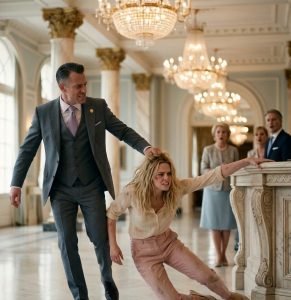
On Live TV, My Son's Celebrity Bride Shoved Me, Accusing Me of Sabotage—Until an Old Clause Turned the Tables


With Dexter Shaw’s 24-hour ultimatum bearing down on her, Bernice felt a renewed sense of urgency. She spent the evening with Aunt Clara Mae, poring over the cease-and-desist letter, dissecting every word. The specific legal terms used by Shaw’s firm, particularly phrases like “contractual obligations” and “implied consent,” seemed to trigger something in Aunt Clara Mae’s encyclopedic memory.
Aunt Clara Mae sat quietly for a long time, her eyes closed, her brow furrowed in concentration. Bernice watched her, her own anxiety mounting with every passing minute. She knew her sister was sifting through decades of knowledge, searching for the crack in Shaw’s carefully constructed armor. The silence in the room was heavy, punctuated only by the soft tick of the grandfather clock in the hall.
“Implied consent,” Aunt Clara Mae murmured, almost to herself. “They always tried to push that. ‘Implied consent’ for public spectacle. But that’s not how it worked, not for real. Not back then.”
Suddenly, her eyes snapped open, blazing with a triumphant clarity. She rapped her knuckles sharply on the coffee table. “Bernice! I remember! There was a specific industry guideline! From the early 1980s. When these ‘Family Narrative Rights’ clauses first started appearing in smaller record deals, there was a huge backlash.”
Bernice leaned forward, desperate for more. “A guideline? What kind of guideline?”
“The industry was still finding its footing with reality-based entertainment, and there were concerns about exploiting artists’ families too aggressively,” Aunt Clara Mae explained, her words coming faster now, fueled by the breakthrough. “So, a consensus formed among some of the major industry associations and even a few of the more ethical labels. It wasn’t a law, but it was a widely accepted principle, almost an unwritten rule that guided how these ‘narrative rights’ were interpreted.”
“What did it say?” Bernice asked, her voice barely a whisper.
“It explicitly clarified that ‘Family Narrative Rights’ clauses applied *only* to *non-public* family disagreements or discussions – the kind of background story elements that could be included in a documentary or a ‘tell-all’ book,” Aunt Clara Mae declared, a triumphant smile spreading across her face. “But it *specifically excluded televised physical confrontations or intentional public defamation* from their purview.”
Bernice felt a jolt of shock, then elation. “It excluded physical confrontations? And intentional defamation?” This was more than just a counter-clause; it was a complete invalidation of their entire scheme. The guideline directly addressed the precise cruelty she had endured.
“Yes! They realized if they allowed labels to stage physical altercations or publicly defame family members on live television, it would open the floodgates to endless lawsuits and destroy public trust,” Aunt Clara Mae explained, her voice rising with excitement. “It was meant to protect families, even those who had signed these broad ‘narrative rights’ clauses, from being actively set up for public humiliation. It was a measure, however small, to prevent the kind of predatory exploitation we’re seeing now.”
This forgotten guideline, a relic from a bygone era of the music industry, was a game-changer. It meant that even if the “intentional harm” sub-clause hadn’t been there, the very act of staging a public shove and accusation on live television fell outside the legitimate scope of the “Family Narrative Rights” clause. It was a double blow, a second, more powerful weapon against Dexter Shaw’s bluster. It confirmed that her humiliation was not only intentionally harmful but also explicitly beyond the scope of any implied consent.
“So, the wedding stunt… the shove, the accusation… it was a clear violation of this guideline?” Bernice clarified, trying to process the full implications.
“An egregious violation,” Aunt Clara Mae confirmed, nodding emphatically. “Dexter Shaw and Chantel’s team have crossed a fundamental line, a line the industry itself recognized decades ago. They can’t hide behind ‘creative storytelling’ when they’re actively staging defamation and physical confrontation on live television. That guideline makes it clear.”
Bernice felt a surge of strength she hadn’t known she possessed. The casual, dismissive way Dexter Shaw had presented her supposed “consent” suddenly seemed flimsy, almost pathetic. He was relying on her ignorance, on the fact that these obscure historical details were buried under layers of new contract law. But Aunt Clara Mae, with her incredible memory, had unearthed a critical piece of ammunition.
The guideline, though not a codified law, held significant weight in industry circles. It established a moral and ethical precedent that even the most ruthless fixers often respected, if only to avoid wider scandal and scrutiny. It made Chantel’s actions, and her team’s orchestration, appear even more cynical and manipulative. The specific, calculated staging of her public humiliation, broadcast live, was not only unethical but also a direct contravention of a long-standing industry standard. This was a specific, personal vindication of her experience.
“This changes everything,” Bernice breathed, clutching the cease-and-desist letter with new resolve. “They thought they had me trapped with my own signature. But now, we have the means to expose their entire plan.”
“We do,” Aunt Clara Mae agreed, a fierce pride in her gaze. “But Dexter Shaw won’t back down easily. He’ll try to discredit us, to dismiss this as ‘ancient history’ or ‘irrelevant.’ You have to be prepared to stand firm. And you have to remember everything you saw in that memo. The intent is key.”
Bernice nodded, her gaze hardening. The 24-hour deadline was still looming, but her fear had been replaced by a quiet, steely determination. She would go to that meeting. She would face Dexter Shaw, Chantel, and Marcus. And she would not be silenced. Armed with the knowledge of both the “intentional harm” sub-clause and the forgotten 80s guideline, she now had a formidable defense. The industry’s own history was on her side, a powerful counter-narrative against their carefully constructed lies. She would remind them of the rules they had forgotten, the ethics they had discarded in their ruthless pursuit of fame. The forgotten guideline felt like a shield, protecting her from their predatory tactics.
More Stories





+ There are no comments
Add yours