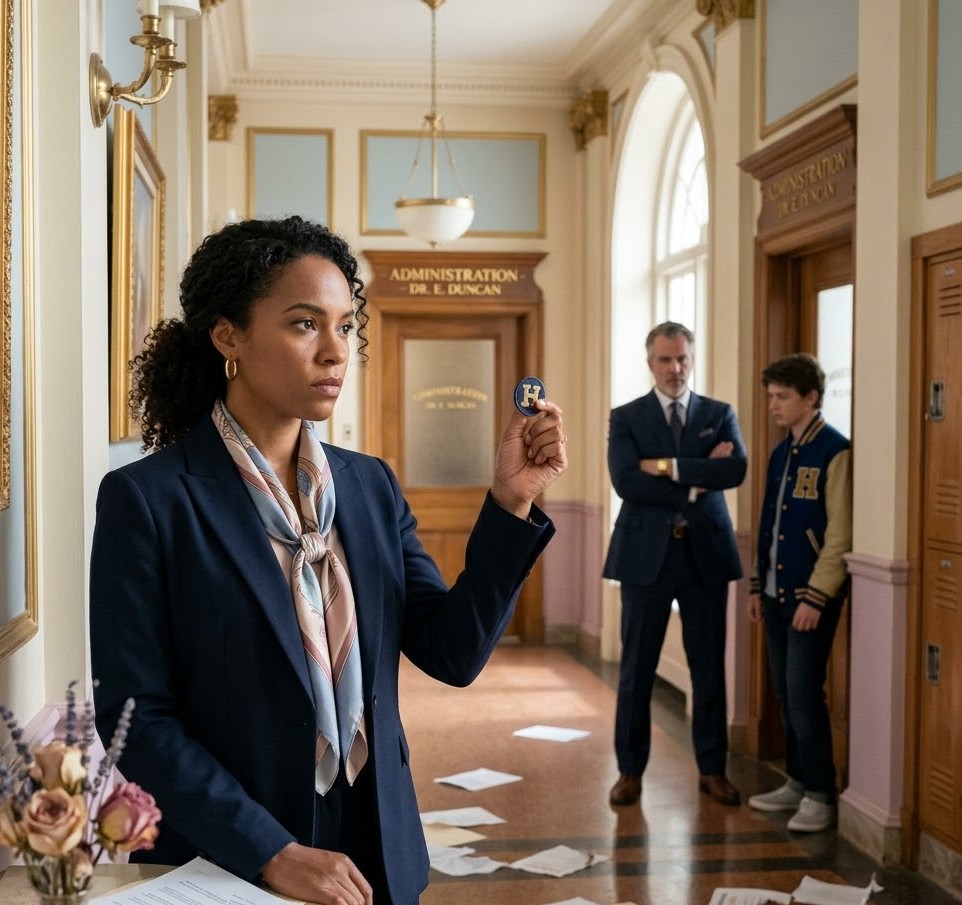
After My Son-in-Law Principal Framed a Student and Gaslit Me, A Witness Silenced for Years Finally Spoke Up


Attorney Ramirez wasted no time. Within days, the civil suit was filed, sending ripples through the tight-knit community of Northwood. The local news briefly covered the story, painting a picture of a respected teacher challenging a popular principal over a student’s scholarship. The school district, predictably, issued a bland statement defending Principal Jones and their disciplinary process.
The legal machinery, once a distant concept, now churned around me. Ramirez’s team immediately moved to subpoena Darnell Jones, Kevon Brooks, and Tashaun Smith. These were the boys I had seen near Jamal’s desk, the ones linked by the varsity button, the ones who held the truth.
The response from Marcus’s legal team was swift and aggressive. They immediately filed a motion to block the subpoenas, citing the students’ minor status and various privacy protections. The legal jargon was dense, but the message was clear: they wanted to shield these students from testifying, to keep their involvement hidden.
“They’re using every trick in the book,” Attorney Ramirez explained to me over the phone. “Claiming it’s an invasion of privacy, that their testimony isn’t relevant to your case, that it’s simply a fishing expedition designed to harass minors.”
“It’s a cover-up,” I stated, my voice sharp with frustration. “They know what those boys will say.”
“Exactly,” Ramirez agreed. “And they’re doing everything they can to prevent that testimony from ever seeing the light of day. This is standard procedure in these kinds of cases. The district will protect its employees and its image at all costs.”
The legal battle felt like a personal affront. It wasn’t just about obscure legal points; it was about silencing the truth, about protecting Marcus and Darnell at all costs. The very notion that the boys’ “privacy” outweighed Jamal’s ruined future was a cruel, institutional injustice. It highlighted the power imbalance, the way the system could be weaponized against the vulnerable. The official-sounding legal arguments felt like a deliberate attempt to obscure the simple, human cruelty at the heart of the matter.
I imagined Marcus, calm and confident, sitting with his lawyers, orchestrating this legal stonewall. He had orchestrated the cover-up, the gaslighting, the digital erasure. Now, he was leveraging the legal system itself to ensure the silence of the key witnesses. The cold, impersonal language of the legal filings felt like another form of gaslighting, attempting to twist clear facts into obscure procedural arguments.
“What are our chances of getting those subpoenas through?” I asked, my anxiety mounting.
“It’s a fight,” Ramirez admitted. “But we have strong arguments. We’re not asking them to admit to a crime, merely to provide testimony about events that led to Jamal’s suspension. Their statements are central to proving Principal Jones’s abuse of power and the fraudulent nature of Jamal’s disciplinary action.”
The legal maneuvering continued for weeks, a tedious dance of filings and counter-filings. Each motion, each response, was a small, drawn-out battle. It drained time, energy, and resources. It was a deliberate strategy, I realized, to wear me down, to make me give up. The cold, dismissive tone of the opposing counsel, often relayed through Ramirez, made me feel insignificant, my concerns easily brushed aside as irrelevant. It was a constant, subtle reminder of the vast resources I was up against.
“They are particularly insistent on blocking Tashaun Smith,” Ramirez noted during one call, a hint of curiosity in his voice. “More so than Darnell or Kevon.”
That detail snagged my attention. Why Tashaun? He was always the quietest, the most withdrawn of the three. He seemed easily intimidated, not someone who would actively defy Marcus. The specific targeting of Tashaun felt deliberate, almost as if Marcus knew Tashaun was the weakest link, the one most likely to crack under pressure. It was a chilling thought, hinting at a deeper secret. Marcus’s lawyers were not just attempting to protect their clients; they were trying to muzzle a specific voice, and that meant Tashaun likely knew something critical. The specific focus on Tashaun was a quiet, insidious cruelty, targeting the most vulnerable of the boys.
More Stories
















+ There are no comments
Add yours