
After My Son-in-Law Principal Framed a Student and Gaslit Me, A Witness Silenced for Years Finally Spoke Up


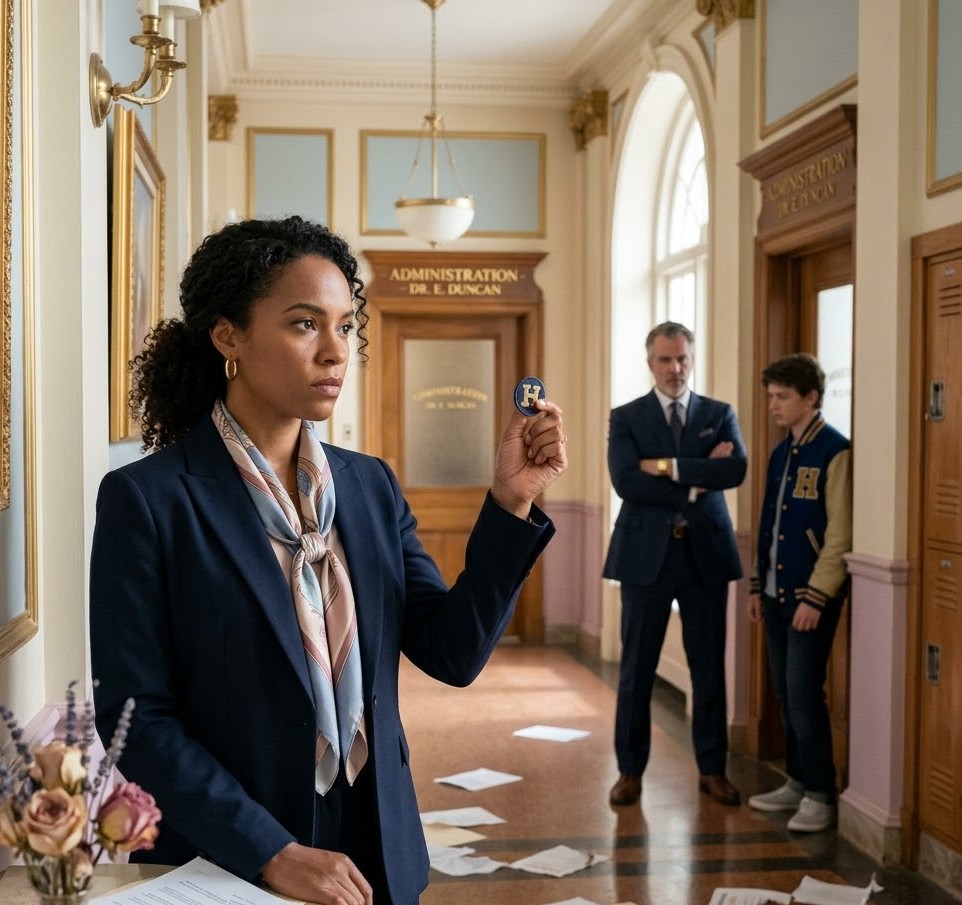


The contentious court hearing to rule on the student subpoenas finally arrived, filling the small courtroom with a tense, expectant energy. I sat beside Attorney Ramirez, my hands clasped tightly, trying to project a calmness I didn’t feel. Marcus sat on the opposite side, impeccably dressed, his posture radiating confident authority. He didn’t look at me, but I could feel his presence, a cold weight in the room.
Marcus’s lawyer, a sharp, unyielding woman named Ms. Thorne, began her arguments, detailing why the students’ privacy should be protected. She spoke of the emotional fragility of minors, the potential for intimidation, the need to shield them from a public spectacle. Her voice was clinical, detached.
Then, she focused on Tashaun Smith.
“Furthermore, Your Honor,” Ms. Thorne stated, her voice rising slightly, “Mr. Smith, in particular, has a documented history of severe anxiety.”
A ripple went through the courtroom. I felt a jolt of surprise. Severe anxiety. My mind flashed back to Tashaun, always quiet, often withdrawn, his eyes frequently darting nervously. It made sense.
“We have here a therapist’s note,” Ms. Thorne continued, holding up a document. “Which details Mr. Smith’s struggles with generalized anxiety disorder, panic attacks, and a propensity for extreme distress under pressure.”
Ramirez leaned closer to me, his voice a low whisper. “They’re trying to portray him as unreliable, emotionally compromised.”
This was their strategy: discredit Tashaun, the quietest and potentially most vulnerable witness, before he even had a chance to speak. It was a calculated move, and another insidious layer of gaslighting, twisting a genuine medical condition into a character flaw. The public revelation of Tashaun’s anxiety felt like a profound, personal cruelty, exploiting his vulnerabilities to serve their agenda. It was a violation of his privacy, laid bare for a legal advantage.
But as Ms. Thorne continued to explain how Tashaun’s anxiety would make his testimony inherently unreliable, a different thought formed in my mind.
Ramirez caught my eye, a subtle understanding passing between us. “Your Honor,” he interjected, his voice firm but respectful, “while we acknowledge the privacy concerns of all minors, and indeed Mr. Smith’s particular health circumstances, we argue that this information actually *strengthens* the need for his testimony.”
Ms. Thorne looked visibly annoyed by the interruption. “Strengthens it, counsel? How so?”
“It provides crucial context, Your Honor,” Ramirez explained, his gaze direct. “If Mr. Smith indeed suffers from severe anxiety, that could make him particularly susceptible to coercion or pressure from authority figures. His potential silence in the face of an injustice might be attributed to this very condition, rather than a lack of knowledge or complicity.”
The courtroom fell silent. A new, unsettling possibility had been introduced. Tashaun’s anxiety, which Marcus’s lawyers had used as a shield, could now be seen as a reason for his past silence, a silent plea for understanding. It gave him a motive for not coming forward earlier, a reason for his potential vulnerability to Marcus’s threats. It was a crack in Marcus’s carefully constructed wall of silence, a glimmer of vulnerability in the entire case. The attempt to weaponize Tashaun’s medical history had backfired, creating an unexpected opening.
The judge, a stern woman with an impassive face, listened intently, then rapped her gavel. “I will consider this point carefully.”
She then ruled: the students would indeed be subpoenaed, but their testimony would be taken in a closed session, with strict privacy protocols. It wasn’t a full victory, but it was a crucial one. We would get to hear from Darnell, Kevon, and, most importantly, Tashaun. The discovery of Tashaun’s anxiety, presented by Marcus’s own lawyer, had inadvertently given us a powerful new perspective, turning a weakness into a potential strength. The cold, hard fact of his diagnosis offered a human explanation for his silence, suggesting that his conscience, though suppressed, might still be very much alive. This detail shifted the entire dynamic, suggesting that his quietness wasn’t indifference, but a profound internal struggle.
More Stories









+ There are no comments
Add yours