
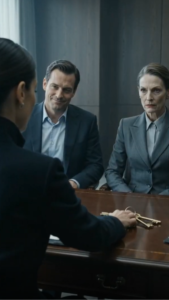
You sold your entire career and reputation to marry a dying 72-year-old woman, Marcus, Julian Cross sneered across the mahogany conference table, tossing the tabloid front page between our coffee...


The weight of Senator Fairview’s public summons pressed down on me like a physical burden. Two places at once, facing either arrest or absolute defeat. It was a classic pincer movement, designed to ensure my complete annihilation.
But I wasn’t dead yet.
I found a quiet corner in a university library, its atmosphere more academic than the public one, and dove into the obscure world of New York Corporate Code. I wasn’t just looking for a way to fight; I was looking for a back door, a hidden passage.
Hours blurred into the late Tuesday night, my eyes burning from the screen glare. I scrolled through dense legal texts, corporate bylaws, and old court precedents, searching for any clause, any regulation that might offer a way out of Julian’s trap.
Then, buried deep within the intricate framework of corporate governance, I found it. An overlooked mandate. Article 9: Emergency Board Proceedings.
It was a contingency clause, designed for situations of extreme corporate malfeasance where immediate action was required. It stated that an active compliance officer — or a former compliance officer with documented standing – holding physical evidence of active material fraud could invoke its provisions.
The critical part: I wouldn’t need to be present for a full legal defense or even to be formally recognized by the board for a vote. I could simply *stall* a board vote without attending in person, provided two specific conditions were met.
First, the evidence had to be undeniably “material fraud.” My proof of Julian’s ghost marriage, the $12.5 million embezzlement, and the expired Section 14-B of the bylaws certainly qualified.
Second, the physical evidence had to be *personally served* to the presiding Chief Risk Officer during live proceedings.
Arthur Kincaid, the Chief Risk Officer. The neutral bureaucrat who wanted only to avoid corporate collapse. He was my target.
This meant I wouldn’t be going to Albany. I would be going straight to the Wright-Cross boardroom. I would risk immediate arrest, bypass all the official channels, and deliver the truth directly into the hands of the one person who could legally acknowledge it and pause the proceedings.
I started drafting a formal Article 9 petition, its language sharp and direct. It detailed Julian’s fraudulent proxy, the expired Section 14-B, the $12.5 million theft, and the evidence of forgery.
My plan was risky. Insane, even. But it was the only way to break Julian’s chokehold, to honor Eleanor’s final wish, and to force a reckoning for his decades of lies.
More Stories










+ There are no comments
Add yours