I was driving my haul truck down Route 15 near Greenwich at 2:00 AM when I saw a starving Golden Retriever dragging a taped wooden crate across the dark asphalt.


Part 1
Inside the crate were four newborn puppies, shivering beneath filthy rags.
I loaded them into my truck and brought them straight to our private garage, calling my wife Clara to help me revive them.
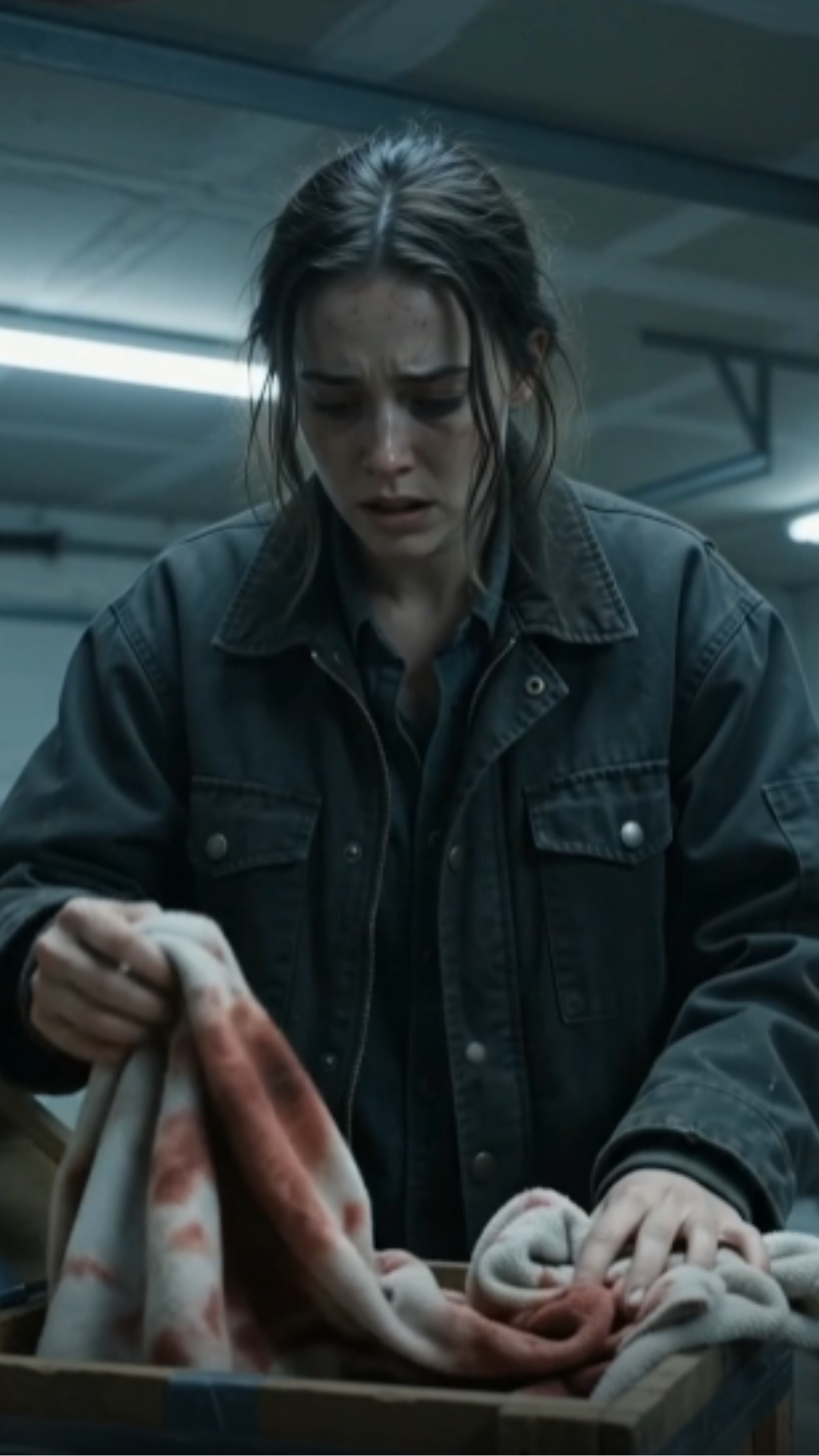
As Clara pulled away the blood-soaked towels, she gasped and pulled out a faded plastic hospital ID bracelet hidden in the lining.
“This is from the psychiatric wing at Greenwich General,” she whispered, staring at the typed patient name.
“And it belongs to my mother, who died three years ago.”
The air in our private garage, usually thick with the smell of diesel and engine grease, now carried the faint, unsettling scent of cold highway asphalt and damp dog fur. My hands, still raw from pulling the large wooden crate from the road, trembled slightly as I helped Clara set up a makeshift bed.
We used an old laundry basket lined with fresh towels and a heating pad. The four tiny puppies, no bigger than my fist, whimpered softly, their eyes still sealed shut.
The mother dog, a beautiful Golden Retriever with matted, mud-caked fur, watched us with weary, intelligent eyes. Her ribs jutted out sharply beneath her coat, a stark testament to her ordeal. She lay protectively next to the basket, nudging her nose against the smallest pup.
Clara, usually so pristine in her silk robes, knelt on the cold concrete floor, her expensive fabric dusting with bits of straw and road debris. She moved with a surprising tenderness, gently wiping away the filth from one of the shivering newborns.
“They’re so fragile, Miguel,” she murmured, her voice soft with pity.
I knelt beside her, my focus on the mother dog. I offered her a bowl of water, which she lapped at greedily, then a handful of premium kibble from a bag we kept for stray cats. She ate slowly, deliberately, her eyes never leaving her babies.
Clara carefully removed the blood-soaked towels and rags from the bottom of the old wooden crate. The wood was rough, splinters catching on the worn fabric. It was crudely constructed, clearly not meant for an animal, or at least not for long.
“Who would do this?” Clara whispered, more to herself than to me.
Her fingers brushed against something hard, tucked deep into a torn section of the crate’s lining. She paused, pulling out a small, faded piece of plastic. It was a hospital ID bracelet, the kind they put on patients.
“What’s this?” I asked, my brow furrowing.
Clara held it closer to the dim light of the overhead garage lamp. Her breath hitched.
“It’s from Greenwich General,” she said, her voice barely audible.
I watched her face, the way her eyes widened. Her skin, usually so smooth and calm, seemed to lose its color.
“The psychiatric wing,” she added, her gaze fixed on the typed name.
A chill snaked up my spine, despite the warmth of the heating pad. Our garage, just moments ago filled with the quiet comfort of our shared rescue, suddenly felt very cold.
“Miguel…” she whispered, her voice cracking.
Her hand trembled violently as she held out the bracelet, the plastic glinting under the harsh light. The name typed on it, in crisp, official lettering, was undeniably clear.
“Audra Montgomery,” she read, the words a raw, guttural sound.
My own blood ran cold. Audra Montgomery. Clara’s mother. She had died three years ago. A quiet funeral, a sudden illness. That was the story.
The mother dog, who had been resting, suddenly sprang to her feet. A low, guttural growl rumbled in her chest, a sound of primal fear and aggression.
Her hackles rose.
Her eyes, moments ago filled with exhaustion, were now wide and wild. She stared directly at Clara, her body tense, every muscle coiled.
Clara, still holding the bracelet, reached out a hand reflexively, as if to soothe the distressed animal.
“Hey, girl, it’s okay,” she murmured, attempting to make a calming sound.
It was the wrong move.
The dog lunged.
Not at Clara to bite, but a desperate, wild scramble, a terrified lurch away from her touch, away from her scent. The sudden, violent movement was unexpected. The dog collided with the antique display cabinet I kept in the corner, filled with old trophies and tools.
The glass cabinet, a heavy, ornate piece Clara had insisted on moving into my “man cave” garage years ago, wobbled precariously. It was a dark mahogany, filled with dusty, polished tools and small, sentimental items from my childhood.
It crashed to the concrete floor with a deafening shatter.
Glass exploded, scattering across the garage. The metallic clang of tools mixing with the tinkling shards.
And there, where the cabinet had stood, was a small, dark iron box. It was locked, nestled into a recess in the concrete wall, completely hidden from view until now.
Part 2
Shards of glass glittered under the harsh garage lights. The mother dog whimpered, backing away from Clara and huddling protectively over her puppies.
The locked iron box in the concrete recess went unnoticed by Clara. Her eyes were fixed on the dog, then on the hospital bracelet still clutched in her hand.
“Audra Montgomery,” she repeated, her voice a fragile whisper. “My mother.”
The dog, still trembling, let out a low, distressed whine. Its fear was palpable.
“She’s microchipped,” I said, my mind racing. Most responsible breeders, even the private estate ones, chipped their animals. It was standard practice.
I moved past the shattered cabinet, ignoring the glinting glass. I walked over to my work bench and grabbed my fleet asset tracker, a heavy-duty handheld scanner I used for inventorying equipment.
Clara watched me, her face a mask of disbelief.
The scanner hummed to life with a quiet beep. I knelt beside the mother dog, gently moving my hand over her neck and shoulder blades.
Another beep. The scanner screen lit up, displaying a series of numbers and then a name.
“Evelyn Montgomery,” I read aloud, my voice flat. My stepmother-in-law.
“Montgomery Estate Kennels.”
Clara gasped, dropping the hospital bracelet. It clattered against the concrete.
“No,” she whispered, her eyes wide with terror. “Miguel, no.”
I stared at her, then back at the screen. “Evelyn? Why would your mother’s dog be registered to Evelyn’s private kennels? Your mother died three years ago, Clara.”
Her face went pale, a sickly white against her dark hair. She shook her head, frantically.
“Don’t,” she pleaded, her voice barely audible. “Please, don’t. Evelyn will destroy us. She controls everything. She’ll ruin your business.”
Her plea was desperate, a raw, naked fear I hadn’t seen in her before. But it didn’t make sense. If Evelyn was involved, and Audra was supposedly dead, this whole story was a lie.
I looked down at the terrified dog, then at the hospital bracelet on the floor, then back to Clara.
“I’m going to find out what really happened,” I said, my voice quiet but firm.
More Stories


+ There are no comments
Add yours