
After My Son Tripped a Billionaire, He Publicly Humiliated Him and Kicked His Prosthetic Leg — Then He Vowed to Ruin My Life


The scent of antiseptic and lukewarm coffee hung in the air, a stark contrast to the cloying perfume of the Starfall Gala. I adjusted the stack of brochures for “Legs for Little Ones,” a local charity supporting pediatric prosthetic care, trying to project an air of calm I didn’t feel. Weeks had passed since Alaric Beaumont’s lawyers sent their letter, but the chill of social isolation still clung to me like a shroud.
My best friend, Olivia, had encouraged me to volunteer, insisting a change of scenery would help. Yet, even in this small, genuinely compassionate gathering, I felt eyes on me, whispers cutting through the murmur of conversation. A woman I vaguely recognized from Ethan’s school board walked past, her gaze flicking over me without acknowledgment, her lips barely parting as she murmured something to her companion.
It was a small, quiet cut, but it stung.
I moved to straighten a display of brightly colored prosthetic covers, a knot forming in my stomach. The humiliation had been so public, so absolute, and Alaric’s subsequent campaign had left me doubting my own perceptions. Was I truly an unstable opportunist, as the rumors claimed?
A woman with kind, intelligent eyes and a name tag reading “Dr. Vivian Albright, Geneticist” approached my table. She offered a warm smile, picked up a brochure, and nodded towards the small, joyful gathering of children playing at the far end of the hall.
“It’s incredible work they do here,” she said, her voice soft but clear.
I managed a weak smile in return. “It really is.”
“I specialize in inherited neurological disorders,” Dr. Albright continued, her gaze thoughtful. “Many of these children, bless them, face challenges that highlight the incredible complexity of the human body. Sometimes, behaviors we perceive as purely psychological or malicious have surprising biological roots.”
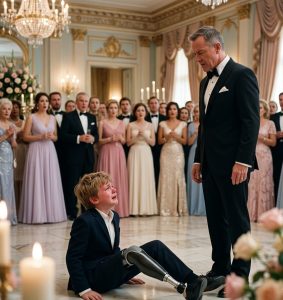
Her words hung in the air, a strange echo to my own recent torment. I found myself recounting, almost without conscious decision, the incident with Alaric. I focused on the raw, irrational fury in his eyes when Ethan fell, the casual cruelty of his kick, and then the utterly cold, almost practiced denial that followed.
“He just… changed,” I explained, my voice barely a whisper. “From pure rage to complete dismissal, as if I was imagining things.”
Dr. Albright listened intently, her brow furrowing slightly. She didn’t interrupt, just absorbed every detail. Her gaze was not one of judgment, but of scientific curiosity, making me feel heard for the first time in weeks.
“That shift,” she mused, tapping a finger against her chin. “Extreme disinhibition, followed by a complete lack of emotional recall or empathy for the incident itself… it’s a pattern.”
A chill traced its way down my spine, replacing the earlier sting of social ostracization. “A pattern of what?” I asked, my voice suddenly hoarse.
“In my field, we sometimes see such rapid, inexplicable swings in temperament associated with certain rare neurodegenerative disorders,” she explained. “Conditions that affect the brain’s frontal lobe, which governs impulse control, judgment, and emotional regulation.”
The idea was shocking, almost absurd. Alaric Beaumont, the epitome of ruthless control and calculated power, suffering from a medical condition? My mind immediately rejected it. He was simply a cruel man, a bully driven by ego and privilege.
“You think… he’s sick?” I asked, a disbelieving laugh escaping my lips. “He’s just an arrogant, vindictive man.”
Dr. Albright held my gaze, her expression unwavering. “Of course, I can’t diagnose anyone without a thorough examination and medical history,” she clarified. “But extreme, unprovoked rage followed by such a complete, almost delusional denial of the event, especially when combined with a history of similar ‘eccentricities,’ can sometimes be symptoms.”
The word “eccentricities” made me pause. Alaric’s reputation for sudden, cutting remarks and abrupt dismissal of people who displeased him was legendary. Everyone knew he was difficult, but they attributed it to his wealth and power. Could there be something else?
“It’s fascinating how the brain works,” Dr. Albright continued, sensing my internal struggle. “What looks like pure malice to an outsider might, in some rare cases, be the tragic manifestation of an internal struggle, a disease that warps personality and perception.”
I stood there, brochures forgotten, my mind racing. The notion that Alaric’s cruelty might not be entirely his fault, but rather a symptom of something beyond his control, was unsettling. It didn’t excuse his actions, not in the slightest, but it added a disturbing layer to the malice I had so readily assigned him.
“You really think it’s possible?” I asked again, the question loaded with the weight of my past weeks of anger and confusion.
“Anything is possible when dealing with the intricacies of genetics and neurology,” she replied, her gaze serious. “Our understanding of the brain is constantly evolving. What was once dismissed as a character flaw, or even a ‘curse,’ can sometimes be traced back to a specific gene.”
I felt a sudden, profound shift within me, a subtle tremor that had nothing to do with physical weakness. The conversation had provided not a solution, but a profound new question, changing the lens through which I viewed my tormentor. Alaric Beaumont might not just be a villain; he might be a victim too, trapped in a body and mind betraying him.
The thought didn’t bring comfort, not yet. It brought a chilling new kind of confusion, adding another layer to the already complex tapestry of my life.
“Thank you, Dr. Albright,” I said, the words feeling inadequate for the new perspective she had just offered.
“Please, call me Vivian,” she responded, offering a small, reassuring smile. “If you ever wanted to discuss this further, or if any other details come to mind, my card is in the brochure.”
She took one of her own cards from her purse and tucked it into my hand, her fingers cool against mine. I watched her walk away, her presence a beacon of unexpected scientific objectivity in a world that had felt increasingly personal and hostile. The gaslighting had made me question myself, but Vivian’s theory, however remote, made me question Alaric in a way I hadn’t before.
Could there truly be a hidden secret, a medical one, behind his venomous cruelty? The thought was terrifying, and strangely, compelling.
More Stories








+ There are no comments
Add yours