
Sign the severance deed and take this black card, Eleanor—you have ten minutes to clear your things before the international investment board arrives, my neighbor Arthur Halloway said, sliding th...


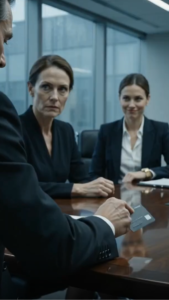
Arthur Halloway stood at the head of the polished oak table, a wide, confident smile spreading across his face. Sunlight, now free from the storm clouds, streamed through the panoramic windows of Halloway Capital’s executive boardroom. He addressed his investment board, a dozen men and women in impeccably tailored suits, all eager for the next phase of the $1.2 billion port expansion.
“With the Kincaid estate finally secured,” he announced, his voice booming with satisfaction, “we can now accelerate Phase Two. The permits for dockage and deeper dredging should clear within the next two weeks.”
He paused, letting his words hang in the air, a sense of triumph radiating from him. He expected applause, or at least a ripple of approving murmurs. Instead, the room remained silent, a few board members exchanging uneasy glances.
Arthur ignored them, his gaze sweeping over the blueprints spread before him. He still believed he had Eleanor Kincaid’s signature on a severance deed, freeing the forty-two acres for his commercial ambitions.
Meanwhile, I felt the chill of that sunshine even through my kitchen window. The phone call had come just an hour ago from the Greenwich Country Club.
“Mrs. Kincaid,” the club manager’s voice had been clipped, apologetic in a practiced way, “I’m afraid the board has voted to revoke your forty-year membership, effective immediately.”
My hand tightened on the receiver. “On what grounds?” I asked, my voice steady despite the sudden ice in my stomach.
“Concerns have been raised regarding… your current health, Mrs. Kincaid,” he stammered, clearly uncomfortable. “Specifically, reports of cognitive decline.”
It wasn’t just the club. An email had arrived moments before that, from the North Shore Neighborhood Association, canceling my upcoming election to the historical preservation committee. The reason given was vague, citing a need for “members with full capacity to manage complex municipal engagements.”
I knew exactly where these whispers originated. Arthur.
He had started it weeks ago, subtle at first, a sympathetic shake of his head to a mutual acquaintance, a whispered concern about my “recent forgetfulness” at a charity gala. Now, he was turning the screws, leveraging my age, transforming polite society into a wall of whispers and exclusions. He believed that isolating me, making me seem unstable, would force me to concede.
He wanted to cut me off from any local support, any voice that might rise in my defense.
It was a tactic I hadn’t foreseen, a cruel manipulation of community trust. I looked out at the familiar, sprawling green of my lawn, bordered by the dense tree line that marked Arthur’s property. The thought of him, so casually fabricating lies, sent a shiver down my spine.
Then, a detail clicked into place. Two years prior, my late husband had been fighting an early battle against Arthur’s encroaching development plans. He’d mentioned a sudden, inexplicable reclassification of a wetland parcel near our property line – a reclassification that cleared the way for industrial use.
At the time, it had seemed like a bureaucratic anomaly. Now, it felt like a cold, calculated move. Arthur hadn’t just *persuaded* the zoning board, as the rumors suggested. He’d likely outright corrupted it. He’d started laying the groundwork for this takeover long before my husband’s passing, altering public land registry records to pave his way.
This wasn’t just about my land. It was about his ruthless, intricate network of influence, twisting every lever of local power. My quiet fight was about to become much louder.
More Stories










+ There are no comments
Add yours