
Sign the severance deed and take this black card, Eleanor—you have ten minutes to clear your things before the international investment board arrives, my neighbor Arthur Halloway said, sliding th...


I called Julian Barrett as soon as I got home, my voice barely containing its excitement. He agreed to meet me at my estate that afternoon. He arrived carrying a worn leather satchel, a magnifying glass, and a small, heavy volume on Connecticut state trust law.
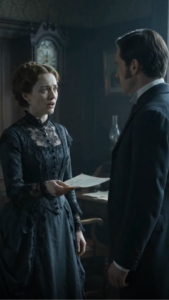
I laid the 1912 letter on my dining room table, its fragile paper stark against the dark wood. Julian carefully put on his reading glasses, picked up the letter, and began to examine it. He read every word, his lips moving silently, then reached for his magnifying glass, scrutinizing the texture of the paper, the ink, the official seal pressed into the bottom corner.
“This is remarkable, Eleanor,” he finally said, his voice quiet, almost reverent. “Absolutely remarkable.”
He reached into his satchel and pulled out a thin, yellowed document – a copy of a 1910 municipal resolution he’d found in his own archives before coming over. “This confirms the context,” he explained, pointing to a paragraph. “It details the town’s initiative to establish public-private conservation agreements with prominent families. Your husband’s grandfather, Thomas Kincaid, was instrumental in that effort.”
Julian then consulted his law book, flipping to a specific section. “Under Connecticut General Statutes § 47-2, regarding ‘Rule Against Perpetuities,’ and more importantly, § 47-32, ‘Charitable Trusts,’ this covenant is ironclad.”
He tapped the 1912 letter with a precise finger. “The language here, ‘unextinguishable perpetual municipal conservation trust covenant,’ places the 42 acres in a unique legal category. It means the land essentially belongs to the public trust, stewarded by your family. It’s not private fee simple land in the way Arthur Halloway understands it.”
My mind whirled. “So, he can’t just buy it?”
“No,” Julian confirmed, his gaze unwavering. “He can’t. The letter explicitly states it cannot be sold, developed, or converted to commercial usage without a ‘unanimous vote of all original founding family heirs.’ And even then, the core ‘conservation trust’ intent would remain.”
“But… what about the zoning changes he pushed through?” I asked, remembering my earlier realization about Arthur bribing the zoning board.
Julian shook his head. “Irrelevant. A perpetual trust covenant, especially one established with municipal blessing over a century ago, supersedes modern zoning. Zoning boards can’t unilaterally overturn a foundational trust designed to protect public interest.”
He added, “This is why modern digital registries missed it. It was never about a simple deed transfer. It was a covenant, a trust, established by resolution and recorded in specific, older archives, not just land titles. A digital search for ‘Kincaid Point ownership’ would only show surface-level fee simple records, not this deep, underlying trust.”
A wave of relief, so profound it almost buckled my knees, washed over me. All of Arthur’s machinations – the lies, the frozen accounts, the isolation, the alleged embezzlement, the bribed zoning officials – all of it was built on a fundamental misunderstanding of what he was actually trying to acquire. He wasn’t dealing with private property; he was encroaching on a public trust.
“This,” I said, holding the fragile letter, “changes everything.”
Julian smiled, a genuine, warm smile. “Indeed it does, Eleanor. Indeed it does. Arthur Halloway has underestimated the endurance of old paper, and the quiet power of a legacy truly preserved.”
This wasn’t just a legal document. It was a shield, forged in history, solidifying my family’s claim, and rendering Arthur’s entire corporate buyout plan utterly impossible.
More Stories







+ There are no comments
Add yours