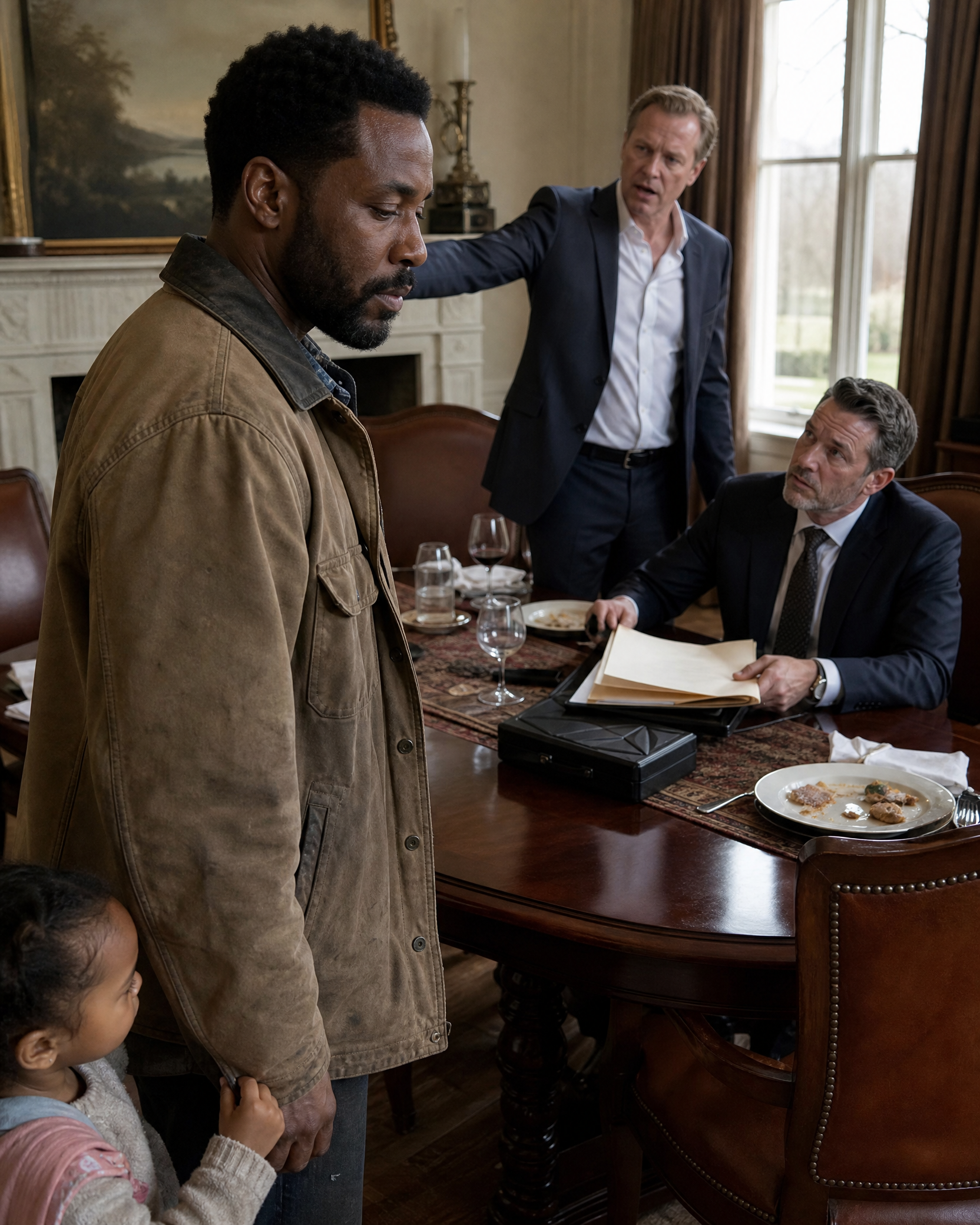
An Invitation to My Aunt's Mansion Uncovered a Mechanic's Secret Link to Our Town's Worst Corporate Scandal and Its Fifty Million Dollar Betrayal


The next morning, a thin mist still hung over Havenwood as I drove my old sedan towards Evan Thomas’s auto repair shop. The familiar scent of oil and gasoline hit me as I pulled into the gravel lot, a stark contrast to the perfumed air of Elara’s mansion. Evan was under a hoisted pickup truck, a wrench in his hand, his face streaked with grease.
His posture was rigid, reflecting the burden he carried. I felt a pang of shame for my initial dismissal of him, my hasty judgment. I had seen him as just a small-town mechanic, unaware of the deep historical roots his family had in Havenwood’s greatest tragedy. His family’s pain, I now understood, was entwined with my own.
I stepped out of my car, the crunch of gravel under my feet announcing my presence. Evan slid out from under the truck, wiping his hands on a rag, his expression unreadable. His eyes, though, held a flicker of something raw, something the gala had clearly ignited.
“Evan,” I began, my voice softer than I intended. “I wanted to apologize for how I acted yesterday. For my assumptions.”
He just nodded, his gaze distant, focused on something beyond the dusty shop. His silence felt heavy, a wall built from years of pain and distrust.
“I didn’t understand the half of it,” I continued, stepping closer. “Not until last night.”
His eyes finally met mine, a flicker of curiosity breaking through his guarded demeanor.
“I found something,” I said, my voice dropping to a near whisper. “My grandfather’s journal. He was a foreman at Atlas Energy.”
Evan’s jaw tightened at the mention of the company. He threw the rag onto a nearby workbench with more force than necessary.
“Atlas Energy cost my grandfather everything,” he stated, his voice flat, devoid of emotion. “Cost my family generations of peace.”
“I know,” I replied, my voice filled with genuine regret. “My grandfather, George Johnson, he documented the faulty pipeline construction. And he was overruled by Elias Washington himself.”
Evan’s eyes widened slightly, a hint of surprise breaking through his stoicism. He stepped away from the workbench, leaning against a stack of tires.
“My grandfather, Thomas Thomas,” he began, his voice gravelly, “he was a whistleblower. Tried to expose the negligence. Atlas Energy silenced him. Blacklisted him from every decent job in this county.”
He gestured vaguely around the small, grease-stained shop.
“This,” he said, indicating the shop, “is all we had left. A legacy of fixing what others broke, because Atlas broke everything else.”
A specific, sharp pain resonated within me. I remembered stories of families forced to sell their homes, their treasured belongings, just to survive. I pictured Evan’s grandfather, a man of integrity, being systematically stripped of his livelihood. The betrayal was so profoundly personal, so mundane in its cruelty. His family had been forced to take back a worthless “Employee of the Year” certificate, framed but meaningless, after his public shaming, a specific humiliation they had never forgotten. They had even seen their names intentionally removed from local historical records, painted over in the old town hall archives.
“They made an example out of him,” Evan continued, his voice laced with bitterness. “Made sure no one else would dare speak up. My father, he never fully recovered from the shame, the constant suspicion from folks who believed Atlas’s lies.”
“My grandfather wrote about a ‘contingency for the guardians’,” I interrupted, needing to share the revelation from the journal. “Elias Washington promised him, if the worst occurred.”
Evan pushed himself off the tires, his expression a mixture of confusion and guarded hope.
“A contingency?” he repeated, the words slow and thoughtful. “What could that mean?”
“I don’t know yet,” I admitted, shaking my head. “But it suggests he wasn’t entirely a villain. That perhaps he had a plan to make amends, even if it was hidden.”
He ran a hand over his face, leaving a streak of grease across his forehead.
“My grandfather kept things too,” Evan confessed, his voice barely audible. “A ledger. But it’s coded. My father tried for years to crack it, but he never could.”
“A coded ledger?” I asked, a spark of excitement igniting in my chest. “Do you still have it?”
Evan hesitated, his eyes scanning the cluttered shop, then the open doorway. It was clear he was weighing trust against years of inherited caution.
“Yes,” he finally said, his gaze returning to mine. “It’s in a safe place. It outlines illicit payoffs, land transfers… but the last sections, the ones he called ‘Atlas’s Debt,’ are gibberish.”
“This could be it, Evan,” I urged, a new urgency in my voice. “The other half of the puzzle. My grandfather’s journal, your grandfather’s ledger. They could be two sides of the same story.”
He remained silent for a long moment, the whir of a distant machine the only sound in the shop. He looked out at the street, a troubled expression on his face. He was clearly imagining the ripple effect this might have, not just on him, but on his daughter, Jasmine.
“My daughter, Jasmine,” he said, his voice softer now. “She deserves a future free from this ghost. A future not shadowed by Atlas Energy’s poison.”
“This isn’t just about the past anymore, Evan,” I responded, meeting his gaze directly. “This is about Havenwood’s future. About breaking this cycle of silence and betrayal.”
He looked at me, a glimmer of resolve hardening his eyes. The guarded mechanic was giving way to the man burdened by a quest for justice. The misunderstanding between us had finally lifted, replaced by a shared purpose.
“Let me finish this,” he said, nodding towards the truck. “Then we talk. About everything.”
I understood. He needed to prepare, just as I had. The secrets of Atlas Energy were beginning to unravel, and Evan Thomas, the quiet mechanic, was now a vital part of that unraveling. We were finally on the same side, bound by our grandfathers’ shared, painful legacies.
More Stories



+ There are no comments
Add yours