
When a Hollywood Celebrity Handler Survives a $15 Million Staged Brake-Failure Crash Engineered by Her Neighbor and Husband, She Crashes Her Memorial with Telemetry Evidence to Destroy Their Empire.


Julian’s legal maneuver, using my own family to question my sanity, felt like a cold shower. But it also clarified something: he was desperate. That desperation gave me an idea.
“Sloane Montgomery,” I said to Detective Reyes a few days later. “Julian’s old business partner. They had a nasty split in 2017.”
Reyes raised an eyebrow. “What about him?”
“Sloane always hated Julian’s shady dealings,” I explained. “He tried to warn me once, years ago, about Julian’s ‘creative accounting.’ He walked away from their label, lost millions, rather than be associated with Julian’s fraud. He regretted not speaking up more.”
Reyes gave a slow nod. “A disgruntled ex-partner. Worth a shot.”
Getting a meeting with Sloane wasn’t easy. He lived off-grid now, running a small, independent music production house in Silver Lake, far from the Hollywood glitz he’d once commanded. He still looked like a rock star, albeit a world-weary one, with long, graying hair and eyes that had seen too much.
He met me in a dimly lit recording studio, the air smelling of old vinyl and ambition.
“Nora,” he said, his voice raspy, “I heard what happened. I’m sorry.”
“Julian tried to kill me, Sloane,” I stated, cutting straight to it. “And he’s trying to use my mother and sister to prove I’m insane.”
Sloane ran a hand through his hair. “Sounds like Julian. Always finding the weakest link, pulling the strings.”
“You said you had dirt on him once,” I pressed. “Corporate fraud. Anything that could help expose his financial motives now?”
He hesitated, a long silence stretching between us. He walked over to a dusty filing cabinet, pulling out a faded manila folder.
“I kept a few things,” he admitted, his voice low. “Just in case. A part of me always knew Julian would eventually self-destruct. Or try to take someone else with him.”
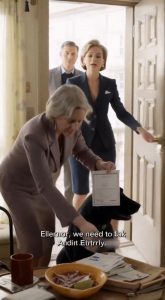
He handed me a document. “This is a distribution contract from 2014. Back when we were still partners.”
I unfolded it carefully. The paper was yellowed at the edges. It detailed a complex agreement for the distribution rights of a major artist Julian had signed, involving a multi-million dollar key-person insurance policy.
My eyes scanned the dense legal jargon, clause after clause. Then I saw it. Tucked away on page nine, a rider clause, dated October 12, 2014.
“Liability waivers,” I murmured, reading aloud. “And key-person insurance payouts. This clause… it expired five years after signing.”
A cold wave of realization washed over me. The clause stipulated that if the primary contract holder—Julian’s label—breached any terms within five years, the key-person insurance policy assigned to *my* studio shareholding became null and void. The five years were up in 2019. It was 2024.
“Julian needed that $15 million payout from my death,” I explained to Sloane, “to cover a huge financial hole. But if this clause is still valid, or *was* valid and he ignored it, his claim is worthless.”
Sloane nodded, a grim satisfaction on his face. “Julian was always trying to find loopholes. This looks like one he forgot about.”
This forgotten 2014 contract was the key. It wouldn’t just expose his motive; it would prove his entire $15 million insurance scheme was dead in the water.
More Stories








+ There are no comments
Add yours