
My Husband Smashed My Mute Daughter's Film Camera at a High-Society Gala — Until an Old Letter Dropped Out and Exposed His Darkest Secret


Part 1
As the heavy brass casing shattered across the marble foyer of the Newport Country Club, the battery compartment popped open, spilling an unlabeled micro-reel and a yellowed letter written thirty years ago.
Richard stepped forward to crush the fragile film under his heel, but a calm, gravelly voice spoke from the shadow of the arched doorway: “I would leave that letter on the floor if I were you, Montgomery.”
What was written in that hidden letter destroyed our marriage in seconds, but the violence Richard unleashed twenty minutes later destroyed my entire world forever.
The air inside the Newport Country Club’s grand foyer usually buzzed with polite chatter, a delicate symphony of clinking champagne flutes and carefully modulated laughter. Tonight, the sound was replaced by a deafening, metallic crash.
Every head in the room swiveled toward the source.
My breath hitched in my throat as I stared at the fragments scattered across the polished Italian marble.
Clara’s vintage 16mm Bolex camera lay in pieces, its beautiful brass casing mangled, the lens snapped clean off.
It was more than just a camera; it was an heirloom, a gift from my own mother, passed down to Clara with a silent understanding that art could speak when words failed.
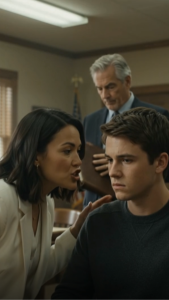
Clara, my fourteen-year-old daughter, stood frozen, her eyes wide with a pain far deeper than mere shock. Her small hands, usually so expressive in sign language, were clenched into fists, trembling at her sides.
She could not speak, but her silence roared through the opulent hall, accusing and heartbreaking.
Richard stood over the wreckage, his custom-tailored tuxedo jacket pulled tight across his broad shoulders. His face was a mask of cold fury, utterly devoid of remorse.
“You are embarrassing me, Eleanor,” he hissed, his voice low but sharp enough to cut through the stunned silence.
He wasn’t speaking to me, not really. His words were for the seventy or so guests, the old-money Newport elite who had gathered for Clara’s documentary showcase. He wanted them to believe *I* was the problem.
He picked up a larger piece of the camera’s body, its weight heavy in his hand, as if contemplating another act of destruction.
“This absurd film,” he continued, gesturing vaguely at the shattered remains, “is an affront to the Montgomery name. We do not air dirty laundry in public.”
Dirty laundry, he called it. Clara’s film, a poignant, beautifully shot exposé on the rising pollution in Newport Harbor, the very waters that defined our town’s identity, was his “dirty laundry.”
A gasp rippled through the crowd. Some faces showed concern, others, mere curiosity. They all knew Richard’s temper, but this was a public display, an uncharacteristic breach of their carefully maintained decorum.
My heart pounded against my ribs. I wanted to scream, to lash out, but my gaze was fixed on Clara. She looked small, utterly crushed, her entire world having just imploded before her very eyes.
Her film, years in the making, was meant to be her voice. Richard had just ripped it away.
As Richard tightened his grip on the camera fragment, something shifted in the debris on the floor. The impact had been so violent that the camera’s battery compartment had sprung open.
It wasn’t just batteries that spilled out.
A tiny, unlabeled micro-reel, no larger than a spool of thread, rolled across the marble. Next to it, a folded, yellowed piece of paper, thick with age, fluttered to a stop.
It was an old letter, its edges soft, a faint postmark visible even from where I stood: “Newport, Rhode Island. July 12, 1994.”
Thirty years ago.
Richard’s eyes, which had been fixed on the gawking guests, suddenly darted down. A flicker of something primal – fear, panic, recognition – crossed his face.
His jaw tightened. He took a swift, purposeful step forward, his expensive leather dress shoe raising to stomp down on the fragile film reel and the letter.
He intended to crush them both, to obliterate whatever secret they held, just as he had Clara’s camera.
But before his heel could descend, a voice, calm and deep as the winter ocean, cut through the tense silence.
“I would leave that letter on the floor if I were you, Montgomery.”
Everyone turned.
From the deep shadow of an arched doorway, where he had been standing unnoticed just moments before, stepped Marcus Finch. His presence was formidable, unhurried.
He moved with an almost languid grace, his dark suit perfectly tailored, his eyes, sharp and unwavering, fixed on Richard.
Marcus, the very man Richard had hired as a “security consultant” to ensure Clara’s film *didn’t* cause any “unnecessary drama” tonight, now stood in Richard’s way. His gaze dropped to the letter on the pristine marble floor, then back to Richard.
A subtle, knowing smile touched Marcus Finch’s lips.
Part 2
Marcus bent, retrieving the yellowed letter from the pristine marble. He unfolded the brittle paper carefully, his eyes scanning the faded cursive. A heavy hush fell over the room.
“It appears, Montgomery,” Marcus announced, his voice carrying clearly, “that thirty years ago, you accepted a payment of five hundred thousand dollars from the ‘Newport Waterfront Development Syndicate.’”
My breath caught. “$500,000? Richard, what is he talking about?”
Richard’s face, which had been frozen in anger, now contorted into a mask of pure, unadulterated panic.
“The agreement,” Marcus continued, lifting the letter slightly, “was to target Eleanor’s family, marry into the Montgomery estate. And I have the original syndicate ledger entries to prove your long-standing treason, Mr. Montgomery.”
More Stories









+ There are no comments
Add yours