
Her Father Lied About Her Illness, Then Blamed The War.


The next morning, armed with a fresh determination that cut through my exhaustion, I made my way to Dr. Elias Reed’s office. The small, bustling waiting room was filled with familiar faces from our Springfield community—a stark reminder of Dr. Reed’s long-standing position and trust. Children coughed, women whispered, and the scent of liniment mingled with dust. It was precisely the kind of place where reputations were built, and where challenging one could be seen as an affront to communal order.
Mrs. Higgins, Dr. Reed’s receptionist, offered me a strained smile when I explained I needed to speak with the doctor directly. “He’s very busy, Mrs. Croft, especially with the surge of flu cases. Is this about Elara again?” Her tone implied my persistence was a nuisance.
“Yes, it is,” I affirmed, my voice unwavering. “And it’s urgent.”
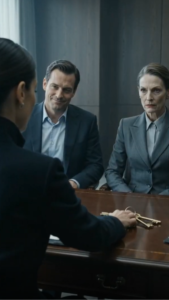
After a considerable wait, during which I replayed Elara’s tearful confession over and over in my mind, I was finally ushered into Dr. Reed’s office. He sat behind his large oak desk, a stack of patient files before him, his glasses perched on his nose. He looked tired, lines of fatigue etched around his eyes, likely from the wartime strain on medical professionals.
“Eleanor,” he greeted, his voice subdued. “I was very sorry to hear about Elara’s surgery. A terrible shock, truly.” He gestured to the chair opposite him. “Arthur told me she’d been feeling a bit run down, but nothing so serious.”
His words immediately put me on edge. Arthur had already been here, shaping the narrative. “Dr. Reed,” I began, cutting straight to the point, “Dr. Caldwell at the Springfield Clinic found a note in Elara’s file. It was from your office, dated five weeks ago. It recommended urgent, specialized X-rays for a suspected abdominal growth.”
He flinched, a subtle tightening around his mouth. He took off his glasses and rubbed the bridge of his nose. “Yes, well,” he said slowly, “Dr. Caldwell is a very keen young doctor. Perhaps a little… overzealous. The medical landscape is different now, Eleanor. Resources are scarce. We must be practical.”
My heart hammered against my ribs. “Practical? My daughter has a life-threatening mass, Dr. Reed. This isn’t about practicality. This is about her life. Did you or did you not recommend those X-rays five weeks ago?”
He leaned back in his chair, avoiding my direct gaze. He reached for a heavy leather-bound book from his shelf—his patient ledger. He flipped through the pages, his finger tracing lines until he found Elara’s name.
“Here it is,” he murmured, his voice formal, almost rehearsed. He turned the ledger so I could see it. The entry, written in neat, flowing script, stated: “Elara Croft: presented with abdominal discomfort, advised observation, follow-up as needed.” There was no mention of urgent X-rays, no suspected growth, no specific timeline.
“This is it,” he insisted, tapping the page with his finger. “My full assessment. I advised Arthur that Elara was experiencing some abdominal discomfort, likely due to typical adolescent issues or perhaps a bit of dietary upset. We discussed observation. There was no urgent recommendation for specialist intervention at that point, Eleanor. Especially not with the current demands on medical facilities.”
I stared at the entry, then at Dr. Reed’s face. He seemed sincere, but my gut screamed that something was wrong. This brief, almost dismissive note contradicted the urgent tone of the message Dr. Caldwell had found. It contradicted Elara’s actual worsening condition. And it certainly didn’t align with the idea of a serious “abdominal growth.”
“But Dr. Caldwell’s note specified urgent X-rays for a *possible internal growth*,” I insisted, trying to keep my voice calm despite the tremor in my hands. “It was quite specific. And Elara’s condition now is far beyond ‘abdominal discomfort.’ She’s in critical condition.”
He sighed, a weary sound. “Perhaps there was a miscommunication. Or a misunderstanding. Dr. Caldwell is young, eager. Sometimes new doctors can be overly cautious. She may have exaggerated what was a general suggestion into something more concrete. I merely indicated that if symptoms persisted, further investigation *might* be warranted. But at the time, given Arthur’s account of Elara’s general well-being and the pressures of the war, I felt a wait-and-see approach was prudent.”
Wait-and-see. Those words, spoken so casually, meant weeks of Elara’s suffering, weeks that had allowed the growth to become life-threatening. He was dismissing Dr. Caldwell’s medical judgment, diminishing his own initial advice, and implicitly defending Arthur.
“And Arthur told Elara ‘nothing was really wrong’,” I challenged, my voice sharper now. “He told her not to worry me because I’d ‘make a fuss.’ Did you instruct him to tell her that?”
Dr. Reed looked genuinely surprised, a flicker of emotion breaking through his professional facade. “No, of course not! I would never advise a parent to mislead their child, especially not about their health. Arthur assured me he would manage Elara’s symptoms at home and report any changes. He’s a good father, Eleanor, a pillar of the community. Always concerned for his family.”
The phrase “pillar of the community” seemed to echo in the small room, a heavy justification for his evasion. He was protecting Arthur, protecting his own reputation, perhaps even protecting himself from admitting a professional oversight. The “good father” narrative, particularly in wartime, was a powerful shield.
“Arthur has drained Elara’s education fund,” I stated flatly, watching his reaction. “Every penny that was meant for her future has been diverted. He claims it’s for the war effort, but it means her surgery is delayed. He’s using the war as an excuse for financial sabotage, Dr. Reed. And I believe he used it as an excuse to ignore your medical advice, too.”
Dr. Reed’s eyes widened slightly, a genuine shock passing over his face. He visibly swallowed, but quickly recovered his composure. “I… I can’t comment on Arthur’s financial decisions, Eleanor. That’s a private matter. My concern is only with patient care. And as my ledger shows, my advice was followed appropriately for a minor abdominal discomfort at the time.”
His refusal to acknowledge the deeper implications, his steadfast adherence to the sparse ledger entry, felt like a deliberate cover-up. He was digging in, presenting a formal, evasive account that seemed designed to protect himself and Arthur, despite the blatant contradiction with the reality of Elara’s condition and Dr. Caldwell’s findings.
I stood up, my frustration simmering into a cold resolve. “Dr. Reed,” I said, my voice low but firm, “you are a medical professional. Your primary duty is to your patients. I believe you are withholding information, or at least misrepresenting it. And I won’t let my daughter suffer for it.”
He cleared his throat, pushing his glasses back up his nose. “Eleanor, I understand you’re distressed. But I assure you, my records are accurate. I advise you to focus on Elara’s recovery and trust in her doctors. And perhaps,” he added, his voice regaining some of its paternalistic tone, “try not to let your anxieties escalate into accusations. It’s not good for anyone, especially in these trying times.”
I left his office, my heart heavy, my mind reeling. The “pillar of the community” had chosen to side with the man who neglected his daughter, implicitly blaming me for “escalating” the situation. Dr. Reed’s evasion confirmed my deepest fears: Arthur’s influence extended beyond our home. But his insistence on the ledger, his formal, unyielding account, solidified my conviction that the truth lay hidden, just out of sight. I had to find irrefutable proof, something that even Dr. Reed, with all his professional decorum and community standing, could not dismiss.
More Stories











+ There are no comments
Add yours