
My grieving son found his voice to expose my husband's plot to drug me for my father's medical research.


David Chen’s office was minimalist, all glass and polished steel, a stark contrast to the old-world warmth of my father’s study. He sat behind his large desk, a stack of legal documents fanned out before him. The atmosphere, however, was charged with an almost electric energy.
“Elena, I have something,” he announced, pushing a document across the desk towards me. “Your father’s will. I’ve been poring over it, every clause, every line of archaic legal jargon.”
I picked up the document, scanning the familiar, formal language. I had read it before, of course, but grief had dulled my focus.
“I found it,” Chen continued, tapping a specific paragraph with his pen. “A specific clause, almost hidden, related to the ownership of his intellectual property – specifically, the genetic research patents.”
My eyes followed his finger. The words swam into focus, then sharpened with startling clarity.
“If Elena Rossi is declared medically incompetent,” I read aloud, my voice tinged with disbelief, “within two years of Dr. Alistair Rossi’s death, control and full rights to all associated research patents and intellectual property shall automatically transfer to the Rossi Medical Research Foundation, for the explicit purpose of continued scientific advancement and philanthropic endeavor.”
I looked up at Chen, stunned. “Not to her spouse,” I whispered, finishing the unspoken thought.
“Exactly,” Chen confirmed, a grim satisfaction on his face. “This changes everything, Elena. Their entire plan. If you are declared incompetent, Marcus gets nothing. Absolutely nothing related to your father’s core research. He would be completely cut out.”
The revelation hit me like a physical blow, yet it was also a profound vindication. This was why they were so desperate for me to *willingly* sign documents, to transfer control while I was supposedly still lucid, but under duress. This was why the “unlabeled vitamin” was designed to keep me compliant, not just incapacitated for a brief period. They needed my signature, or they needed me to be dead. Incapacitation without my active consent would cost them everything.
“This explains the frantic urgency,” I mused, the puzzle pieces clicking into place. “They don’t want me ‘incompetent’; they want me pliable. Or they need me gone.”
“Precisely,” Chen affirmed. “The ‘early signs of cognitive decline’ narrative was designed to make you seem susceptible, vulnerable, someone who *should* hand over control for your own ‘good.’ It wasn’t about making you officially incompetent in a way that would trigger this clause, at least not initially. It was about creating a path to control without setting off this tripwire.”
“So, the fake diagnosis Clara found,” I said, remembering the terrifying document. “That was to pressure me, not to legally incapacitate me.”
“It was a preliminary step,” Chen clarified. “A tool of coercion. If they could get you to sign over control, great. If not, and you fought back, *then* they might push for full legal incompetence, hoping to somehow argue around this clause. But it’s clear your father saw through something similar in his lifetime. He put this clause in to protect his life’s work from exactly this kind of predatory maneuvering.”
My father. Even in death, he was protecting me, protecting his legacy. A fresh wave of grief, mixed with fierce love, washed over me. He had always been so perceptive.
“This is a game-changer,” I repeated, feeling a surge of power. “So, their entire strategy is fundamentally flawed.”
“It certainly puts them in a bind,” Chen agreed. “If they proceed with a formal incompetence declaration, they shoot themselves in the foot financially. The patents go to the foundation, not to Marcus or Evelyn. The only way for them to win is if you *voluntarily* cede control, or if they can somehow discredit you so completely that the foundation, or a court, would ignore this clause for some other reason.”
“Which means they’ll escalate the ‘unstable’ narrative,” I predicted. “They’ll try to get me to crack under pressure, to do something that seems truly irrational.”
“That’s my fear,” Chen confirmed. “They’re cornered. And cornered predators are often the most dangerous. They’ll try to force your hand.”
This new understanding shifted my perspective completely. It wasn’t just a battle for my professional autonomy; it was a race to protect my father’s monumental research from being subsumed by the Albright family’s self-serving agenda.
“What’s our counter-move?” I asked, my voice steady, eyes bright with determination.
Chen leaned back, a thoughtful expression on his face. “We leverage this. We let them dig their own grave. We continue to quietly build our case, gather evidence, and most importantly, we maintain your public composure. Every time they try to bait you, every time they spread a rumor, you respond with calm, reasoned professionalism. You refuse to give them the ‘unstable’ proof they so desperately need.”
He then outlined a new, more potent strategy. Instead of reacting defensively to their rumors, we would strategically leak snippets of my father’s will to trusted colleagues, planting seeds of doubt about Marcus’s true intentions. We would make it known that if anything happened to my competence, the research would be protected, but *not* by Marcus.
Meanwhile, Marcus, completely unaware that his primary motivation was now a ticking time bomb, grew increasingly desperate. The temporary hold on my research servers wasn’t enough. He needed control, and he needed it *now*. He saw my silence, my controlled demeanor, not as strength, but as a sign of my alleged withdrawal and emotional fragility.
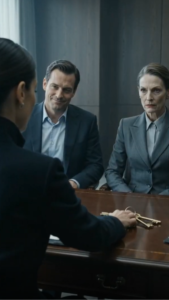
A few days later, a formal invitation landed on my desk: a special hospital board meeting, called at Marcus’s urgent request. The agenda stated, “Discussion and Resolution regarding the future leadership of the Albright-Rossi Research Initiative, in light of Dr. Elena Rossi’s ongoing personal challenges.”
He was pushing for an official appointment as co-director, citing my “absence” from my work and my supposed “well-being” issues. He was making his move, bold and public, completely oblivious to the legal landmine laid within my father’s will.
I called David immediately. “He’s calling a board meeting. To officially appoint himself co-director.”
“Expected,” Chen said calmly. “It’s the natural escalation. He thinks he’s seizing control. But he’s actually setting the stage for his own downfall.”
“How?” I asked, a thrill running through me.
“Because we’re going to use this meeting as a platform,” Chen explained. “Not to defend you, but to expose them. We have Clara’s evidence, we have Serena Jenkins’s messages, and now we have this clause in the will. We just need one more piece to complete the picture.”
“What piece?”
“Something directly linking Evelyn to the fabrication of your diagnosis,” Chen replied. “Marcus’s father failed because of a lawyer. Evelyn ensured she wouldn’t fail again, making her actions more discreet. But if we can show her actively involved in falsifying records, it proves malicious intent at the highest level. That’s the smoking gun that will sink them both.”
I understood. The board meeting was a trap Marcus thought he was setting for me. But with David’s strategic mind, and my father’s foresight, it was quickly transforming into a trap for him. Evelyn’s involvement, though suspected, needed concrete proof. And I knew exactly who might be able to provide it. Serena Jenkins. The colleague Marcus had roped into his scheme. The one whose messages Clara had already found. The tension escalated, the stakes impossibly high. The board meeting loomed, a battlefield where I would either reclaim my legacy or lose everything. But now, I had an edge Marcus didn’t even know existed.
More Stories













+ There are no comments
Add yours