
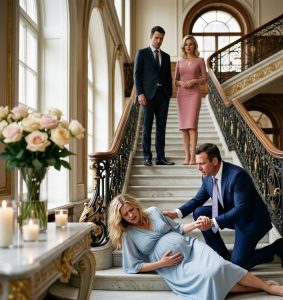
Pregnant Linh Nguyen Was Kicked by Her Husband's Mistress in the ER — He Covered It Up, Not Knowing the Cameras Caught Everything.


Days blurred into a monotonous cycle of prenatal checks, bland hospital food, and the constant hum of worry. From my temporary downtown apartment, I now found myself poring over legal documents that Ethan’s team had sent, trying to decipher the complex language. The stack of papers related to Ethan’s upcoming tech acquisition was particularly daunting, filled with jargon and endless clauses.
I was trying to understand why he was so desperate to avoid scandal, beyond the obvious blow to his ego. He had threatened me with ruin if I spoke, almost immediately after Tiffany’s kick. It wasn’t just about his image; there was something more. He had focused so intensely on the “multi-million dollar tech acquisition” in that hallway.
I pulled out a recent press release from Ethan’s company, scrolling through it on my borrowed tablet. It highlighted his brilliance, his unblemished record, the ethical cornerstone of his business empire. My eyes snagged on a phrase buried deep within the article: “The deal is predicated on maintaining Mr. Harrison’s impeccable public image and adhering to strict morality clauses.”
Morality clauses. The words stood out, stark against the corporate fluff. I hadn’t seen anything like that in the earlier contracts I’d briefly glimpsed. It hinted at something deeper, something beyond just a bad headline.
I leaned forward, my pulse quickening. This felt like a crucial detail, a hidden lever in the vast, imposing machine of Ethan’s business. I opened a new browser tab and typed “morality clause acquisition deal” into the search bar. The results poured in, revealing a common practice in high-stakes corporate mergers.
One article, from a financial journal, explained it in stark terms: “Such clauses protect investors from reputational damage. Any public scandal involving key personnel can trigger immediate withdrawal provisions.” It often meant automatic investor withdrawal if specific criteria were met.
I kept reading, my eyes scanning for specifics. A major public scandal, especially one involving personal conduct and alleged violence, could indeed trigger such a clause. The article went on to explain that depending on the severity and public reaction, an investor withdrawal could cause a company’s valuation to plummet by over 80%.
Eighty percent. The number echoed in my mind, a staggering figure. It wasn’t just about losing a deal; it was about the potential systemic collapse of his entire empire. My breath hitched. This wasn’t a minor inconvenience for him; it was an existential threat to everything he had built, everything he valued.
Suddenly, his furious reaction in the hospital, his immediate concern for his reputation over my welfare, made chilling sense. He wasn’t just a narcissist; he was a narcissist whose entire financial world was balanced precariously on the carefully constructed illusion of his “impeccable public image.” The assault, the mistress, the cover-up – it wasn’t just embarrassing; it was a ticking time bomb under his carefully constructed façade.
I imagined the frantic phone calls he must have made, not to check on me or our baby, but to his lawyers and PR team, all scrambling to contain the damage. His attempts to have the hospital footage deleted, his brutal smear campaign against me – they weren’t just about controlling me. They were about protecting his investments, his entire financial kingdom.
The specific, petty cruelty of his actions now took on a different shade. Freezing my accounts wasn’t just to punish me; it was to weaken me, to make me less capable of fighting back, less capable of triggering that devastating clause. Canceling my health insurance, relocating me – all strategic moves to isolate me and minimize my ability to expose his truth.
I scrolled further, finding examples of similar clauses invoked in past corporate dealings. The consequences were almost always catastrophic: stock value plummeting, investor confidence shattered, executives terminated. This wasn’t just a slap on the wrist; this was financial annihilation.
A strange, cold resolve settled over me. He had used money and power to control, to inflict pain, to try and silence me. But now, I saw how money and power could also be used to bring him down. The morality clause was a weapon, forged from his own greed and hypocrisy. It was a path to justice that didn’t rely on his conscience, but on the ruthless logic of the financial world.
The small, temporary apartment felt less like a prison and more like a strategic hideout. From this unassuming place, I could observe the machinations of his world, hidden from his watchful eyes. I closed the tablet, the screen reflecting my determined face. The shame my father felt, the public’s misunderstanding—none of it mattered as much as this revelation. I had found his weakness, his Achilles’ heel. The path to justice was now clear, even if it was fraught with personal risk. Ethan Harrison’s empire, built on a foundation of lies and ruthlessness, suddenly seemed vulnerable.
More Stories










+ There are no comments
Add yours