
When the Governor's Daughter Fell, a Ragged Boy Conjured an Earthen Hand — Then His Landlord Accused Him of Dark Magic


Lord Cedric did not rest on his laurels. With my family’s three-day eviction deadline fast approaching, he intensified his campaign against me, turning the screws tighter with each passing hour. He understood that public opinion, manipulated correctly, was a far more potent weapon than any official decree.
He began by subtly planting seeds of doubt among the villagers. I overheard snippets of conversations, carefully orchestrated by his servants, about my “secret pacts” and “unnatural solitude.” He painted me as an outsider, someone who didn’t belong, thereby making my unique ability seem even more sinister.
One morning, as I walked past the market square, I saw old Master Finnegan, the blacksmith, shaking his head at a group of villagers. “He always kept to himself, that boy,” Finnegan grumbled, loud enough for me to hear. “Too quiet for a lad his age. Always mucking about with the earth.”
A woman nearby, Elara’s seamstress, added, “And that family. Always so proud, despite their humble station. Too good for us, perhaps.”
It was a systematic character assassination, chipping away at my already fragile reputation. Cedric leveraged existing prejudices, the small-town suspicions of anyone different, to turn the community further against me.
During the initial, preliminary stages of the village inquiry, which mostly consisted of Elder Bramble holding hushed conversations with influential villagers, Cedric ensured his allies spoke out. Goodman Barlow, a prosperous farmer who owed Cedric a substantial loan, publicly voiced his “concerns” about the safety of children near “such unpredictable magic.”
“What if the boy loses control?” Barlow asked, his voice ringing with feigned civic duty. “What if his powers turn against us?”
These were not genuine worries; they were calculated maneuvers. Each whisper, each fear-mongering statement, was a brick in the wall Cedric was building around me, designed to isolate and condemn.
Then came the final, crushing blow. Lord Cedric, ever the opportunist, made a public announcement. He declared that, in light of the Ashfall family’s unfortunate “inability to maintain their lease,” he was prepared to “generously” offer to buy their soon-to-be-vacated land.
He stood in the village square, his hands clasped benevolently before him, a portrait of civic virtue. “It pains me to see a family displaced,” he proclaimed, his voice dripping with false empathy. “So, in the spirit of community, I shall acquire the land myself. It will be for the betterment of Oakhaven, I assure you.”
He spoke of improving the land, perhaps even building new cottages for deserving families. He presented it as an act of magnanimity, a way to help my displaced family by taking their burden.
“I will even provide a small sum,” he announced, “a kindness for their troubles, so they may start anew elsewhere.”
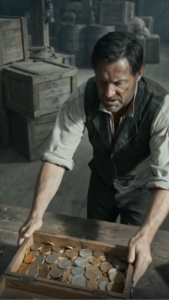
The sum he named was a pittance, barely enough to cover a few months’ rent in a squalid hovel, certainly not enough to start a new life. It was a cruel mockery of charity, a final insult.
My mother, hearing this, had broken down completely. The offer was not just an insult; it was a clear signal that he fully intended to go through with the eviction. He wasn’t just taking our home; he was offering us scraps for it.
His true motive, however, was far more insidious than simple land acquisition. I knew from Rhys’s words that he was in financial straits, and our land, our humble plot, was the key to his recovery.
What Rhys didn’t know, and what Cedric guarded fiercely, was a faded, brittle map, hidden deep within his personal study. It was a map drawn by his grandfather, marked with cryptic symbols pointing to mineral deposits. Specifically, it hinted at a vein of iron ore, rich and untapped, lying directly beneath our family’s ancestral plot.
This wasn’t just about punishing me; it was about wealth. Lord Cedric had been quietly researching his grandfather’s old journals, discovering the forgotten lore of the land. Our “troublesome lease” wasn’t troublesome because it was inconvenient; it was troublesome because it stood directly in the way of his hidden fortune.
His “generous” offer was a grotesque farce, a predatory move disguised as compassion. He wanted our land, not for the village’s “betterment,” but for his own desperate, hidden greed. The small, specific cruelty of his offer, coupled with the underlying betrayal of its true purpose, made my blood run cold.
He thought he was being clever, hiding his true intentions behind a veil of public concern. But the truth, I now realized, was buried far deeper than anyone suspected, right beneath the very ground he so eagerly sought to claim. He intended to strip us of our legacy, our home, and then plunder the earth beneath it.
More Stories










+ There are no comments
Add yours