
Aging filmmaker exposes her mogul father's dark studio secrets with a "useless" script


The formal letter arrived via courier, emblazoned with the imposing masthead of Wallace Reed’s studio. It was crisp, professional, and utterly brazen. It invoked a “first refusal” clause from the original, manipulated debt contract I had signed, demanding the distribution rights to “Unstoppable Current: Echoes from the Margins” for a paltry sum, barely a tenth of the actual market value Brenda Olsen had offered.
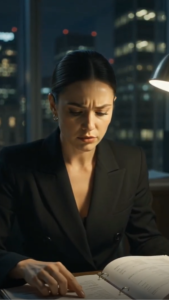
My hand trembled as I read the legalese. Wallace was trying to leverage his fraudulent debt, the one Arthur Finch had orchestrated, to seize control of my success. He wanted to claim my mother’s legacy as his own, to re-package it under his brand, stripping it of its independent voice.
“He thinks I’m still the same desperate filmmaker who took that script,” I told Noah, crumpling the letter in my hand. “He thinks he can just strong-arm me.”
“He doesn’t understand,” Noah replied, his expression grim. “He’s still playing the old game. We’re playing a new one.”
I called his legal team myself. “The original contract was signed under duress and based on manufactured debt,” I stated, my voice firm. “Any clause derived from it is null and void. We will not be selling.”
The studio lawyer, a sharp-tongued woman I’d sparred with before, sputtered, “Ms. Reed, this is a legally binding document. Your studio’s solvency was predicated on that agreement.”
“No,” I countered. “My studio’s solvency was threatened *by* that agreement. Your client created a false debt to force me into relinquishing rights. That’s fraud, not a binding contract.”
The conversation ended with a terse threat of litigation from their side, and an equally firm promise of counter-litigation from mine. It was a standoff, and Wallace knew his public image wouldn’t survive a messy court battle over a “fabricated debt” after my film’s critical acclaim.
A few days later, an email landed in my inbox: an invitation to a nationally televised industry panel discussion titled “The Future of Documentary: Art vs. Commerce.” Wallace Reed was listed as the keynote speaker. Brenda Olsen and Grant Healy were also slated to appear, eager to ride the coattails of “Unstoppable Current.”
I saw my opportunity. This wasn’t just about refusing his demands; it was about publicly challenging his narrative. It was about exposing the rot at the heart of his empire, not through legal filings, but through the quiet power of truth.
“I need to be on that panel,” I told Noah. “Get me a spot. Any spot.”
Noah, ever resourceful, worked his connections. He leveraged my recent critical success, the buzz around my film, and the growing public interest in my unique approach. Within forty-eight hours, an invitation arrived. I was listed as a late addition, a “fresh voice” in the documentary landscape.
“Wallace won’t know what hit him,” Noah said, a mischievous glint in his eye. “He thinks this is his stage, his coronation.”
“It is his stage,” I agreed. “But I’m going to make sure the spotlight shifts.”
The days leading up to the panel were a blur of preparation. Noah helped me distill my arguments, not into a fiery condemnation, but into a calm, articulate defense of artistic integrity and ethical filmmaking. We reviewed Sarah’s methodologies, the evidence of Wallace’s manipulation, and even the subtle hints Lena Petrova had shared.
“This isn’t about grandstanding, Evie,” Noah reminded me, ever practical. “It’s about planting seeds. About making people *think*.”
I rehearsed my answers, anticipating Wallace’s dismissive baritone, his arrogant charm. I envisioned Brenda and Grant, once my mockers, now forced to acknowledge my success. My resolve hardened with each passing hour. I wasn’t going there to simply promote my film; I was going there to subtly dismantle his carefully constructed facade, to set the stage for a truth he had spent decades trying to suppress.
The manipulated debt, the coerced contract, the gaslighting whispers—it had all been a hook. But I had bitten down, not to be reeled in, but to turn the tables. Tonight, Wallace would discover that some fish, when hooked, could also pull the fisherman into the depths.
More Stories






+ There are no comments
Add yours