
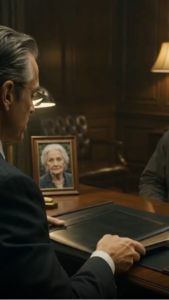
She never paid a single dollar for this charity service, the lawyer said, sliding the worn paper across the mahogany desk.


Homeless, my workshop seized, and Beatrice’s ledger burning a hole in my pocket, I felt a desperate clarity. The district attorney would take weeks, months. Arthur worked faster, harder, and dirtier. The public needed to know, and the press was the only way to bypass his power and influence.
I made my way to the *Philadelphia Bulletin* newsroom, a buzzing hive of clattering typewriters, ringing phones, and shouted conversations. The air smelled of stale coffee and ink. I asked for Clara Croft, the investigative journalist Beatrice had mentioned, known for her sharp reporting on corporate corruption.
Clara was younger than I expected, probably in her late twenties, with bright, intense eyes that missed nothing. Her desk was buried under stacks of newspapers and overflowing ashtrays. I sat opposite her, placing Beatrice’s leather ledger and Evelyn’s bank notices onto her cluttered desk.
“My name is Julian Kincaid,” I began, my voice hoarse. “And my father is Arthur Kincaid.”
Her eyebrows lifted, a flicker of surprise in her eyes. “The Congressional candidate? What can I do for you, Mr. Kincaid?”
I laid out the story, starting with Evelyn, the pawned medals, my father’s firm cutting her pension, and finally, Beatrice’s comprehensive ledgers. Clara listened, her expression unreadable, occasionally scribbling notes on a small pad. She picked up the ledger, flipping through the faded pages, then Evelyn’s bank statements, connecting the dates and routing numbers.
“These are original bank wire entries,” she murmured, tracing a column with her finger. “And these match Kincaid Logistics’ accounts. This is a clear paper trail, Mr. Kincaid. This is… big.”
She leaned back, her chair groaning under her weight. Her gaze sharpened, fixing on me. “You understand what this means, don’t you, Mr. Kincaid? If we publish this, it won’t just hurt your father’s campaign. It will destroy the Kincaid family name. This kind of scandal, it stains everyone.”
“I understand,” I said, though the words felt hollow. The Kincaid name, to me, was already stained.
“You also have a trust fund, don’t you?” she continued, her eyes dissecting me. “Your mother’s inheritance. A quarter of a million dollars, I hear. This will certainly jeopardize that. Your father will see to it. You will be disinherited.”
The $250,000. It was my mother’s legacy, meant to provide me with security, to help expand my workshop. Now, that workshop was gone, and the trust fund felt like a distant, irrelevant dream.
“I don’t care about the money,” I told her, the words firm, surprising even myself. “I care about the truth. About Evelyn. About all the Evelyns.”
Clara studied me for a long moment, a flicker of something—respect, perhaps—in her eyes. “And your social standing, Mr. Kincaid? You will be publicly associated with this scandal. People won’t just see the truth; they’ll see the family drama, the betrayal. You’ll be ostracized by many who currently admire your father.”
“Let them,” I said, feeling a strange lightness. The fear was still there, a knot in my stomach, but it was overshadowed by a greater purpose. “My brother, Leo, he died in Vietnam for this country. For honorable service. My father is profiting from the families of men like Leo and Evelyn’s husband. That’s what I care about. Not my social standing.”
Clara nodded slowly. “Alright, Mr. Kincaid. This is enough to move forward. We’ll verify every last detail. And then, we print.”
More Stories










+ There are no comments
Add yours