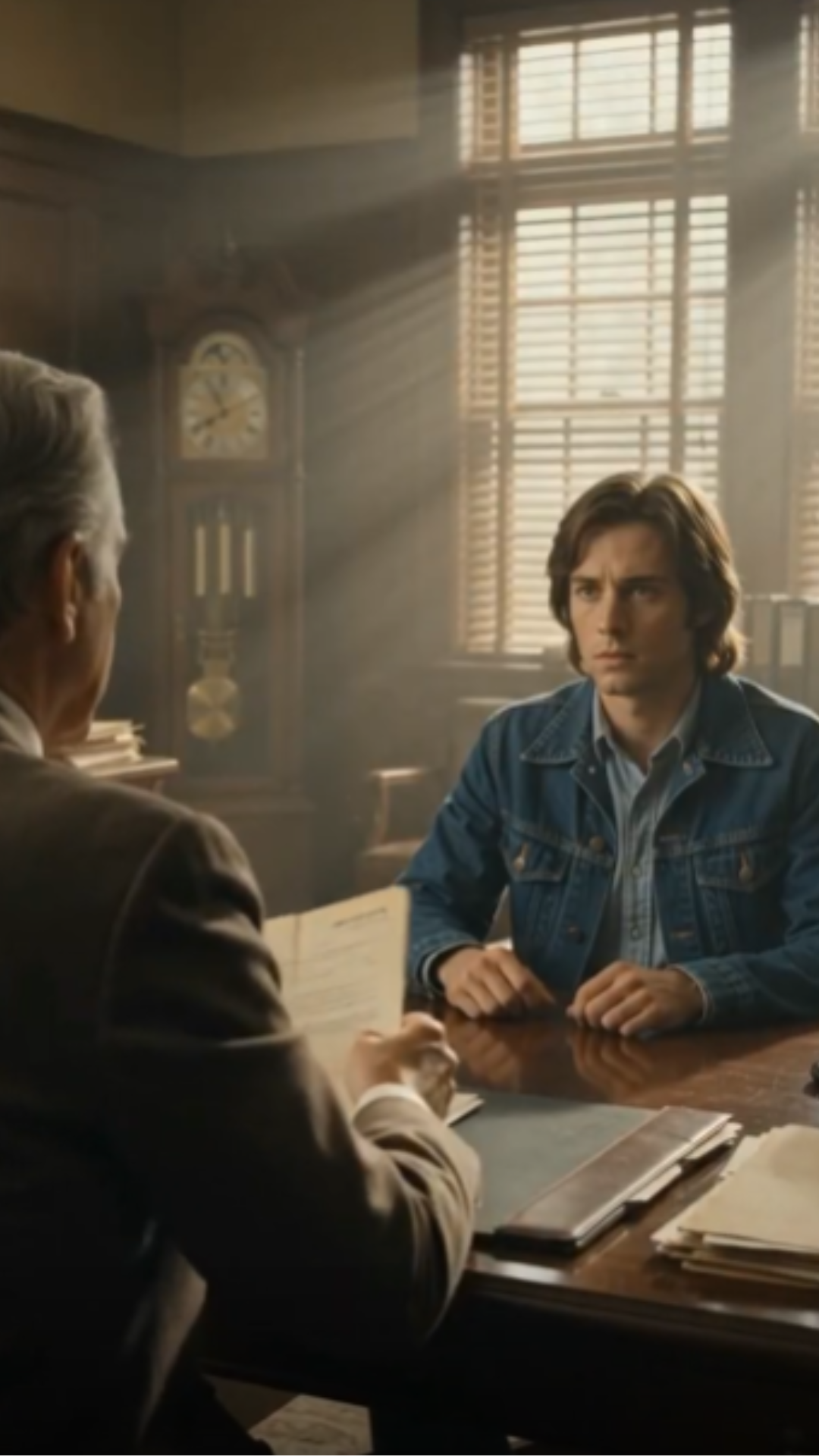
She never paid a single dollar for this charity service, the lawyer said, sliding the worn paper across the mahogany desk.


Part 1
“Mrs. Albright canceled the official contract after the first four weeks back in November 1971 because her widow pension was slashed.”
“Every $25 envelope you received for visiting her over the past eight months came directly out of her own pocket, paid by selling her late husband’s WWII service medals.”
“She told me you were the only reason she woke up in the morning after her son died at Chosin, and she knew you were grieving your brother.”
The May sunlight, hazy and thick with the promise of a humid Philadelphia summer, streamed through the tall windows of Attorney Richard Halloway’s office. Julian Kincaid sat across the polished mahogany desk, feeling the familiar weight of his carpentry calluses against the fine wood. Two days ago, he’d stood in a quiet cemetery, watching the earth take Evelyn Albright.
He’d offered what words he could to the few mourners present, mostly neighbors.
Now, he was here, ready for the formalities.
Halloway, a man whose tailored suit seemed to absorb all the light in the room, cleared his throat. He looked at Julian with an expression that was both professional and deeply empathetic.
Julian shifted in his seat, trying to ignore the lingering unease that always came with official business. His brother, Leo, was barely gone a year, lost somewhere in the mud of Vietnam, and the grief still clung to Julian like sawdust.
He had taken the job visiting Evelyn Albright partly to keep his hands busy, partly for the $25 a week that helped keep his small woodworking cooperative afloat.
He’d always seen Evelyn as an eccentric, wealthy widow, perhaps a little lonely. He’d brought her tea and listened to her stories, sometimes about her late husband’s time in the war, sometimes about the son she’d lost in Korea.
It was a simple arrangement, a civic foundation paying him to provide companionship. He’d delivered what he thought was a decent performance.
Halloway picked up a thin file from the corner of his desk. Its cream-colored cover seemed to absorb the light.
“Mr. Kincaid, thank you for coming in,” he began, his voice soft, almost a murmur, yet it held a certain gravitas. “As Mrs. Albright’s estate attorney, there are a few final matters we need to address.”
Julian nodded, expecting the standard release forms, probably a formal thank you from the foundation. He had done his part. He’d sat in her parlor every Friday afternoon for eight months, drinking weak tea and nodding along to tales of a Philadelphia that no longer existed.
He’d offered what comfort he could, even as his own heart felt like a hollowed-out log. Evelyn had seemed fragile but fiercely independent. He had admired that.
Halloway opened the file. A stack of papers, crisp and official, lay within. Julian glimpsed dates, letterheads he didn’t recognize.
“You performed a valuable service for Mrs. Albright,” Halloway continued, his gaze steady, searching Julian’s face. “She spoke of you often, and with great fondness.”
A faint blush touched Julian’s cheeks. He had always felt a touch like a fraud, being paid to simply exist in an old woman’s company. But it was honest money, he told himself.
He had bills to pay, a workshop that needed new tools, and the looming shadow of property taxes.
He’d seen Evelyn’s house on 4th Street, a modest rowhouse, but neat, well-maintained. He’d assumed her husband, a decorated war veteran, had left her well-off. An old lady with too much money and too much time on her hands, wanting to buy some company. He understood the need.
Halloway reached into the file and pulled out a single, folded sheet of paper. It looked older than the rest, creased at the edges, perhaps handled many times. He smoothed it out on the desk before him.
Julian watched, a prickle of unease starting to form in his stomach. This wasn’t just a simple release form.
“This is a copy of the original contract between Mrs. Albright and the Philadelphia Civic Foundation,” Halloway stated, tapping the paper. “For the provision of a paid companionship service.”
Julian nodded. “Yes, I remember signing that.”
“And you were paid $25 every Friday, correct?”
“That’s right,” Julian confirmed. Twenty-five dollars bought him a week’s worth of supplies, a few meals, sometimes just the quiet satisfaction of knowing his small business hadn’t collapsed yet.
Halloway paused, his eyes sweeping over the document, then back to Julian. His expression softened further, a hint of sorrow around the corners of his mouth.
“The foundation provided this service for the first four weeks, beginning in October 1971,” Halloway said slowly, his voice dropping slightly in pitch. “It was part of their pilot program for Gold Star widows.”
Julian waited, his brow furrowed. What was the lawyer getting at? Four weeks? He’d been visiting Evelyn for eight months.
“However,” Halloway continued, “in November 1971, Mrs. Albright contacted the foundation directly.”
He paused, letting the words hang in the air, creating a deliberate space that Julian suddenly found suffocating. The air in the office grew heavy.
“She informed them that she could no longer afford their services.”
Julian frowned. “Afford? I thought the foundation covered it. It was a charity thing.”
A small, sad smile touched Halloway’s lips. “It was, Mr. Kincaid. But Mrs. Albright’s widow pension, her sole source of income after her husband’s passing, was suddenly and significantly cut that month.”
Julian felt a cold dread begin to coil in his gut. A cut pension? That explained why she might cancel. But if she canceled, then how…?
“She officially withdrew from the program,” Halloway clarified. He looked directly into Julian’s eyes. “Effective the fifth week.”
Julian stared, uncomprehending for a beat. The fifth week. That meant… all those Fridays. All those envelopes.
He had received a crisp $25 bill every single Friday for the past eight months, always from Evelyn’s own hand. Sometimes she’d hand it to him tucked inside a cookie tin. Sometimes, she’d just press it into his palm as he left.
His mind raced, replaying every visit. The gentle smile. The way her hand trembled slightly when she gave him the money. He’d never questioned it. Never. He’d just assumed it was the foundation’s money, handled by her for convenience.
A deep flush began to creep up Julian’s neck. His stomach churned.
“But… then who paid me?” he managed to ask, the words feeling thick and foreign in his mouth.
Halloway’s gaze was unwavering, compassionate. He slid a second paper across the desk, a bank statement, worn and thin. It showed small, regular withdrawals, perfectly timed.
“Every $25 envelope you received for visiting Mrs. Albright over the past eight months,” Halloway said, his voice quiet but firm, “came directly out of her own pocket.”
He gestured to the statement, then to another document beneath it.
“She paid you herself, Mr. Kincaid. By selling her late husband’s World War II service medals.”
Part 2
Julian’s breath caught. He felt a sharp, sickening lurch in his stomach.
This couldn’t be right.
He looked at the bank statement, then at the documents that Halloway had called “receipts.” They were small slips of paper, official-looking but creased, tucked beneath the bank statement.
Halloway reached across the desk again. This time, he didn’t slide a paper.
He placed a small, dark wooden box onto the mahogany. It was simple, unvarnished, perhaps a handmade keepsake box.
Julian stared at it, his hands on the desk, unable to move.
“These are the pawn receipts, Mr. Kincaid,” Halloway explained, his voice low. “From local pawn shops on South Street.”
He gestured for Julian to open the box.
Slowly, Julian reached out. His fingers felt numb as they traced the smooth, cool wood. He lifted the lid.
Inside lay a handful of folded slips of paper. Not medals. Just the records of their sale. He saw dates, small numbers, and the word “Medal” scrawled next to one. Another read “Pocket Watch.”
A dull ache spread through his chest, heavier than any grief for Leo.
“She kept these in her nightstand drawer,” Halloway continued. He picked up a leather-bound journal that had been open on his own side of the desk.
“Mrs. Albright also left a diary,” he said softly. “It speaks of you frequently.”
He turned a page, his finger finding a specific paragraph.
“May I read a brief entry?” Halloway asked.
Julian could only nod, his throat tight, suddenly feeling the weight of Evelyn’s quiet generosity pressing down on him.
Halloway cleared his throat. “Here, from November 1971, the same month her pension was cut.”
He began to read, his voice steady. “‘My dear boy, Julian. He comes every Friday, just like my Tommy used to visit. But his eyes… they hold a hunger that has nothing to do with food.’”
Julian flinched, a jolt of ice water running through his veins.
Halloway continued reading, “‘He is starving, I can see it. Not just for bread, but for a reason to keep breathing after losing his brother, my little Leo.’”
Julian squeezed his eyes shut for a moment. He hadn’t spoken much about Leo to Evelyn. He thought he’d hidden his pain well enough.
“‘I will not let him go,’” Halloway read, his voice now a tender whisper. “‘He believes I am buying company. Let him believe it. It is a small price to pay to keep a good boy alive, even if it means selling the last physical memories of my dearest William.’”
The words hit Julian like a physical blow. He had thought he was a hustler, taking advantage of a lonely old woman for quick cash, a way to keep his head above water.
Instead, Evelyn, herself barely scraping by, had seen his hollow eyes. She had seen the raw grief that he’d tried to bury under sawdust and long hours. And she had secretly sacrificed her last tangible links to her own beloved dead, all to keep him from falling apart.
More Stories







+ There are no comments
Add yours