
Her Children Tried To Seize Her Company And Erase Her Legacy


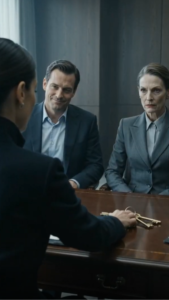
The air in the Hawthorne Designs boardroom crackled with tension. The emergency board meeting had been called by me, Eleanor Hawthorne, in defiance of my suspension. Marcus and Sophia sat opposite me, flanked by their corporate lawyers, their faces a mixture of forced calm and thinly veiled apprehension. Sarah Jenkins, my senior project architect, sat further down the table, her usually confident posture stiff, her gaze fixed on her clasped hands. Daniel Chen was present, a quiet observer, his presence unnerving Marcus and Sophia more than any legal team.
“We are here today to address the blatant disregard for corporate governance, the systematic siphoning of company funds, and the planned liquidation of Hawthorne Designs’ intellectual properties,” I began, my voice clear and steady. I held up the copy of the encrypted ledgers Daniel had given me. “This isn’t a ‘health crisis,’ gentlemen. This is corporate malfeasance, orchestrated by Arthur Finch, with the full complicity of Marcus and Sophia Hawthorne.”
Marcus’s lawyer immediately jumped in. “Objection! This is baseless slander, Mrs. Hawthorne. You are suspended. You have no authority to present such spurious claims.”
“Silence,” I said, my eyes locking with Marcus’s, who flinched. “The board has the right to hear evidence of criminal activity that threatens the very existence of this firm.”
I proceeded to lay out Daniel’s comprehensive financial evidence. Slide after slide projected onto the large screen: detailed financial transfers from Hawthorne Designs to shell companies linked to Finch, then to accounts controlled by Marcus and Sophia. Dates, amounts, specific project codes that revealed which IP was being valued for sale. I showed them emails between Marcus, Sophia, and Finch discussing market timing, target buyers, and the estimated profits from dismantling my company.
“Here,” I stated, pointing to an email from Marcus to Finch. “‘Ensure Project Phoenix proceeds smoothly. We need to capitalize on the modular housing patent before Mother’s return becomes problematic.’ This isn’t just ambition. This is a deliberate, calculated plot to strip the firm of its assets.”
Arthur Finch’s meticulous records, now turned against him, were damning. The board members, initially skeptical, grew visibly alarmed. Their murmurs filled the room. Marcus, pale and sweating, tried to interrupt.
“This is fabricated! Lies! Mother is clearly unstable,” he stammered, his voice cracking. “She’s lashing out because we tried to protect the company from her erratic behavior.”
Sophia nodded fiercely, her usual charm replaced by a desperate, panicked expression. “Yes! It’s an illusion! She’s making things up!”
“Are these projections for the sale of our sustainable materials IP also an ‘illusion,’ Marcus?” I challenged, projecting another slide. “An IP that took us fifteen years and millions of dollars to develop?”
Marcus rose from his seat, pushing his chair back with a scrape. “This is absurd. I’m leaving. This meeting is a farce.” He started to edge towards the door, his eyes darting around the room, avoiding everyone’s gaze. He was trying to escape.
“Sit down, Marcus,” Daniel Chen’s voice cut through the rising chaos, calm but commanding. Everyone turned to him. “There’s one more piece of evidence the board needs to consider before anyone leaves.”
Daniel looked at me, giving me a subtle nod. I reached down and picked up the dusty, leather-bound notebook and the original 1998 corporate charter.
“When I founded Hawthorne Designs, I built it not just with bricks and mortar, but with a foundation of integrity,” I announced, holding up the documents. “And I also built in safeguards. Against the very kind of betrayal we are witnessing today.”
I opened the charter to Section 4b, my finger tracing the faded text. “This is the ‘Legacy Safeguard’ clause. Authored by me in 1998. It states that in the event of a documented, malicious attempt by a direct descendant of the Founder to seize control of the corporation for purposes of liquidation or asset stripping, and upon irrefutable evidence of such unethical actions, a temporary transfer of all strategic voting power for a five-year term shall occur.”
The board members leaned forward, their faces etched with confusion and then growing understanding. Marcus had frozen mid-stride, his hand on the doorknob. Sophia stared, her mouth slightly agape.
“This provision,” I continued, my voice gaining strength, “transfers that strategic voting power, for all major corporate decisions, to the firm’s most senior non-family architect.” I paused, letting the implication sink in. “Effective immediately, that individual is Sarah Jenkins.”
Sarah gasped, her head snapping up, her eyes wide with shock. She looked at me, then at the stunned board, then back at Marcus and Sophia, who now looked utterly defeated. This was a position she never sought, a power she had never craved.
“This is illegal!” Marcus finally blurted out, turning fully back into the room, his face a mask of disbelief. “You can’t do this! This is a sham!”
“It’s a signed, witnessed, and legally filed provision of the original corporate charter, Marcus,” Daniel Chen said, stepping forward. His voice was quiet, but it resonated with unquestionable authority. “It’s boilerplate contract law, designed specifically for these types of contingencies. And your actions, documented here,” he gestured to the screen, “have triggered it.”
He then turned to the board. “The evidence presented by Eleanor Hawthorne, combined with additional intelligence gathered by Chen Capital regarding Arthur Finch’s broader network of corporate fraud, leaves no doubt. His involvement here is part of a pattern.”
Marcus stared, aghast, unable to formulate a response. Sophia was openly weeping, tears streaming down her face. Their carefully constructed plan had not only unraveled; it had become a noose around their necks.
Daniel then delivered the final, crushing blow, his voice remaining level, almost conversational. “For the board’s information, Chen Capital has already shared its extensive findings on Arthur Finch’s activities, including the specific details of ‘Project Phoenix,’ with federal authorities. An investigation into Finch and his wider network of corporate malfeasance has been formally initiated. It’s likely that anyone complicit in these schemes, including those who directly participated in the siphoning of company resources or the planning of asset liquidation, will face severe scrutiny, potentially extending beyond internal corporate penalties.”
Marcus stopped breathing. His face drained of all color, turning ashen. The legal repercussions were no longer hypothetical internal sanctions; they were federal. He wasn’t just losing the company; he was facing a criminal investigation. He stood frozen, utterly speechless, the doorknob still cold under his fingers, his world collapsing around him. The silence in the room was deafening, a final, unspoken verdict.
More Stories







+ There are no comments
Add yours